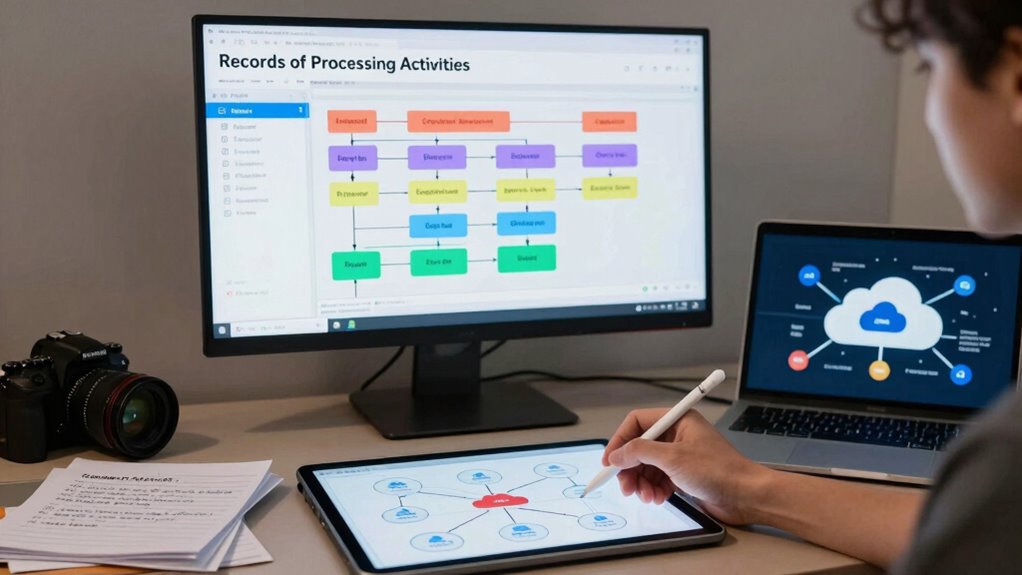

To do RoPA for cloud services, you need to identify and document all personal data processed, including data types, processing purposes, and data flow routes across cloud environments. Map roles of controllers, processors, and third parties involved while noting security measures like encryption and access controls. Keep track of data locations, transfer mechanisms, and retention periods. Regular updates and validation guarantee compliance and clarity. Continuing further will help you master the detailed steps to maintain effective RoPA records for cloud services.

Get business pricing on networking and server gear
- Business-only prices and quantity discounts
- Tax-exempt purchasing
- Multiple users, one account, clear invoices
Key Takeaways
- Map all cloud data flows, applications, and APIs to identify processing activities and responsible parties.
- Document purpose, categories of data, data subjects, and processing scope, including sensitive data.
- Record cloud provider roles, subprocessors, security measures, and cross-border transfer mechanisms.
- Conduct comprehensive data discovery and classify data types to ensure accurate RoPA entries.
- Regularly review and update RoPA to reflect changes in cloud architecture, contracts, or processing activities.

Have you ever wondered how organizations demonstrate their accountability and compliance with GDPR when processing personal data in cloud environments? One key tool is the Records of Processing Activities (RoPA), mandated by GDPR Article 30. RoPA serves as a detailed record that documents all processing activities, showing regulators and stakeholders that your organization manages data responsibly. When it comes to cloud services, RoPA is essential for mapping lawful bases, purposes, and data flows, ensuring transparency and accountability.
Creating a RoPA for cloud services starts with identifying the key information. You need to record the names and contact details of controllers, processors, and any joint controllers involved in each cloud workload. If a Data Protection Officer (DPO) exists, include their contact info. Next, describe the purpose(s) of processing and specify the categories of data subjects and personal data involved in each cloud activity. Be precise here, especially when dealing with sensitive or special categories of data. Understanding the scope of data processing in cloud environments is critical for compliance. Conducting thorough data discovery is vital to accurately capture all data flows, storage locations, and integrations within your cloud architecture.
You also have to list the categories of recipients, including subprocessors and third parties, along with details about any cross-border transfers. For international data flows, document the transfer mechanisms used, such as Standard Contractual Clauses (SCCs), adequacy decisions, or Binding Corporate Rules (BCRs). This transparency helps demonstrate compliance with GDPR’s transfer restrictions. Retention periods are equally important; specify how long data will be stored and the erasure timelines, especially for data cached or stored in cloud environments.
Security measures form a core part of RoPA. You need to record high-level technical and organizational controls like encryption, identity and access management (IAM), logging, backups, and vulnerability management. These details show that you’re actively protecting personal data processed in the cloud. To build a detailed RoPA, you should first conduct data discovery—mapping out cloud applications, APIs, data flows, storage locations, and integrations. Classify data types, such as PII or pseudonymous data, to tailor your records accurately.
Engage with stakeholders across IT, legal, and business units to gather insights about processing purposes, security controls, and third-party relationships. Use standardized templates or privacy management tools to record each cloud service’s details, making updates easier and ensuring consistency. Regularly validate your RoPA by cross-referencing with cloud provider contracts, vendor inventories, and recent architecture changes.
Cloud-specific risks, like third-party subprocessors and cross-border data transfers, must be documented meticulously. Record responsibility models—what the cloud provider manages versus what your organization controls—and include details about encryption keys, geographic locations, and resilience plans. Maintaining, auditing, and updating RoPA should be an ongoing process. Whenever your cloud architecture changes, update the records accordingly, and schedule periodic reviews to ensure accuracy. Keeping RoPA exportable and linked to contracts, SCCs, and security certifications prepares you for regulator audits or DPIA requirements.
Frequently Asked Questions
How Often Should Ropa for Cloud Services Be Reviewed and Updated?
You should review and update your RoPA for cloud services regularly, ideally on a quarterly or annual basis. Keep it current whenever there are changes to your cloud architecture, vendor relationships, or processing purposes. Regular reviews help guarantee accuracy, compliance, and readiness for audits or regulator inquiries. Incorporate updates into your change management processes, and always verify your RoPA reflects the latest cloud environment and data flows.
What Tools Are Recommended for Automating Cloud Ropa Documentation?
Did you know automation can reduce RoPA documentation time by up to 50%? You should consider using privacy management tools like OneTrust, TrustArc, or Collibra, which offer cloud integration and auto-discovery features. These tools help map data flows, classify data, and generate reports seamlessly. Additionally, integrating GRC platforms like ServiceNow or Jira can streamline change management and audits, ensuring your RoPA stays current without manual effort.
How to Handle Ropa for Ephemeral or Serverless Cloud Resources?
You should document ephemeral or serverless cloud resources by capturing higher-level processing activities instead of individual instances. Use deployment labels, naming conventions, and automation tools to track resource creation and purpose. Regularly update your RoPA to reflect architecture changes, focusing on data flows, purposes, and security controls. Collaborate with cloud teams to guarantee visibility, and incorporate automated discovery and monitoring solutions to maintain accurate, up-to-date records for these dynamic environments.
How to Incorporate Third-Party Subprocessors in Cloud Ropa?
A stitch in time saves nine, so you should document third-party subprocessors in your cloud RoPA promptly. List each provider, their processing roles, data centers, and jurisdiction of operation. Include details on subprocessors’ security measures, transfer mechanisms, and contractual obligations. Regularly update this info as relationships evolve or new vendors are added. Transparency is key—completeness in documenting subprocessors guarantees compliance and builds trust with regulators and stakeholders alike.
What Are Best Practices for Maintaining Ropa Compliance Across Multiple Jurisdictions?
You should establish a centralized process to track processing activities across jurisdictions, ensuring compliance with local laws. Regularly review and update RoPA entries to reflect changes in cloud architecture, data flows, and legal requirements. Use automated tools for consistency, and document transfer mechanisms like SCCs or adequacy decisions. Collaborate with legal teams to interpret jurisdiction-specific rules, and schedule periodic audits to maintain accuracy and accountability everywhere your cloud services operate.
Conclusion
By maintaining thorough records of processing activities, you not only comply with GDPR but also gain valuable insights into your cloud services. While some believe detailed ROPA can be cumbersome, studies suggest it ultimately streamlines data management and boosts trust. Embracing this practice proves that transparency isn’t just regulatory — it’s a strategic advantage. So, take the time now; the deeper understanding you gain could reveal opportunities you hadn’t considered before.
Columbus Day / Indigenous Peoples' Day Picks
long weekend sales
As an affiliate, we earn on qualifying purchases.