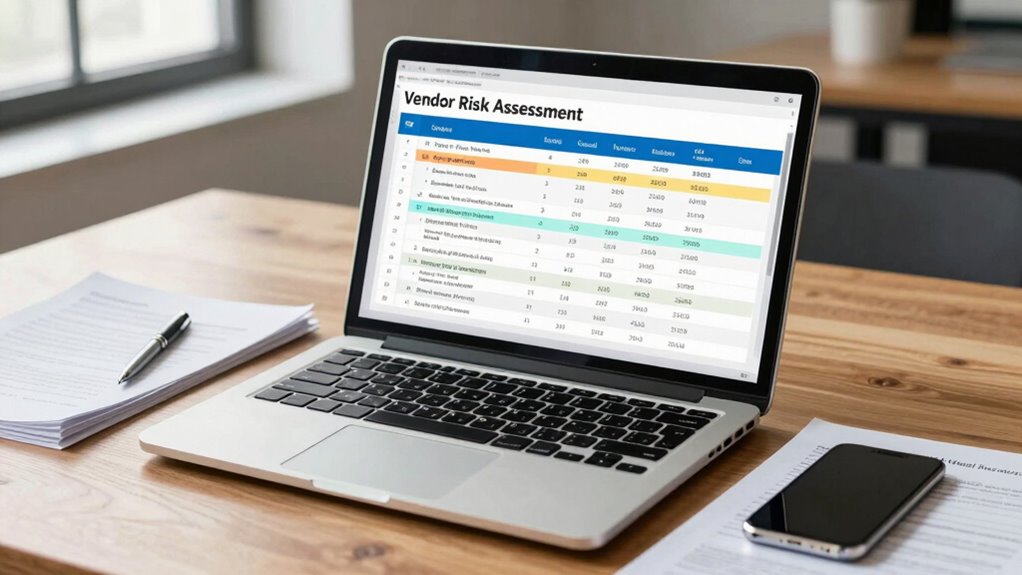

When evaluating cloud vendors, start by gathering basic info on their services, ownership, and risk level. Verify compliance with standards like ISO 27001, SOC 2, or GDPR, and review their security controls and disaster recovery plans. Analyze their financial stability and operational resilience to spot systemic risks. Establish ongoing monitoring, clear SLAs, and review schedules based on vendor risk. If you keep exploring, you’ll discover detailed steps to build a thorough, reusable risk assessment checklist.
Key Takeaways
- Include vendor details such as ownership, location, and subcontractor reliance to assess operational criticality and dependencies.
- Verify compliance certifications (ISO, SOC 2, GDPR, HIPAA) and recent audit history to ensure regulatory adherence.
- Evaluate cybersecurity controls like firewalls, encryption, and incident response plans to identify potential vulnerabilities.
- Assess financial stability, disaster recovery plans, and SLAs to gauge operational resilience and systemic risk.
- Establish ongoing monitoring with risk scoring, review schedules, and contractual safeguards to manage evolving cloud vendor risks.

In today’s cloud-driven landscape, conducting thorough vendor risk assessments is essential to safeguarding your organization’s data and operations. When evaluating cloud vendors, start by gathering basic information about their services and operational criticality. You need to understand who owns the vendor, where they’re located, and if they rely on subcontractors. Identifying the vendor type—such as a cloud provider—and their level of access to your data or infrastructure helps determine risk exposure. For example, vendors with access to sensitive customer or employee data should be classified as high risk, while those with limited access may fall into medium or low-risk categories. Properly tiering vendors based on these factors allows you to focus your efforts on the most critical relationships. Additionally, document financial stability indicators like revenue and funding history to assess systemic risks linked to economic health.
Next, verify the vendor’s compliance posture. Check for relevant certifications such as ISO 27001, SOC 2, GDPR, HIPAA, or PCI DSS, and review their audit history, especially the recency of their last SOC 2 audit. Confirm they adhere to applicable regulations, and look for evidence of compliance in their documentation. Don’t forget to evaluate ESG accountability and ethics practices, ensuring the vendor aligns with regulatory and societal standards. Moving on, assess their cybersecurity practices. Confirm they implement technical safeguards like firewalls, virus scanning, and encryption both during transit and at rest. Review their network security controls, penetration testing routines, and incident response capabilities. Ensure they conduct annual business continuity planning (BCP) testing, and verify disaster recovery plans specify maximum tolerable downtime, protecting your organization from potential operational disruptions.
Verify vendor compliance through certifications, audit history, and adherence to regulations; assess cybersecurity safeguards and disaster recovery plans.
Your evaluation should include a close look at their financial and operational stability. Analyze their financial health, performance metrics, and resilience measures to identify systemic risks. Confirm they maintain robust disaster recovery procedures and SLAs aligned with ISO/IEC 19086-1:2016 standards. For cloud-specific risks, verify data hosting details, whether they operate in single-tenant or multi-tenant environments, and review their data transfer and migration services. Ensure they have risk mitigation strategies in place and conduct preventive maintenance with proper qualification of cloud infrastructure. Additionally, understanding cloud environment configurations helps in assessing potential vulnerabilities associated with multi-tenant setups and shared resources.
Finally, use a risk scoring matrix to consolidate your findings and assign overall risk levels. Tailor your assessment depth based on vendor criticality, and establish a review cadence—more frequent for high-risk vendors—to ensure ongoing monitoring. Incorporate contractual safeguards such as SLAs, liability clauses, and audit rights. Regularly reassess vendors, schedule periodic reviews, and remain vigilant for new risks or policy changes. By systematically following this checklist, you’ll be able to make informed decisions, prioritize remediation efforts, and maintain a strong, secure cloud environment.
Frequently Asked Questions
How Often Should Vendor Risk Assessments Be Updated?
You should update your vendor risk assessments regularly, ideally at least annually, to stay ahead of evolving risks. For high-risk or critical vendors, consider more frequent reviews—every six months or even quarterly. Keep an eye on changes in their operations, compliance status, or cybersecurity posture. Continuous monitoring and periodic reassessments assist you in identifying emerging risks early and guarantee your cloud environment remains secure and compliant.
What Tools Assist in Automating Risk Assessment Processes?
You can use automated tools like GRC platforms, risk management software, and security information and event management (SIEM) systems to streamline your risk assessments. These tools help gather data, evaluate vulnerabilities, and generate reports quickly. They also enable continuous monitoring and real-time alerts, reducing manual effort and human error. By integrating these tools into your process, you guarantee more consistent, timely, and accurate risk evaluations, enhancing your overall cloud vendor security posture.
How to Handle Vendors With Incomplete Compliance Documentation?
When vendors have incomplete compliance documentation, you should request additional evidence promptly and clearly communicate the importance of compliance for risk management. If they can’t provide the required documentation, consider escalating the issue or reassessing the vendor’s risk level. Document all communications, and if necessary, implement temporary restrictions on their access until compliance is verified. Prioritize transparency and make certain your risk mitigation measures are aligned with your organization’s security standards.
What Metrics Best Indicate Vendor Operational Resilience?
Did you know that 80% of operational disruptions are linked to vendor failures? To gauge vendor resilience, focus on metrics like recovery time objectives (RTO), incident response times, and the frequency of business continuity plan tests. You should also track infrastructure uptime, the speed of incident resolution, and the robustness of backup systems. These indicators reveal how quickly and effectively a vendor can recover from disruptions, ensuring your cloud environment stays resilient.
How to Address Emerging Cybersecurity Threats During Assessments?
You should stay proactive by continuously monitoring cybersecurity threat intelligence sources for emerging risks. Incorporate simulated attack scenarios and penetration tests into your assessments to identify vulnerabilities. Regularly review and update your cybersecurity controls, encryption practices, and incident response plans. Engage with vendors to understand their latest security measures. By maintaining ongoing awareness and updating your evaluation criteria, you can effectively address new threats and strengthen your cloud security posture.
Conclusion
By mastering meticulous vendor risk assessments, you minimize mishaps and maximize security in the cloud. Remember, thoroughness transforms threats into tame tasks. With a clear checklist, you confidently confront concerns, curb complications, and cultivate a secure cloud environment. Stay sharp, stay strategic, and safeguard your systems by simplifying scrutiny. In the world of vendor vetting, vigilance and vigilance alone pave the path to peace of mind. Take charge, and let your cloud confidence soar.