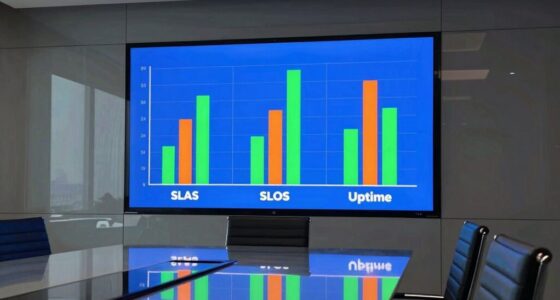

Service credits are designed as automatic compensation for SLA breaches, often calculated as a percentage of recurring fees. While they provide quick relief, they usually don’t match your actual damages or downstream losses, such as lost revenue or remediation costs. Caps further limit their value, and measurement issues can underreport impacts. To truly understand how these credits fall short and what else might be needed, explore this topic further.

Get business pricing on networking and server gear
- Business-only prices and quantity discounts
- Tax-exempt purchasing
- Multiple users, one account, clear invoices
Key Takeaways
- Service credits are based on contractual formulas tied to recurring fees, not actual or downstream damages.
- They often have caps that limit total compensation, preventing full recovery for catastrophic failures.
- Measurement and reporting challenges can lead to underestimating the true impact, reducing credit effectiveness.
- Service credits are incentives, not penalties, and typically do not cover damages outside predefined metrics.
- Complex systems or delayed damages may not be captured by simple metrics, making credits inadequate for real harm.

Have you ever wondered how service providers compensate clients when SLAs are missed? Service credits are the typical mechanism used. They’re contractual remedies that activate automatically when measurable SLA violations occur, like drops in availability, response time breaches, or error-rate surges. Unlike penalties, which often depend on fault or negligence, service credits don’t require proof of damage—they’re designed as straightforward incentives to encourage providers to maintain performance levels. Usually, they’re calculated as a percentage of the recurring service fees, often ranging from 5% to 25%, and are graduated based on the severity of the breach. These credits are applied automatically once thresholds are undershot, simplifying enforcement and reducing legal disputes.
However, service credits rarely match the client’s actual economic losses. This mismatch stems from their core design: they’re based on a set formula referencing recurring fees rather than downstream damages like lost revenue, penalties, or remediation costs. Caps are common, limiting total credits per period to prevent providers from facing full liability for major failures. These caps are often tied to monthly or annual fees, which means catastrophic outages or cascading damages usually fall short of full compensation. Measurement windows and granularity also play a role—if the system logs availability hourly or daily, it might underreport the real impact on business, especially when harm is nonlinear or deferred. Additionally, the limited scope of objective metrics, like uptime percentages, can be manipulated or misreported, leading to disputes. Automated calculations depend on provider self-reporting or dashboards, giving you little leverage to challenge or verify the numbers. Timing issues, such as notice periods and claim deadlines, add procedural traps, risking forfeited credits if not strictly followed. In addition, the effectiveness of service credits can be influenced by the provider’s compliance culture and reporting transparency. Furthermore, the use of performance metrics as the basis for credits often fails to capture the full scope of business impact, especially in complex or integrated systems.
service level agreement SLA monitoring tools
As an affiliate, we earn on qualifying purchases.
As an affiliate, we earn on qualifying purchases.
Frequently Asked Questions
Can Service Credits Be Considered Legal Damages in Contract Disputes?
No, service credits can’t be considered legal damages in contract disputes. They’re typically viewed as contractual remedies or performance incentives, not compensation for actual losses. Courts usually see them as a limited, agreed-upon remedy that restricts damages to the credit amount, rather than awarding full economic damages for breach. If you want real damages recognized, you’ll need to pursue separate claims for actual losses beyond the scope of service credits.
How Do Jurisdictional Laws Affect the Enforceability of Service Credit Clauses?
Jurisdictional laws can substantially impact how enforceable service credit clauses are. In some areas, courts may refuse to uphold overly broad liability limits or deem certain clauses unconscionable, especially if they limit damages for gross negligence or fraud. You should review local laws and seek legal advice to guarantee your SLA provisions are enforceable, as jurisdictional differences can alter the protections and remedies available if disputes arise.
What Are Common Pitfalls When Negotiating Service Credit Terms?
When negotiating service credit terms, you might stumble into pitfalls that can sink your protections. Watch out for caps that are too low, measurement methods prone to dispute, and exclusion clauses that dodge responsibility during major failures. Don’t accept vague language; push for clear, measurable, and enforceable metrics. Without these safeguards, you risk leaving yourself defenseless against significant damages, turning what should be a safety net into a paper tiger.
Do Service Credits Impact a Vendor’s Liability Insurance Coverage?
Service credits generally don’t impact a vendor’s liability insurance coverage directly. They are contractual remedies, not insurance claims. However, if a dispute or claim arises from SLA breaches, the vendor’s insurance might cover related third-party damages or legal costs. You should review the specific policy language, as some insurers may exclude damages linked to contractual remedies like service credits or limit coverage for certain breach types.
How Should Clients Document SLA Breaches to Maximize Credit Claims?
You should thoroughly document SLA breaches by collecting objective, timestamped evidence like system logs, monitoring reports, and incident alerts. Use third-party monitoring when possible to guarantee unbiased data. Record exact times and durations of outages or performance issues, and document any communication with the provider about the breach. Keep detailed records of all relevant metrics and incidents to strengthen your credit claims and reduce disputes, ensuring your documentation clearly links the breach to service impact.
business impact measurement software
As an affiliate, we earn on qualifying purchases.
As an affiliate, we earn on qualifying purchases.
Conclusion
Service credits are like Band-Aids for a sinking ship—they might patch up small leaks, but they rarely fix the deep holes causing real damage. While they offer a glimmer of reassurance, they often fall short of covering the true cost of your frustration. Think of them as a quick flicker of light in a dark tunnel—nice, but not enough to guide you safely out. Ultimately, don’t rely on service credits to mend what’s truly broken.
contract management software for service credits
As an affiliate, we earn on qualifying purchases.
As an affiliate, we earn on qualifying purchases.
performance metric reporting tools
As an affiliate, we earn on qualifying purchases.
As an affiliate, we earn on qualifying purchases.
Columbus Day / Indigenous Peoples' Day Picks
long weekend sales
As an affiliate, we earn on qualifying purchases.