
If you want a simple guide, think of IaaS as renting raw infrastructure like servers and storage, giving you full control but requiring management efforts. PaaS provides a ready platform to develop, deploy, and scale applications without worrying about underlying systems. SaaS delivers complete software ready to use, with minimal setup. Understanding these differences helps you choose the right option for your needs—and if you keep going, you’ll get even clearer insights.
Key Takeaways
- IaaS offers raw compute, storage, and networking with maximum control and management responsibility.
- PaaS provides a managed platform for faster app development, reducing operational complexity.
- SaaS delivers ready-to-use software, minimizing user control and management.
- Costs vary: IaaS is pay-as-you-go; PaaS has tiered pricing; SaaS uses subscription models.
- Security and data control responsibilities shift from provider to user depending on the service model.
What Are the Core Differences Between IaaS, PaaS, and SaaS

The core differences between IaaS, PaaS, and SaaS lie in the level of control, management responsibilities, and the type of services they provide. With IaaS, you get virtualized compute, storage, and networking as raw resources, giving you full control over the infrastructure and software setup. PaaS offers a managed platform that handles the OS, middleware, and runtime, so you can focus on building applications without managing underlying hardware. SaaS delivers complete, ready-to-use software over the internet, with the vendor handling everything from infrastructure to updates. As you move from IaaS to SaaS, control and responsibility shift from you to the provider. Each model serves different needs, from full customization to quick, low-maintenance solutions. Additionally, understanding the levels of abstraction involved can help clarify how these models differ in complexity and management. Recognizing the management responsibilities at each level can aid in choosing the most suitable cloud service model for your organization. Moreover, being aware of the service deployment models can assist in aligning the cloud solution with your specific operational requirements.
How Pricing Works for Each Cloud Model

Understanding how cloud service models are priced is essential for managing costs effectively. With IaaS, you pay for what you use—VM hours, storage, and bandwidth—on a pay-as-you-go basis. Usage spikes can increase costs quickly, so monitoring is key. PaaS typically uses a mix of fixed tiers and usage-based fees, such as build minutes or user counts, which can reduce operational expenses but may include platform charges. SaaS usually involves per-user or per-seat subscriptions, making costs predictable and easy to budget. However, watch out for hidden expenses like data egress, integrations, and add-ons that can add up. Your control over costs depends on the model: autoscaling for IaaS, quotas for PaaS, and license management for SaaS.
Who Controls What in IaaS, PaaS, and SaaS
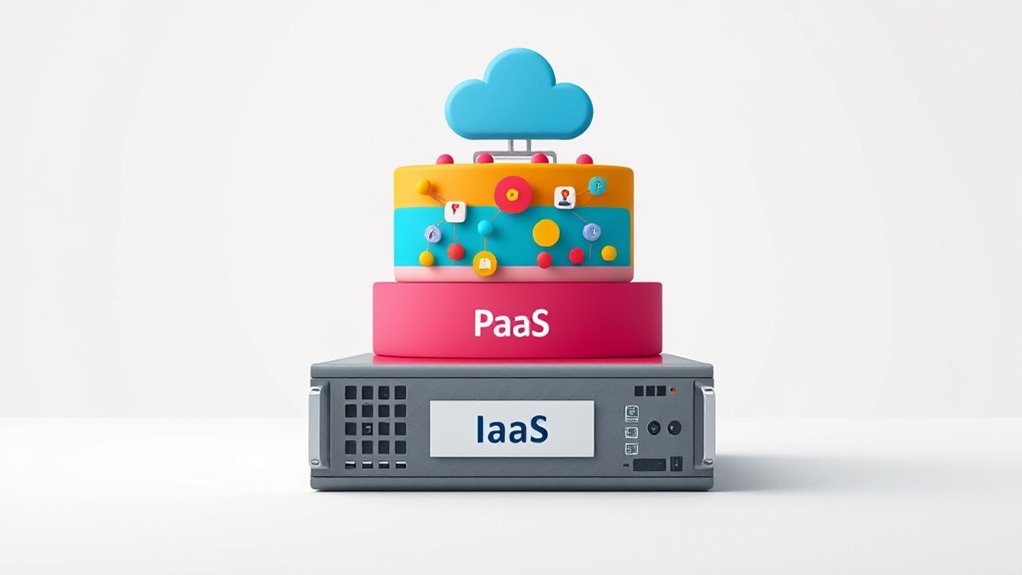
Who controls what in cloud service models determines how much responsibility you have for managing and securing your environment. In IaaS, you handle most, including OS, applications, and security. PaaS shifts some control to the provider, who manages the platform, while you focus on your apps. SaaS offers the least control, with the provider managing the entire software stack. The level of control also influences your ability to implement floating on water security measures and customizations tailored to your needs.
Best Uses for IaaS, PaaS, and SaaS

You should consider IaaS when you need full control over infrastructure, such as for legacy systems, high-performance computing, or bespoke environments. PaaS is ideal if your focus is on rapid application development, leveraging managed runtimes and integrated tools to speed up deployment. SaaS works best for standard business functions like email or CRM, where minimal management and quick setup are priorities.
Ideal Infrastructure Scenarios
Choosing the right cloud infrastructure depends on your specific needs and workload characteristics. If you require full control, custom configurations, or handle legacy systems, IaaS is ideal. It suits high-performance computing, big data, or applications needing tailored environments. For rapid development, deployment, and standardization, PaaS works best—especially for application teams wanting managed runtimes, integrated tools, and scaling. SaaS fits well when you need ready-to-use software with minimal maintenance, like email, CRM, or collaboration tools. It’s perfect for organizations aiming to reduce IT overhead and accelerate user adoption. Often, combining these models provides flexibility: use IaaS for core infrastructure, PaaS for app development, and SaaS for end-user services. Your choice depends on balancing control, speed, and operational simplicity.
Application Development Focus
Application development strategies benefit greatly from selecting the right cloud service model, as each offers different levels of control and efficiency. With IaaS, you have maximum flexibility to customize your infrastructure, making it ideal for legacy systems, high-performance computing, or bespoke environments. PaaS streamlines development by providing managed runtimes and tools, perfect for teams focused on rapid deployment and continuous integration. SaaS, on the other hand, suits scenarios where end-user productivity tools or industry-specific applications are needed, requiring minimal development effort. Understanding cloud service models helps organizations choose the best fit for their specific needs and goals.
In summary:
- Use IaaS for full-stack control, legacy migration, or high-performance needs.
- Opt for PaaS for faster app development, standardized frameworks, and scaling.
- Choose SaaS for ready-to-use solutions with minimal customization.
Key Technical Features and Limitations
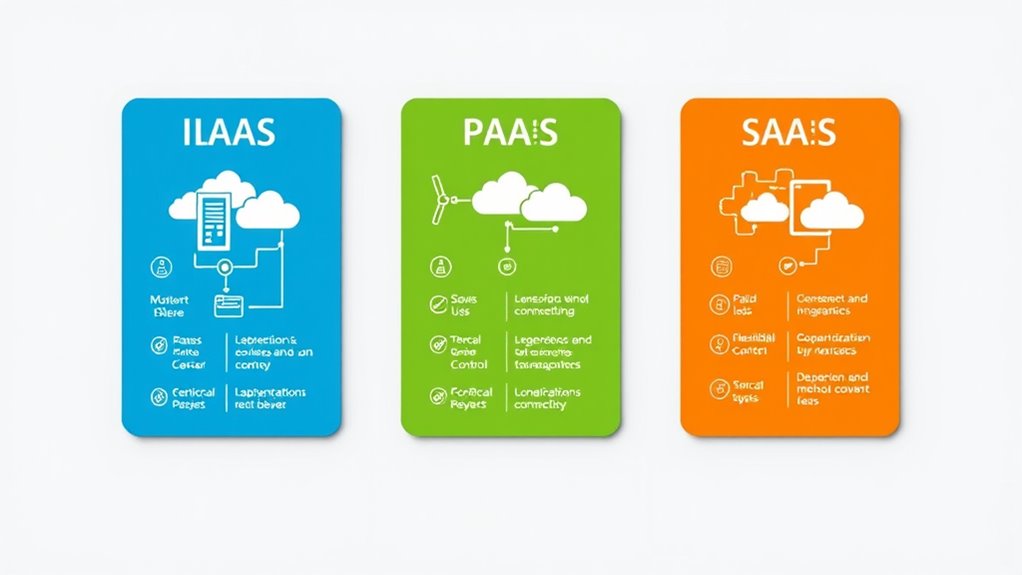
Cloud service models differ markedly in their technical features and inherent limitations, shaping how you deploy and manage resources. IaaS offers virtualized hardware with full OS access, giving you maximum control and flexibility but requiring extensive management and maintenance. PaaS provides managed runtimes and tools that simplify development, though it limits low-level customization and can introduce platform-specific dependencies. SaaS delivers ready-to-use applications with minimal setup, but customization options are limited, and you’re constrained by the vendor’s features and APIs. Performance in IaaS can be fine-tuned for latency-sensitive workloads, but shared infrastructure in PaaS and SaaS may impact peak performance. Portability is easiest in IaaS, while PaaS and SaaS pose challenges due to platform-specific services and proprietary formats. Additionally, understanding the technical features and limitations helps you select the right model for your specific needs. Recognizing the platform dependencies and vendor lock-in is essential for long-term planning and flexibility. An understanding of infrastructure management complexity is also important when choosing between these models, as it directly affects operational overhead. Moreover, evaluating the scalability options available in each model can influence your ability to grow efficiently and adapt to changing demands.
Security, Compliance, and Data Control

You need to understand how responsibility sharing affects your security and compliance efforts across cloud models. Data portability becomes more complex as you move from IaaS to SaaS, making migration and vendor lock-in major concerns. Managing compliance also varies, requiring different strategies depending on your control level and the provider’s certifications and guarantees. Additionally, adopting a home security system can serve as a deterrent to criminal activity, highlighting the importance of physical security measures in safeguarding your assets. Understanding the security responsibilities associated with each cloud model can help you better allocate resources and ensure comprehensive protection. Recognizing security best practices tailored for each model can further enhance your overall security posture.
Responsibility Sharing Levels
Responsibility sharing in cloud service models varies markedly across IaaS, PaaS, and SaaS, shaping how security, compliance, and data control are managed. With IaaS, you handle most security aspects, including OS patches and network security, giving you maximum control but increasing management efforts. PaaS shifts some responsibilities: you secure your application and data, while the provider manages platform security. SaaS places the bulk of security and compliance on the provider, leaving you mainly responsible for user access and data governance. Specifically, you are also responsible for privacy management, which involves understanding how security responsibilities are distributed and ensuring compliance with data protection regulations. Understanding shared responsibility models is crucial to effectively manage your security and compliance obligations across these cloud service types.
Data Portability Challenges
Data portability issues become more pronounced as responsibilities shift and organizations seek to maintain control over their information. In IaaS, you have the most control, making data migration easier, but you still face challenges with formats, tools, and dependencies. PaaS complicates portability because platform-specific services and APIs tie your data and applications to a particular environment. Moving data or apps often requires significant adjustments, increasing complexity and risk. SaaS presents the highest hurdles, as proprietary data formats, limited export options, and embedded integrations restrict seamless transfer. Security concerns like data breaches, compliance issues such as data residency requirements, and maintaining control over sensitive information add to these challenges. Ultimately, each model’s degree of data portability depends on how well you can manage vendor lock-in, data formats, and migration tools.
Compliance Management Strategies
Effective compliance management in cloud environments requires understanding how security controls, regulatory requirements, and data governance are shared between providers and customers. Your approach varies by service model.
- In IaaS, you’re responsible for securing OS, applications, and data, giving you maximum control but increasing compliance complexity. Understanding shared responsibility is essential to effectively allocate security tasks. Additionally, leveraging cloud security frameworks can help streamline compliance efforts.
- PaaS shifts some responsibilities to the provider, who manages platform security, while you secure your applications and data.
- With SaaS, the provider handles almost everything, including security and compliance, leaving you mainly to manage user access and data controls.
- When working with electric bikes and generators, it’s important to consider their safety features and regulatory standards to ensure compliance and rider safety.
To guarantee compliance, you should verify provider certifications (like SOC or ISO), establish clear SLAs, and implement continuous monitoring tailored to each model’s responsibilities. This layered approach helps maintain security and regulatory adherence.
Migration Challenges and Portability

Migrating workloads across cloud service models presents significant challenges due to differences in architecture, tools, and vendor ecosystems. Moving from IaaS to PaaS requires adapting your applications to platform-specific services and APIs, which can involve code refactoring and testing. Shifting to SaaS often means exporting data, reformatting it, and reworking business processes to fit new workflows, risking data loss and compatibility issues. Portability is easier in IaaS because you can replicate virtual machines and configurations, but PaaS and SaaS impose more constraints due to platform-specific dependencies and proprietary formats. These limitations increase migration complexity and time. To guarantee smooth movement, you need detailed planning, compatibility assessments, and possibly hybrid strategies to bridge gaps and minimize disruption during the changeover.
Making the Right Choice for Your Business

Choosing the right cloud service model depends on your business’s specific needs, technical capabilities, and long-term goals. To make an informed decision, consider these factors:
- Control and Customization: Do you need full control over infrastructure (IaaS), or prefer managed environments with less overhead (PaaS/SaaS)?
- Cost and Budget: Can you handle variable costs and management complexity (IaaS), or do predictable expenses (SaaS) better suit your finances?
- Speed and Agility: Do you aim for rapid development and deployment (PaaS), or require ready-to-use solutions with minimal setup (SaaS)?
- Alignment with Personal Traits: Understanding how your astrological sign might influence your decision-making style can also provide unique insights into choosing the most suitable cloud model.
Analyzing these aspects helps you align your choice with your operational demands, technical skills, and growth plans.
Frequently Asked Questions
How Do I Determine Which Cloud Model Fits My Business Needs?
You determine which cloud model fits your business needs by evaluating your control, customization, and management requirements. If you need full control and customization, IaaS suits you best. For faster development with managed services, PaaS is ideal. If you want ready-to-use applications with minimal setup, SaaS works well. Consider your budget, compliance, and scalability needs to choose the model that aligns with your goals and resources.
Can I Combine Iaas, Paas, and Saas in One Environment?
You can weave IaaS, PaaS, and SaaS into a seamless tapestry, each layer adding its unique thread. By blending these models, you create a flexible environment where foundational infrastructure supports custom apps, which then serve end-users. This hybrid approach lets you optimize control, speed, and simplicity, adapting to evolving business needs. Just remember, managing this multi-layered fabric requires careful coordination to keep everything stitched together smoothly.
What Are the Common Hidden Costs Associated With Each Model?
You should watch out for hidden costs in each model. In IaaS, unexpected expenses come from data egress, over-provisioning, and managing security. For PaaS, watch for charges related to additional platform features, build minutes, or scaling limits. With SaaS, hidden costs often stem from licensing overuse, integrations, customizations, or data migration. Always consider these factors to avoid surprises and manage your cloud expenses effectively.
How Do Security Responsibilities Differ Across the Three Models?
Did you know that, in 2023, 60% of cloud security breaches involved misconfigurations? You’ll find that your security responsibilities vary by model: with IaaS, you’re responsible for OS and app security, giving you full control. In PaaS, the provider handles platform security, but you manage your apps. With SaaS, the provider manages everything, but you’re responsible for user access and data security.
What Factors Influence Migration Complexity Between Cloud Service Types?
You influence migration complexity based on your chosen cloud service model. With IaaS, migration mainly involves transferring VM images and configuring networks, making it relatively straightforward. PaaS requires code and platform adjustments due to platform-specific services, adding complexity. SaaS migrations are the most complex, often needing data extraction, transformation, and rework because of proprietary formats and limited export options. Your familiarity with these factors shapes the migration process.
Conclusion
Choosing between IaaS, PaaS, and SaaS isn’t just a decision—it’s the difference between running your business on a rocket or walking. Get it wrong, and you might face a tech nightmare or missed opportunity of epic proportions. By understanding these models, you can discover the true power of the cloud and propel your business to heights you never imagined. Make the right choice today, or risk being left in the dust of competitors who got it right.