
TL;DR

Get business pricing on networking and server gear
- Business-only prices and quantity discounts
- Tax-exempt purchasing
- Multiple users, one account, clear invoices
Brennen Puth published an October 24 essay arguing that websites, especially text-focused ones, should be designed to print clearly. He describes using print-specific CSS to adjust type, remove page elements and make links readable in grayscale, then says feedback prompted him to simplify the stylesheet.
Web developer Brennen Puth published an essay on October 24 arguing that websites should be designed to print well, after finding that his own page produced an awkward paper copy when printed using a browser’s default settings. His post describes changes made with print-specific CSS and frames print support as a small accommodation for readers who prefer working with physical documents.
Puth says he often reads printed papers because he finds that marking up paper helps him engage with a document. When he tried printing his own site, he found the text too large, the header unattractive on paper and the links too faint in grayscale. The page retained its content, but its on-screen design did not translate well to print.
His example stylesheet uses CSS rules that apply only when a page is printed. It hides selected screen elements, allows a print-only author attribution, sets explicit sizes for body text and headings, and changes link color to black. Puth also adjusts the border and type size of a code block. He writes that code blocks remain a problem because they can be difficult to fit across page breaks.
In an update dated October 26, Puth said feedback from readers on Hacker News and Lobsters had led him to reconsider parts of the approach and simplify his stylesheet. He did not provide metrics on how many people print websites or report broader adoption of the changes. The post is a personal argument and implementation example, not a survey of web-printing practices.
Making Web Pages Work on Paper
Print support affects whether readers can use web content in a format that suits their needs. A page designed only for a screen can carry over navigation, oversized type, low-contrast colors or other elements that add clutter on paper. Puth’s example shows that browser printing is available, but the resulting page may not be useful without deliberate styling.
The practical point is modest: for text-heavy sites, a separate print layout can improve legibility and remove screen-focused decoration. That can help readers who annotate documents, keep physical copies or work away from a screen. Puth does not claim that every website needs a print feature, or that print-friendly styling will benefit every visitor; he presents it as a low-key design consideration for sites whose main content is text.
Products Worth Considering

Amazon Kindle Paperwhite Signature Edition (12th Generation, 2024), 32 GB, Metallic Black

Sonos Era 100 SL Compact Microphone-Free Speaker, Black

Bose QuietComfort True Wireless Earbuds with Active Noise Cancellation, Black
As an affiliate, we earn on qualifying purchases.
From Browser Print to CSS Rules
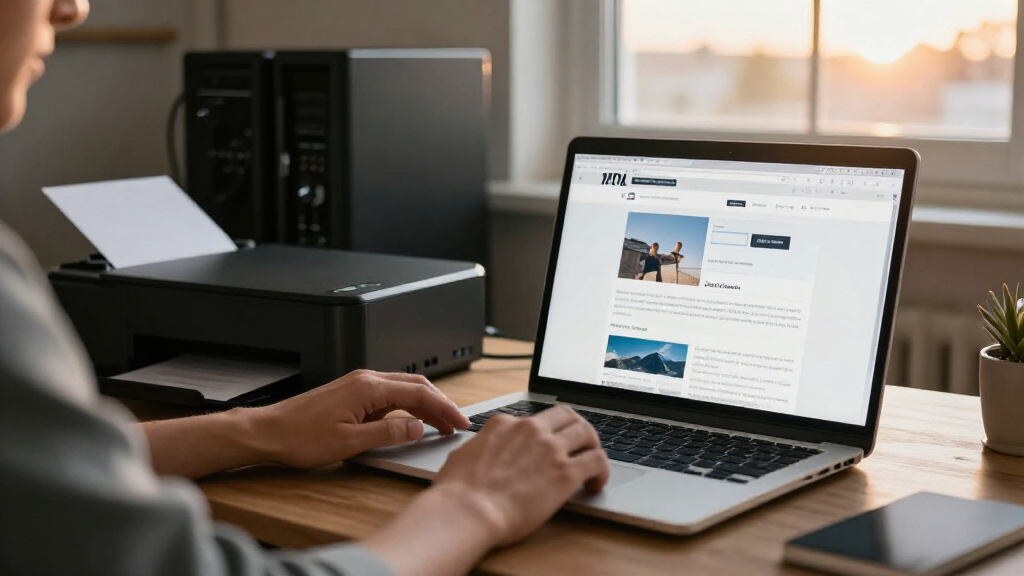
Web browsers allow users to print a webpage through a print command or keyboard shortcut, but the output depends partly on how the page is styled. CSS includes print media rules, which let a site specify a different appearance when sent to a printer instead of displayed on a screen. Puth uses those rules to control font sizes, hide the header and adjust link color.
The post focuses on a small personal site rather than a large publishing platform. Puth says applying and testing the changes took a substantial part of his morning despite the site’s limited complexity. His October 26 edit notes that readers identified issues in his first version, and that he was simplifying it in response. The revision underscores that the sample code is an evolving personal implementation, not a tested standard or universal template.
“I would personally love to experience more webpages that think about how printing works.”
— Brennen Puth
Questions the Post Leaves Open
The post does not establish how common webpage printing is, how many readers would use a tailored print layout, or whether the suggested adjustments work across different browsers and printers. Puth describes his own experience and invites others to use or adapt his CSS; he does not report systematic testing across devices.
Some implementation details also remain unsettled. Puth says code blocks are still difficult to print cleanly across page breaks and asks readers for suggestions. His October 26 update says the stylesheet is being simplified, but the post does not specify a final version or provide a comparison of print results before and after that revision.
Further Revisions and Reader Feedback
Puth said he was simplifying the print stylesheet after comments on Hacker News and Lobsters. The post does not announce a release date for a finalized version or outline a formal testing plan. Readers can inspect the page’s print output and adapt the example CSS, though results may vary with their browser and printer settings.
The immediate next development is whether Puth publishes further revisions, particularly a solution for code blocks breaking across pages. More broadly, the essay leaves the question to individual site owners: whether a separate print layout is worthwhile for their content and audience.
Key Questions
What is the news about?
Brennen Puth published an essay arguing that websites should print well and describing print-specific CSS changes he made to his own site.
What did Puth change for print?
His example stylesheet hides selected screen elements, adds an element intended only for print, sets text and heading sizes, modifies a code block and changes links to black for grayscale readability.
Why does Puth want websites to print well?
He says he reads and annotates printed papers, and argues that people should be able to read text in their preferred medium. The post does not claim that most readers print webpages.
Did Puth say the stylesheet was finished?
No. In an October 26 update, he said feedback from readers led him to simplify the stylesheet. He also said code blocks remained difficult to handle across page breaks.
Source: brennenputh.me