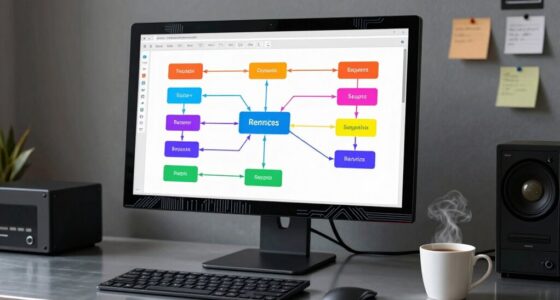

To get your product team to care about error budgets, show how they turn reliability goals into clear, measurable targets that influence daily decisions. Use visuals like dashboards and alerts to keep everyone informed, and encourage a blameless culture for incident reviews. Emphasize how error budgets balance innovation and stability, helping the team prioritize features or fixes. If you want practical ways to make this mindset stick, there’s more to uncover.
Open a free Amazon Business account
Business pricing, bulk buying and tax-exempt orders.
As an affiliate, we earn on qualifying purchases.
Key Takeaways
- Clearly communicate how error budgets directly impact product reliability and customer satisfaction.
- Integrate error budget metrics into regular team meetings and decision-making processes.
- Use visual dashboards and alerts to make error budget status transparent and actionable for product teams.
- Promote a blameless culture that views error budgets as a shared tool for improvement, not punishment.
- Tie error budget consumption to release policies, emphasizing their role in balancing innovation and stability.

Have you ever wondered how product teams balance delivering new features with maintaining system reliability? One key tool they use is the error budget — the allowable amount of system unreliability over a set period, tied directly to Service Level Objectives (SLOs) or Service Level Agreements (SLAs). This budget quantifies how much downtime or errors are acceptable without upsetting customers or breaching contractual promises. For example, a 99.99% SLA allows roughly 52 minutes and 35 seconds of downtime per year. Understanding this helps teams see the margin for error and plan their work accordingly. Error budgets are calculated based on the inverse of the SLO, which provides a clear numerical target for reliability. Calculating the error budget is straightforward. It’s fundamentally the inverse of the SLO target. If your SLO is 99.9%, then your error budget is 0.1%, translating to about 43 minutes of downtime each month or roughly 8.77 hours annually. These figures turn abstract reliability goals into concrete numbers, making it easier for teams to see how much room they have for innovation or risk-taking. When the budget is healthy, teams can push forward with new features; when it’s depleted, they need to pause and focus on stability.
The primary purpose of error budgets is to strike a balance. They provide an objective measure for deciding whether to accelerate feature releases or slow down for improvements. When teams see their error budget shrinking, they can hold back on deploying risky changes, opting instead to fix existing issues. Conversely, a healthy budget encourages pushing new releases, knowing there’s room to absorb potential failures. This data-driven approach aligns development efforts with reliability goals, preventing overreach and protecting user trust.
For teams to make effective use of error budgets, stakeholders like product managers, SREs, DevOps, and engineers need to own and monitor them continuously. Dedicated roles, such as error-budget DRIs, track consumption through observability tools like Grafana or New Relic, translating percentage-based SLIs into actionable timeframes. Policies enforce actions like release freezes once the budget is exhausted, ensuring stability takes precedence when needed. Regular dashboards and alerts keep everyone informed, and incident reviews help identify systemic issues before they drain the budget.
To foster a culture that values error budgets, teams should view them as a shared decision-making currency rather than a punitive measure. Clear signals like green, yellow, and red simplify understanding, encouraging predictable behaviors. When breaches occur, blameless postmortems help identify systemic improvements, turning failures into opportunities for growth. This approach promotes continuous improvement and aligns everyone toward shared reliability and innovation goals.
Ultimately, error budgets make the trade-offs transparent. They help teams prioritize work, manage risk, and deliver better products. By tracking how much unreliability has been consumed, teams can make smarter decisions about when to innovate and when to stabilize, ensuring sustained customer satisfaction and contractual compliance.
error budget monitoring dashboard
As an affiliate, we earn on qualifying purchases.
As an affiliate, we earn on qualifying purchases.
Frequently Asked Questions
How Do I Determine the Appropriate Error Budget Size for My Service?
To determine the right error budget size, start by analyzing your service’s customer impact and business needs. Consider existing SLIs and SLOs, then set a realistic tolerance for downtime or errors that balances reliability with innovation. Review historical incident data, stakeholder input, and industry standards. Adjust the budget based on service criticality, user expectations, and risk appetite, ensuring it aligns with your overall reliability and growth goals.
What Tools Best Support Automated Error Budget Enforcement?
You should use observability tools like Grafana, New Relic, or Datadog to support automated error budget enforcement. These platforms help you track SLIs and SLOs in real-time, set thresholds for budget breaches, and trigger alerts or automated actions like release freezes. Integrate these tools with your CI/CD pipelines and incident management systems to guarantee consistent enforcement, reduce manual oversight, and quickly respond when budgets are at risk.
How Should We Handle Error Budget Breaches During Critical Releases?
When your error budget is breached during a critical release, pause deployments and assess the impact. Communicate transparently with stakeholders about the breach, emphasizing the importance of reliability. Implement a release freeze if necessary, and prioritize fixing issues before proceeding. Use the breach as an opportunity to review processes, reinforce reliability practices, and adjust future release plans to prevent recurrence, ensuring customer trust remains intact.
What Metrics Reliably Indicate Approaching Error Budget Exhaustion?
You should monitor the error budget burn rate, which shows how quickly you’re consuming your available reliability margin. Keep an eye on SLIs like availability, latency, and error rates, especially when these metrics trend toward predefined thresholds. Use dashboards to track these in real-time, set alerts for when you’re nearing limits, and analyze incident patterns. This proactive approach helps you catch approaching exhaustion early and adjust releases or focus on fixes.
How Can Teams Balance Innovation With Reliability When Managing Error Budgets?
You can balance innovation with reliability by closely monitoring your error budget and setting clear thresholds for release approvals. Use automation to pause deployments when the budget nears exhaustion, and prioritize reliability fixes over new features when needed. Communicate openly with your team about budget status, and incorporate reliability tasks into your planning and sprints. This approach guarantees you innovate confidently while maintaining system stability and customer trust.
reliability metrics observability tools
As an affiliate, we earn on qualifying purchases.
As an affiliate, we earn on qualifying purchases.
Conclusion
Just like the steadfast lighthouse guiding ships safely home, error budgets illuminate your path to balanced innovation and reliability. When you make them a shared goal, your team navigates the complex waters of development with clarity and purpose. Embrace these boundaries, and you’ll foster trust and resilience—transforming challenges into opportunities. Remember, by caring about error budgets, you’re not just avoiding storms; you’re guiding your product toward calm seas and brighter horizons.
service level agreement SLA monitoring software
As an affiliate, we earn on qualifying purchases.
As an affiliate, we earn on qualifying purchases.
incident review tools for DevOps
As an affiliate, we earn on qualifying purchases.
As an affiliate, we earn on qualifying purchases.
Evergreen bestsellers Picks
bestsellers
As an affiliate, we earn on qualifying purchases.