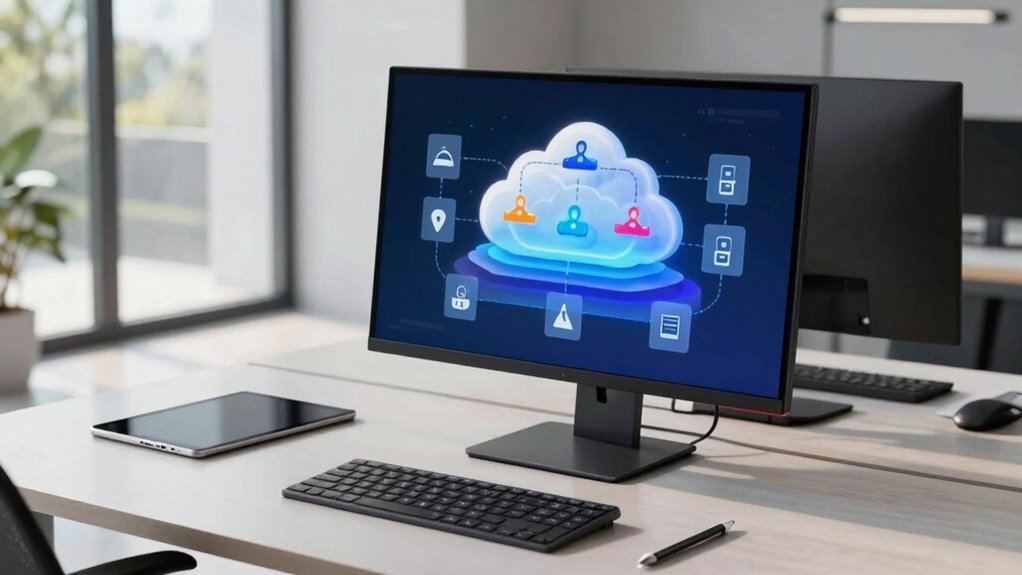

A good access model in hybrid cloud centralizes identity management, making it easier to control and secure user credentials across on-premises and cloud systems. It should incorporate layered security measures like multi-factor authentication and role-based access controls, along with continuous monitoring to detect suspicious activity. Automated provisioning and de-provisioning ensure permissions stay current, reducing risks. When you comprehend these core elements, you’ll be better equipped to design a flexible, secure hybrid cloud environment—exploring further can help you refine your approach.
Key Takeaways
- Centralized identity management ensures consistent access controls across on-premises and cloud environments.
- Multi-factor authentication and role-based access control enhance security and user accountability.
- Continuous monitoring and real-time auditing detect suspicious activities and enable swift incident response.
- Automated provisioning and de-provisioning support dynamic organizational changes and maintain security.
- Layered security measures and risk assessments provide comprehensive protection against emerging threats.

Have you ever wondered how organizations securely manage access across their hybrid cloud environments? In today’s digital landscape, a good access model is essential to maintaining cloud security and ensuring that only authorized users can reach critical data and applications. When working with hybrid clouds—combining on-premises infrastructure with public cloud resources—you need a robust system that balances flexibility with control. That’s where effective identity management becomes a cornerstone. It allows you to precisely identify and authenticate users and devices, regardless of where they’re connecting from, reducing the risk of unauthorized access.
Effective identity management ensures secure, seamless access across hybrid cloud environments, balancing flexibility with rigorous control.
A strong access model in a hybrid cloud environment relies heavily on centralized identity management. Instead of managing identities separately across different platforms, you want a unified approach that consolidates user credentials and access policies. This setup simplifies administration and enhances security because you gain an all-encompassing view of who’s accessing what and when. With identity management, you can enforce consistent access controls across all environments, making sure that policies are uniformly applied whether a user logs in from an on-premises network or a cloud service. Incorporating identity federation can further streamline access across multiple cloud providers and on-premises systems.
In terms of cloud security, your model should incorporate multi-factor authentication (MFA) to add an extra layer of protection. MFA makes it considerably harder for malicious actors to gain unauthorized access, even if they compromise a password. You should also implement role-based access control (RBAC), assigning permissions based on a user’s role within the organization. This way, users only get the level of access they need to perform their jobs, which minimizes potential damage from insider threats or accidental data breaches. Additionally, adopting layered security controls** enhances your overall security posture by combining multiple safeguards. A comprehensive security strategy should also include risk assessment to identify vulnerabilities proactively. Employing automated security tools** can further improve your ability to respond rapidly to emerging threats and vulnerabilities. Regular audits and updates are crucial, as they help adapt your access controls to evolving security landscapes.
Another critical component is continuous monitoring and real-time auditing. A good access model doesn’t just set policies and forget them; it actively tracks access patterns and flags suspicious activity. This immediate visibility helps you respond swiftly to potential breaches or anomalies. Additionally, integrating identity management solutions with your security information and event management (SIEM) system ensures that you get an all-encompassing overview of access events across your hybrid cloud environment. Advanced analytics can also be employed to identify patterns that might indicate security risks before they materialize into breaches.
Finally, your access model should be adaptable, supporting the dynamic nature of hybrid clouds. As your organization evolves, so do your access needs. Automating provisioning and de-provisioning of user accounts based on role changes or employment status keeps your security tight without creating cumbersome manual processes. In essence, a good access model in hybrid cloud environments hinges on combining strong identity management practices with layered security controls, continuous monitoring, and flexibility. When done right, it safeguards your cloud security posture while enabling seamless access for authorized users.
multi-factor authentication hardware token
As an affiliate, we earn on qualifying purchases.
As an affiliate, we earn on qualifying purchases.
Frequently Asked Questions
How Do Access Models Differ Between Public and Private Clouds?
In public clouds, access models often rely on broad access frameworks and dynamic user permissions, allowing quick scalability and flexibility. Private clouds, however, emphasize stricter control, with more granular access frameworks and tightly managed user permissions to guarantee security. You’ll notice that public cloud access is more about ease and speed, while private cloud access prioritizes security and precise control. Both models adapt to different organizational needs, balancing flexibility and control.
What Security Risks Are Associated With Hybrid Cloud Access Models?
Think of hybrid cloud access like charting a complex maze—without proper precautions, you risk getting lost or exposed. Security risks include data breaches and unauthorized access, especially if data isn’t encrypted or if compliance standards aren’t met. You must implement strong data encryption and enforce strict access controls to protect sensitive information across both private and public environments, ensuring you don’t compromise your system’s integrity or violate regulations.
How Can Organizations Enforce Consistent Access Policies Across Environments?
You can enforce consistent access policies by implementing role-based access controls across all environments, ensuring users only access what they need. Combine this with multi-factor authentication to add an extra security layer. Regularly audit and update these policies to accommodate changes in roles or threats. Using centralized identity management helps synchronize controls, maintaining uniformity and reducing security gaps in your hybrid cloud infrastructure.
What Tools Are Best for Managing Hybrid Cloud Access Controls?
You should use tools that support role-based access control (RBAC) and multi-factor authentication (MFA) to manage hybrid cloud access effectively. Platforms like Azure Active Directory, AWS IAM, and Google Cloud Identity enable you to assign permissions based on roles, ensuring consistent policies. They also support MFA, adding an extra security layer. These tools streamline access management, helping you enforce policies seamlessly across different environments.
How Does User Identity Management Work in Hybrid Cloud Setups?
You manage user identity in hybrid cloud setups through identity federation, allowing seamless access across multiple environments using a single identity. You assign role-based access controls (RBAC), ensuring users only access data and resources relevant to their roles. This setup simplifies user management, enhances security, and provides a unified experience, making it easier to govern and monitor access across both on-premises and cloud platforms effectively.
role-based access control software
As an affiliate, we earn on qualifying purchases.
As an affiliate, we earn on qualifying purchases.
Conclusion
A good access model in a hybrid cloud balances security and flexibility, much like a well-designed lock that’s easy for trusted users but tough for intruders. While your organization’s agility grows, so should your safeguards, ensuring seamless access doesn’t compromise security. Remember, in the hybrid cloud, the key isn’t just in the technology but in how you manage and adapt it. Striking this balance lets you gain access to innovation without exposing yourself to unnecessary risks.
identity management system for hybrid cloud
As an affiliate, we earn on qualifying purchases.
As an affiliate, we earn on qualifying purchases.
automated security monitoring tools
As an affiliate, we earn on qualifying purchases.
As an affiliate, we earn on qualifying purchases.