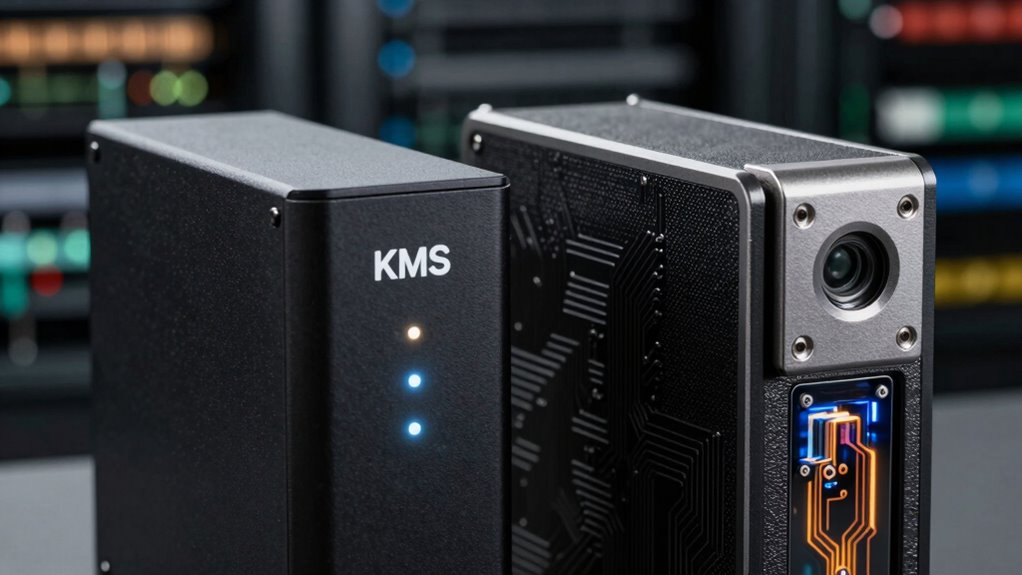

When choosing between a KMS and an HSM, you’re investing in different levels of security, control, and flexibility. An HSM offers hardware-backed, tamper-resistant protection ideal for high-security needs and strict compliance, but it comes with higher costs and management complexity. A KMS provides centralized, easier-to-manage key storage, often in cloud environments, with less physical security but greater adaptability. To understand which aligns best with your goals, explore these differences further.

Get business pricing on networking and server gear
- Business-only prices and quantity discounts
- Tax-exempt purchasing
- Multiple users, one account, clear invoices
Key Takeaways
- HSM provides hardware-based, tamper-resistant security primarily for high-security environments, while KMS offers centralized, flexible key management often in software or virtual hardware.
- HSMs deliver superior physical security and cryptographic performance, whereas KMS emphasizes ease of integration, automation, and broader algorithm support.
- HSMs are a higher-cost, complex solution suited for regulatory compliance and sensitive use cases; KMS is more cost-effective and easier to deploy in cloud environments.
- Buying an HSM means investing in dedicated hardware with specialized management, while KMS involves software or virtual hardware for scalable, policy-driven keys.
- The choice depends on security requirements, compliance needs, operational complexity, and whether you prioritize hardware-backed security or flexible, cloud-friendly management.
As an affiliate, we earn on qualifying purchases.
Understanding the Core Differences Between KMS and HSM

To understand the core differences between KMS and HSM, recognizing their primary functions and security strengths is vital. An HSM acts as a secure crypto processor, generating and safeguarding cryptographic keys within a tamper-resistant hardware boundary. It’s designed for high-security environments, ensuring keys never leave the device and are protected against physical attacks. In contrast, a KMS provides centralized key management through software or hardware-backed storage, often built on HSMs, but with added policy enforcement and interoperability via standards like KMIP. While HSMs focus on physical security and fast cryptographic operations, KMS emphasizes ease of management, policy control, and integration across multiple systems. The use of hardware security modules is essential for environments requiring stringent key protection, as they provide both secure key storage and cryptographic processing. Understanding these distinctions helps you choose the right solution based on your security needs and operational scope. Additionally, compliance requirements often influence whether an organization opts for HSMs or KMS, ensuring adherence to industry standards and regulations.
As an affiliate, we earn on qualifying purchases.
Key Security and Compliance Features of Each Solution

When evaluating key security and compliance features, it’s important to recognize that HSMs offer hardware-enforced protections that are difficult to bypass, making them ideal for high-security environments. HSMs provide tamper-resistant storage, with physical defenses like FIPS 140-2 Level 3 certification that can destroy keys if tampering is detected. They store keys within a secure hardware boundary, ensuring only authorized cryptographic operations occur. HSMs support robust algorithms such as RSA, EC, and AES, and operate independently of the OS, reducing vulnerability. Conversely, KMS relies on software or hardware-backed storage, often integrating HSMs but with less physical tamper resistance. KMS emphasizes policy enforcement and compliance standards like KMIP, making it suitable for broader, less sensitive use cases. Additionally, key management processes differ significantly between the two, with HSMs focusing on physical security and KMS on policy-driven access controls. Implementing proper security protocols and understanding the different threat models are essential to choose the right solution for specific security needs.
Furthermore, understanding the trust assumptions associated with each approach helps organizations align their security architecture with their overall risk management strategy. An understanding of hardware security features can provide deeper insight into the robustness of each option. Moreover, Glycolic Acid is widely recognized for its ability to exfoliate dead skin cells, which can complement certain skin care routines for enhanced skin health.
As an affiliate, we earn on qualifying purchases.
Typical Use Cases and Deployment Scenarios

Both HSMs and KMSs serve distinct roles in securing cryptographic keys, making them suitable for different deployment scenarios. If you need a provable root of trust, strict regulatory compliance, or high-performance cryptography, HSMs are ideal. They’re perfect for use cases like payment processing, digital signatures, and secure key generation in regulated industries such as finance and healthcare. On the other hand, KMSs excel in cloud environments, offering centralized key management, automated key rotation, and policy enforcement across distributed systems. If your organization requires seamless integration with cloud services, flexible access controls, and simplified key lifecycle management, a KMS suits your needs better. Both solutions adapt to your environment’s complexity, but their deployment choices depend largely on your security requirements and operational scale. Additionally, understanding luggage & bags can help organizations select the right security tools that match their operational needs and compliance standards.
cryptographic key management software
As an affiliate, we earn on qualifying purchases.
As an affiliate, we earn on qualifying purchases.
Compatibility and Algorithm Support

You need to understand how each solution supports different cryptographic algorithms and hardware capabilities. HSMs typically offer robust hardware acceleration for algorithms like RSA, EC, and AES, ensuring high performance and security. Hardware acceleration can be crucial for processing-intensive cryptographic operations, making HSMs a suitable choice for high-demand environments. Additionally, cryptographic acceleration hardware can significantly reduce latency for encryption and decryption tasks. KMS, on the other hand, supports a wider range of algorithms and standards through software, making it more flexible for diverse integration needs. Additionally, Youngster Choice reflects the importance of choosing solutions that align with your specific security and operational requirements. Considering cryptographic algorithm support can help you determine the best fit for your organization’s security infrastructure, especially when evaluating hardware acceleration capabilities for specific cryptographic processes.
Algorithm Compatibility and Support
Algorithm compatibility and support are crucial factors in choosing between an HSM and a KMS. You need to guarantee your chosen solution supports the cryptographic algorithms your applications require. HSMs typically support a core set like RSA, EC, AES, and hashing algorithms, optimized for high performance and security. KMS solutions often have broader support for various algorithms, including legacy options, and adapt easily to evolving standards. Additionally, KMS solutions often accommodate a wider range of cryptographic standards to ensure compatibility with diverse systems. Consider these points:
- HSMs focus on high-speed, hardware-accelerated algorithms like RSA, EC, and AES.
- KMS supports a wider array, including newer and legacy algorithms, for flexibility.
- HSMs often have limited support for niche or outdated algorithms.
- KMS can be updated more frequently to incorporate new cryptographic standards, making it more [adaptable to technological advancements] and ensuring ongoing security compliance.
Hardware vs. Software Capabilities
Hardware security modules (HSMs) excel at providing dedicated, hardware-accelerated cryptographic operations that deliver high performance and robust security. They support a wide range of algorithms like RSA, ECC, AES (including GCM, PSS), and key wrapping, enabling fast, secure processing for demanding applications. Because HSMs operate independently of operating systems, they avoid common OS vulnerabilities, ensuring consistent algorithm support and compatibility. In contrast, Key Management Systems (KMS) rely on software or hybrid solutions, often supporting a broader but less specialized set of algorithms, such as TDES and digital certificates. While KMS may integrate with various cloud services and open standards like KMIP, their algorithm support can be less optimized for high-performance cryptography. Ultimately, HSMs focus on hardware-backed, high-assurance cryptography, while KMS emphasizes flexibility and broad compatibility.
Cost, Complexity, and Management Considerations

When choosing between a Key Management System (KMS) and a Hardware Security Module (HSM), understanding their cost, complexity, and management needs is essential. HSMs typically involve higher upfront costs due to hardware investment, maintenance, and specialized staff, making them less flexible. KMS solutions usually have lower initial costs, especially in cloud environments, and are easier to deploy. Managing an HSM requires physical security, regular firmware updates, and strict access controls, adding to complexity. KMS management is more straightforward, often handled via user-friendly interfaces and automated policies. Additionally, security standards compliance plays a crucial role in selecting the appropriate solution. Here’s what to contemplate: 1. HSM costs include hardware, maintenance, and security personnel. 2. KMS offers lower TCO with easier setup. 3. HSM demands rigorous physical and operational management. 4. KMS simplifies ongoing administration and policy enforcement. Incorporating security compliance requirements effectively can influence the decision, as different standards may favor one solution over the other. Moreover, understanding cloud integration options can help tailor the solution to existing infrastructure needs. Furthermore, assessing survivability and durability features can be vital for ensuring long-term security and operational resilience.
Integration Capabilities and Ecosystem Support

Integration capabilities and ecosystem support determine how seamlessly a KMS or HSM fits into your existing infrastructure. If you choose a KMS, you’ll benefit from open standards like KMIP, which enable interoperability across diverse systems and cloud services. This flexibility allows you to centralize key management without extensive customization, streamlining deployment. An HSM, on the other hand, often requires specific APIs such as PKCS#11 or vendor-specific SDKs, which can limit compatibility but offer optimized performance for cryptographic operations. Cloud HSM solutions integrate smoothly with major cloud providers, while on-prem HSMs might need tailored integration efforts. Your choice depends on your existing ecosystem’s openness, the need for standardization, and whether you prioritize ease of integration or optimized hardware performance.
Making the Right Choice for Your Organization

To choose the right solution, you need to evaluate your organization’s security requirements, budget, and regulatory obligations. HSMs offer hardware-based security for strict compliance, while KMS provides flexible, cost-effective management for less regulated environments. Examining these factors helps you identify whether hardware-level protection or easier integration best supports your goals. Understanding security standards and efficiency can also inform your decision on implementing secure management systems. Additionally, being aware of industry trends and evolving regulations can help you future-proof your security investments.
Security Needs Alignment
Choosing between a Hardware Security Module (HSM) and a Key Management System (KMS) hinges on your organization’s specific security requirements and regulatory obligations. To align your security needs effectively, consider these points:
- If you require hardware-backed, tamper-proof protection for highly sensitive keys and strict compliance (e.g., PCI, FIPS 140-2 Level 3), an HSM is essential.
- For flexible, scalable, and policy-driven key management across multiple environments, a KMS suits organizations with less rigid compliance needs.
- If high-performance cryptography and secure key generation are priorities, HSM offers accelerated hardware processing.
- When ease of integration and cost-efficiency matter, KMS provides a low-overhead solution for cloud-based or hybrid setups.
- Understanding the Free Floating concept can help you decide which solution best fits your landscape by emphasizing natural, adaptable security practices.
Matching these factors guarantees your security infrastructure aligns with your organizational goals.
Cost and Complexity
Deciding between a Hardware Security Module (HSM) and a Key Management System (KMS) involves weighing their costs and complexity to find the best fit for your organization. HSMs require significant upfront investment in dedicated hardware, plus ongoing maintenance for high availability and disaster recovery. They involve complex deployment, specialized expertise, and physical security measures, which can increase operational overhead. In contrast, KMS solutions tend to have lower initial costs, especially when cloud-based, and are easier to deploy and manage. They integrate seamlessly with existing workloads, reducing complexity. While HSMs deliver unmatched hardware security and performance, they come at a higher price and complexity. KMS offers a more straightforward, cost-effective option, especially for organizations without strict compliance mandates or high-performance needs.
Regulatory Compliance Requirements
Regulatory compliance requirements often dictate the level of security and control your organization must maintain over cryptographic keys. Choosing between a KMS and HSM depends on specific mandates you face. Here’s what to consider:
- Regulations like PCI DSS, FIPS, and eIDAS often require hardware-backed key storage, favoring HSMs for strict compliance.
- Data sovereignty laws may demand keys remain within certain geographic boundaries, achievable with dedicated HSM hardware.
- Audit and reporting standards necessitate detailed controls, which KMS platforms can provide through policy enforcement.
- Industry-specific mandates might specify tamper resistance or key lifecycle management, areas where HSMs excel.
Understanding these requirements helps you select the solution that ensures compliance and minimizes legal risks.
Frequently Asked Questions
Can a KMS Fully Replace an HSM in High-Security Environments?
No, a KMS can’t fully replace an HSM in high-security environments. While KMS provides centralized key management and policy enforcement, it relies on software or hardware-backed storage, which isn’t as tamper-resistant as an HSM’s hardware-enforced boundary. HSMs offer hardware-backed, tamper-proof protection, essential for strict regulations and sensitive data. For maximum security, especially in regulated industries, combining KMS with HSMs remains the best approach.
What Are the Scalability Limits of Hardware Security Modules?
Imagine stacking HSMs like LEGO bricks—each one adds capacity, but eventually, you’re limited by physical space and complexity. You can scale horizontally with multiple devices, but there’s a practical cap, often dictated by cost, management, and latency. So, you’re not infinitely expandable; beyond a point, it’s like trying to build a skyscraper with paper-thin walls. Your scalability has natural limits, and pushing further gets tricky fast.
How Do Updates and Firmware Management Differ Between KMS and HSM?
You’ll find that firmware updates for HSMs are often manual and require physical access or secure remote procedures, ensuring hardware integrity. With KMS, updates are usually software-based, automated, and managed centrally through APIs or cloud interfaces, making the process faster and more flexible. HSM updates prioritize security and compliance, while KMS updates focus on ease of deployment and minimizing downtime across multiple systems.
Are There Interoperability Challenges When Integrating KMS With Existing HSMS?
Integrating KMS with existing HSMs can be like fitting puzzle pieces together—sometimes they align smoothly, but other times, compatibility issues arise. You might face challenges with differing protocols, standards like KMIP, or firmware versions that don’t match. To guarantee seamless integration, you’ll need to verify interoperability capabilities, update firmware, and possibly customize interfaces, so your system works cohesively without compromising security or performance.
What Are the Disaster Recovery Considerations Specific to Each Solution?
You need to plan for disaster recovery by considering that HSMs require physical backup and secure, off-site storage of keys, since keys are hardware-bound and non-exportable. For KMS, guarantee robust backup and replication policies across multiple locations, leveraging cloud or hybrid setups for high availability. Regularly test recovery procedures, update access controls, and document procedures, so you can confidently restore cryptographic keys and services after an outage or disaster.
Conclusion
Imagine standing at a crossroads, with KMS as a versatile toolkit ready to fit various paths, and HSM as a sturdy vault guarding your most valuable treasures. Your choice shapes your security landscape—whether you prefer flexibility or rock-solid protection. By understanding their unique features and how they align with your needs, you can confidently navigate your organization’s future, ensuring your data stays safe like a well-guarded fortress, no matter which road you take.
Halloween Picks
halloween
As an affiliate, we earn on qualifying purchases.