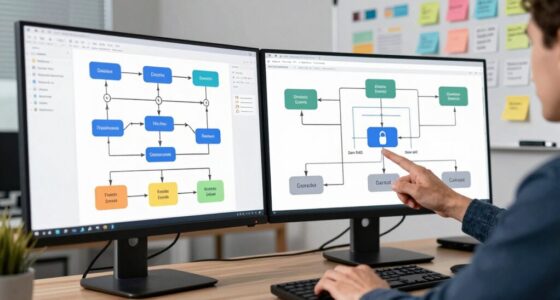

To evaluate risks of admin access in support contracts, start by examining the scope of privileges given to vendors and their potential impact if compromised. Check if access is limited to essentials and if strong authentication, like MFA, is enforced. Review contract terms for clear access termination procedures and security controls. Keep an eye on how vendor activities are monitored and whether accounts are regularly reviewed or rotated. Understanding these factors helps you gauge vulnerabilities—exploring more ensures you can tighten your security effectively.
Key Takeaways
- Assess whether support contracts specify strict access controls, privilege levels, and credential management policies.
- Verify if contractual clauses include procedures for timely access revocation and offboarding.
- Evaluate the scope of admin rights granted to third parties and ensure they’re aligned with minimal necessary permissions.
- Check for provisions requiring continuous monitoring, activity logging, and session recording of privileged accounts.
- Confirm that vendor risk assessments address third-party admin access and enforce compliance with security standards.

Have you ever considered how excessive admin access in support contracts can substantially elevate your organization’s security risks? When vendors, contractors, or third-party service providers are granted broad administrative privileges, you’re opening the door to potential breaches. These accounts often carry more rights than necessary, creating large attack surfaces that cybercriminals can exploit. For instance, local admin rights are a top attack vector, and overprovisioned service accounts with domain or enterprise-wide access make lateral movement during a breach much easier. Static credentials for privileged accounts, which are rarely rotated or expire, further heighten your vulnerability. If a credential is stolen, it’s a matter of time before it’s used maliciously.
Third-party involvement is a major contributor to cyber incidents, accounting for over half of recent breaches. When vendors have broad admin privileges, they become prime targets for social engineering or credential theft. Unfortunately, many contracts lack explicit security controls, retention limits, or procedures for revoking access once a vendor’s engagement ends. This often results in lingering admin credentials that can be exploited long after the contract has expired, increasing your organization’s exposure. External contractors operating outside your internal policies make continuous enforcement and monitoring difficult, creating gaps that adversaries can leverage.
Overprivileged vendor access often leads to lingering credentials and increased security vulnerabilities.
Monitoring these privileged accounts presents noteworthy challenges. Service accounts, often non-human, run in the background and lack clear ownership, making them difficult to track. Their activities blend with legitimate system operations, reducing the likelihood of detecting malicious activity promptly. Traditional audit logs and sparse monitoring mean that suspicious actions often go unnoticed, delaying incident response. Additionally, many organizations still rely on infrequent password updates—quarterly or annually—and some accounts have no expiration date at all. Old, unused accounts aren’t always deleted, leaving vulnerabilities open. Studies show that unmonitored privileged accounts are a significant weak point in many security frameworks.
Compliance is another critical concern. Excessive admin rights complicate adherence to regulations like GDPR, SOC 2, and ISO 27001. Failing to demonstrate proper privilege management can result in audit failures, regulatory penalties, or breach notification obligations. Weak privilege controls also increase the risk of missing contractual security obligations, which could lead to fines or legal liabilities.
To mitigate these risks, you need a strategic approach. Implement Privileged Access Management (PAM) tools to automate credential rotation, session recording, and access brokering. Apply least-privilege principles, granting only the necessary rights and using just-in-time privilege elevation. Enforce network-layer MFA for privileged sessions to add an extra layer of protection. Define clear vendor access policies with automated onboarding and offboarding processes, including time-bound access that’s easily revoked. Continuous monitoring, centralized logging, and regular reviews complete the picture, ensuring you detect anomalies early and maintain compliance. By tightening controls on admin access in support contracts, you considerably reduce your organization’s attack surface and safeguard your critical assets.
Frequently Asked Questions
How Can Organizations Detect Unauthorized Privileged Access in Vendor Environments?
You should implement continuous monitoring of vendor activities, focusing on privileged actions. Use automated tools to log and analyze session data, looking for anomalies like unusual login times or access patterns. Enforce strict access controls and MFA, and review activity reports regularly. Establish clear offboarding procedures to revoke permissions promptly, and conduct periodic audits to identify any unauthorized privileged access in vendor environments.
What Metrics Are Best for Measuring Privilege Overprovisioning Risks?
You should track metrics like the percentage of local admin accounts, frequency of privilege reviews, and the number of accounts with persistent logon rights. Don’t overlook overprovisioned accounts or static credentials, which increase risk. Regularly audit privilege levels against actual needs, monitor for orphaned or stale accounts, and measure how often privileged access is revoked or rotated. These metrics highlight overprovisioning and help reduce attack surfaces effectively.
How Often Should Privileged Access Reviews Be Conducted in Support Contracts?
You should conduct privileged access reviews at least quarterly to effectively mitigate risks. Regular reviews help you identify and revoke unnecessary privileges, reducing attack surfaces and preventing credential misuse. In high-risk environments, consider monthly reviews for tighter control. Consistent, scheduled audits guarantee compliance, improve security posture, and catch stale or orphaned accounts early. Automate review processes where possible to maintain accuracy and efficiency, keeping your support contracts secure and compliant.
What Are the Legal Implications of Inadequate Privilege Controls in Contracts?
Inadequate privilege controls can lead to serious legal consequences, especially since weak access management increases breach risks by up to 94%. If you neglect to include clear privilege policies, revocation procedures, or vendor access limits in contracts, you risk violating regulations like GDPR, SOC 2, or ISO 27001. This can result in hefty fines, contractual penalties, and damage to your reputation, making legal compliance essential for safeguarding your organization.
How Can Automated Tools Improve Privileged Account Lifecycle Management?
Automated tools streamline privileged account lifecycle management by automatically provisioning, rotating, and revoking access, reducing human error. You can set policies for just-in-time elevation and time-bound privileges, ensuring accounts don’t stay active longer than necessary. These tools also provide continuous monitoring and session recording, helping you detect suspicious activity quickly. With automation, you get consistent enforcement, better compliance, and less risk of orphaned or stale accounts, strengthening your security posture.
Conclusion
Steering admin access in support contracts is like walking a tightrope over a stormy sea—you must balance convenience with caution. By carefully evaluating the risks, you’re guiding your ship through treacherous waters, avoiding hidden icebergs that could sink your security. Remember, every decision you make is a lighthouse guiding your organization safely ashore. Stay vigilant, keep your defenses strong, and you’ll guarantee your digital voyage remains steady and secure amidst turbulent waves.