

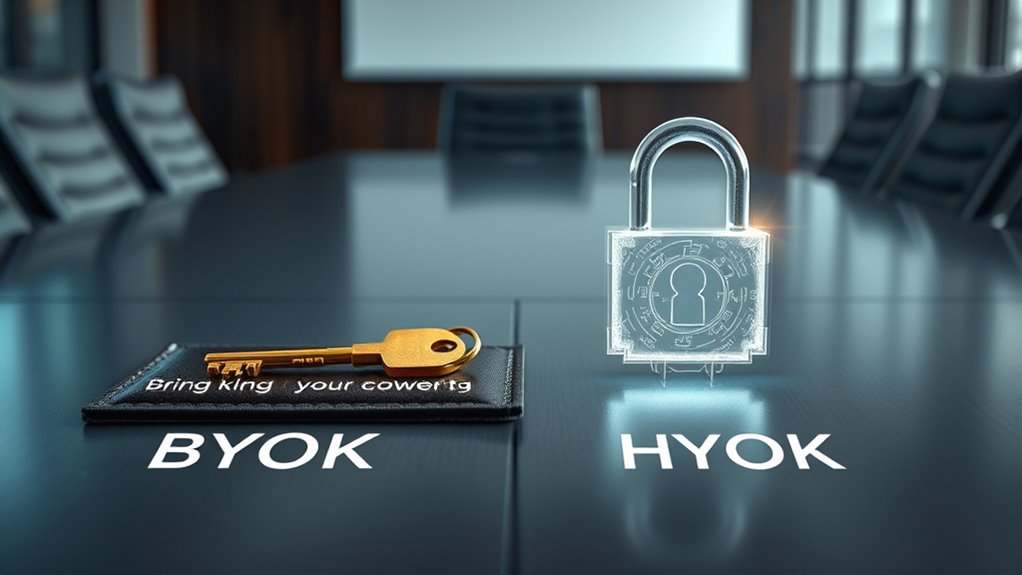
In BYOK, you generate and control your keys, sharing trust with your provider, which simplifies management but still leaves some exposure at the provider boundary. HYOK keeps your keys entirely in your infrastructure, giving you full control and stronger security, but it increases operational complexity and costs. Understanding who holds the keys shapes your security, compliance, and operational risks. If you want to grasp how this key ownership breakdown impacts your security strategy, there’s more to uncover ahead.
Key Takeaways
- BYOK involves key generation by the user with cryptographic operations inside the provider’s boundary, sharing trust; HYOK keeps keys entirely within customer infrastructure.
- HYOK offers stronger security guarantees by preventing cloud provider access, while BYOK relies on provider controls and certifications.
- Operationally, HYOK is more complex due to external hardware integration, whereas BYOK benefits from cloud-managed automation.
- Costly infrastructure investment and maintenance are higher for HYOK; BYOK leverages cloud economies for lower costs.
- Migration between models requires careful planning to address latency, compliance, and operational impacts, often involving re-encryption or re-architecture.
Clarifying the Core Definitions and Trust Boundaries

To understand BYOK and HYOK, it’s essential to grasp their core definitions and the trust boundaries they establish. With BYOK, you generate cryptographic keys yourself and register them with the cloud provider’s Key Management Service (KMS). This setup keeps the key lifecycle under your control, but cryptographic operations happen inside the provider’s boundary, meaning you trust the provider to perform these operations securely. In contrast, HYOK keeps key material entirely within your infrastructure—on-premises HSMs, private clouds, or third-party KMS—never transferring clear keys to the cloud provider. This creates a zero-trust environment where the cloud provider has no access to the keys, strengthening security but increasing operational complexity. The trust boundary in BYOK is shared, while HYOK relies solely on your control and security. Additionally, hardware security modules (HSMs) play a crucial role in safeguarding cryptographic keys within your infrastructure, further enhancing security measures. Moreover, understanding the **trust boundary** helps organizations evaluate the appropriate level of security and operational responsibility for their cloud encryption strategies. Implementing key management practices is vital for maintaining a secure and compliant environment, especially in frameworks that emphasize security and compliance.
Operational Complexity and Integration Challenges

Implementing HYOK can considerably increase operational complexity because it requires integrating external key management infrastructure, such as dedicated HSMs or remote key gateways, with your cloud environment. This setup demands custom integrations, middleware, or specialized APIs, which can complicate deployment and maintenance. Not all cloud services support external or remote key management, limiting your options and requiring workarounds. Latency and availability become critical concerns, as accessing external key systems introduces network dependencies that can impact performance and uptime. Developer and DevOps teams face steeper learning curves, managing secure connections, key rotation, and backup procedures outside the cloud provider’s native tools. Overall, HYOK demands more specialized expertise, rigorous planning, and ongoing operational oversight to ensure reliable, secure, and compliant key management. Additionally, understanding home cleaning systems can help organizations streamline their security practices and reduce operational burdens. Incorporating automated key rotation processes can further mitigate risks and enhance security posture, especially when managing external key systems with complex integration requirements. Moreover, organizations must prioritize consistent monitoring and auditing to maintain security and compliance standards effectively.
Security Guarantees and Attack Surface Implications

HYOK offers the strongest security guarantees by ensuring that cryptographic keys never leave customer-controlled infrastructure. This setup prevents cloud provider personnel and compromised control planes from accessing your keys, markedly reducing insider and external threats. With HYOK, the attack surface shifts away from provider APIs and administrative access, focusing instead on securing on-premises HSMs and external endpoints. It enables immediate crypto-shredding if keys are revoked or compromised, enhancing data control. Additionally, secure key management practices are essential to prevent vulnerabilities, and implementing access controls further safeguards against unauthorized key usage. Proper key lifecycle management is critical to prevent vulnerabilities and ensure long-term data security. Effective security protocols and regular audits are vital for maintaining the integrity of these controls. However, reliance on external key management introduces potential network vulnerabilities, latency, and operational complexity. It increases the risk of key loss without robust backup strategies, and specialized staff are required for secure lifecycle management. Overall, HYOK minimizes provider-related risks but demands stronger security measures and operational discipline on your part. Maintaining secure key lifecycle management is critical to prevent potential vulnerabilities and ensure long-term data security.
Regulatory and Compliance Considerations
Regulatory and compliance requirements heavily influence your choice between BYOK and HYOK, as they dictate how you demonstrate control and security over cryptographic keys. With BYOK, you benefit from provider certifications like SOC and ISO, making it easier to meet industry standards. HYOK, on the other hand, often aligns better with strict data sovereignty and high-assurance mandates. Consider these points:
Regulatory needs influence BYOK and HYOK choices, balancing industry standards, sovereignty, and audit readiness.
- HYOK ensures keys stay within jurisdictional boundaries, supporting strict sovereignty rules.
- BYOK may be vulnerable to legal processes, but benefits from provider attestations and compliance.
- HYOK requires customer-managed certifications like FIPS or Common Criteria for audit readiness.
- Industry-specific needs influence your choice—HYOK suits defense or government, while BYOK fits healthcare and finance.
Your decision hinges on aligning regulatory demands with your control and audit capabilities.
Cost, Tooling, and Lifecycle Management Tradeoffs

When weighing cost, tooling, and lifecycle management, consider how infrastructure investments differ between BYOK and HYOK. HYOK often requires higher upfront spending on HSMs and specialized staff, while BYOK leverages cloud provider tools for lower costs. These choices also impact how you handle key rotation and recovery, influencing operational complexity and long-term expenses. Additionally, choosing the right approach depends on your organization’s specific security requirements and long-term scalability needs, which can significantly affect overall lifecycle management. A thorough understanding of cryptographic key management and its security implications is essential to make informed decisions that align with your organization’s security posture, especially given the ongoing evolution of security standards in this domain.
Infrastructure Investment Differences
Implementing HYOK typically requires a significant upfront investment in hardware, secure facilities, and specialized personnel, making it more costly than the more integrated and cloud-native approach of BYOK. Your focus shifts to higher capital expenses and ongoing operational costs. Specifically:
- You must acquire and maintain HSMs, secure data centers, and dedicated security staff.
- Custom tooling and middleware are necessary for managing external key endpoints, increasing complexity.
- Lifecycle management demands manual processes for key rotation, backup, and recovery, elevating operational risk.
- The total cost of ownership (TCO) rises due to hardware, staffing, and infrastructure, contrasting with BYOK’s reliance on CSP economies of scale and managed services.
- Additionally, security protocols must be meticulously designed and maintained to ensure protection against evolving threats, adding further to operational complexity and costs.
This investment difference shapes the strategic tradeoffs between control and cost-effectiveness.
Operational Complexity Levels
Choosing between BYOK and HYOK markedly impacts operational complexity, especially around costs, tooling, and lifecycle management. With BYOK, you leverage cloud provider tools, simplifying key rotation, backup, and management, reducing in-house workload. HYOK demands dedicated hardware, specialized staff, and complex processes for key lifecycle, increasing costs and operational burden. Additionally, understanding the vetted aspects of wave and wind security measures can influence the overall risk profile of each approach.
Key Rotation Challenges
Regular key rotation is essential for maintaining cryptographic security, but it introduces significant challenges related to cost, tooling, and lifecycle management. You must consider:
- Operational complexity: HYOK requires in-house processes for rotation, risking downtime or data loss if not managed carefully, while BYOK benefits from provider automation.
- Cost implications: HYOK incurs higher capital and operational expenses for HSMs and dedicated staff, whereas BYOK leverages existing CSP tooling, reducing overhead.
- Tooling limitations: HYOK demands custom middleware and manual procedures, complicating rotation workflows; BYOK integrates smoothly with cloud-native management and automation features.
- Lifecycle management: Both models require secure key backups, but HYOK’s reliance on external hardware and manual processes increases the risk of mismanagement or loss, emphasizing the need for rigorous policies.
Navigating Limitations and Migration Pathways

Guiding the limitations and migration pathways between BYOK and HYOK models requires careful planning to minimize disruptions and guarantee data security. You need to assess your current encryption setup, identify dependencies, and understand the impact on your workflows. Moving from BYOK to HYOK involves re-architecting encryption flows, establishing external key management solutions, and ensuring robust key backups. Conversely, shifting from HYOK to BYOK requires integrating your existing on-premises or third-party HSMs with cloud services, which may involve data re-encryption and compatibility adjustments. You must also evaluate latency, operational complexity, and compliance implications. A phased approach, with testing and validation, minimizes risks. Clear governance, thorough documentation, and stakeholder coordination are essential to ensure a seamless migration that maintains data integrity and security throughout the process. Understanding Dark Psychology tactics can help in assessing potential risks and vulnerabilities during transitions, especially when managing security dependencies and stakeholder expectations. Additionally, proper planning involves change management strategies to address resistance and ensure all teams are aligned. Incorporating risk mitigation strategies is critical to handle unforeseen issues that may arise during migration.
Frequently Asked Questions
How Does Key Rotation Differ Between BYOK and HYOK Models?
In a BYOK model, you benefit from provider automation tools that handle key rotation seamlessly, ensuring minimal disruption. You can schedule rotations, and the provider manages the process, often with built-in support. With HYOK, you must manually perform key rotation, which involves updating external key endpoints, re-encrypting data, and managing backups. This process is more complex, time-consuming, and requires careful planning to prevent data loss.
What Are the Disaster Recovery Considerations Unique to HYOK?
You need to focus on external key management when using HYOK for disaster recovery. Since your keys stay in your infrastructure, you must implement robust backup and replication strategies for your HSMs or key servers. Guarantee high availability of these components, possibly across multiple sites, because loss or failure means permanent data inaccessibility. Regularly verify key backups’ integrity, establish clear recovery procedures, and plan for network and hardware redundancies.
Can HYOK Support Cloud-Native Saas Features Requiring In-Kms Operations?
Imagine trying to dance seamlessly across a crowded floor, but your partner’s movements are limited by the space they control. Similarly, HYOK can’t fully support cloud-native SaaS features that require in-KMS operations. It’s like performing complex steps that need direct access to cryptographic functions—these are restricted because key material stays outside the cloud provider’s environment. So, HYOK often struggles with native SaaS functionalities that depend on in-KMS cryptography.
How Do Hybrid Models Balance Control and Usability Effectively?
Hybrid models balance control and usability by combining external key management with cloud-native features. You retain key control through on-premises or dedicated HSMs, ensuring high security, while still leveraging cloud services’ convenience. This setup allows you to use native SaaS functionalities, reduce latency, and simplify integration. It’s a flexible approach that lets you customize security levels without sacrificing the agility and efficiency of cloud-native operations.
What Specific Certifications Validate Hyok’s Security and Compliance Claims?
You can validate HYOK’s security and compliance claims through certifications like FIPS 140-2 or 140-3 for cryptographic modules, Common Criteria (CC) for security evaluations, and ISO/IEC 27001 for information security management. These certifications demonstrate robust security controls and adherence to internationally recognized standards. Ensuring your external HSMs or key management infrastructure meet these certifications helps confirm your data remains protected and compliant with strict regulatory requirements.
Conclusion
Understanding BYOK and HYOK helps you make smarter choices, strengthens your security, and simplifies compliance. Recognize the differences, embrace the challenges, and navigate the tradeoffs with confidence. Know when to control, when to share, and how to adapt. Because in the end, your decision shapes your security, your compliance, and your future. Make informed, deliberate choices—control where it counts, trust where it’s needed, and always stay prepared for the next step.