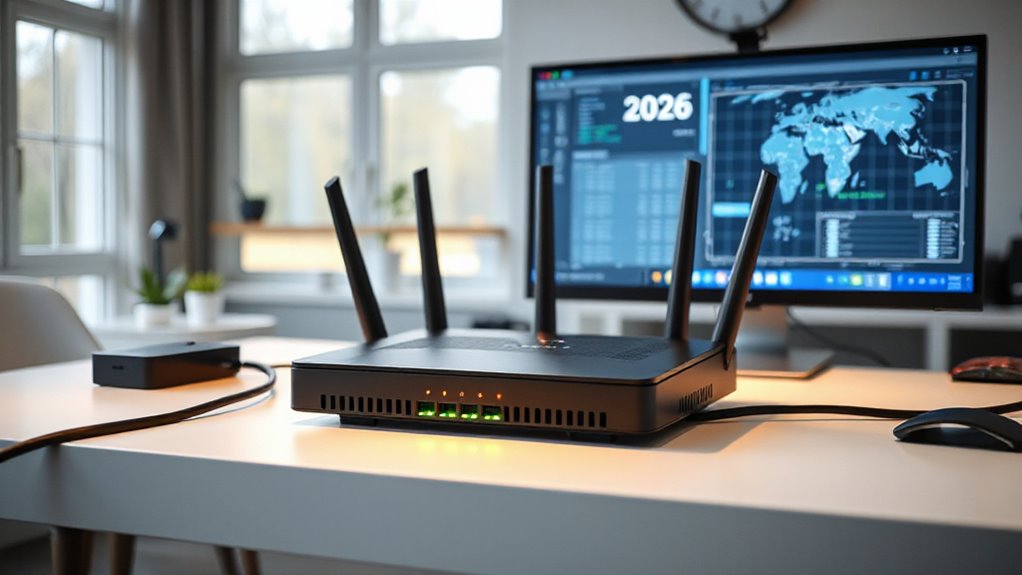

When searching for a router with built-in LTE failover, you need a device that combines reliable cellular backup with strong Wi-Fi performance. The Teltonika RUT241 stands out as the best overall pick thanks to its industrial-grade durability and stable LTE connectivity, ideal for critical applications. The Peplink MAX BR1 Pro offers advanced load balancing for high-demand setups, while the GL.iNet GL-XE3000 provides a versatile solution with dual SIMs and Wi-Fi 6 for smaller businesses or travel. All options come with tradeoffs: some excel in ruggedness, others in ease of use or speed. Keep reading for a detailed breakdown of each device and what suits your specific needs.

Get business pricing on networking and server gear
- Business-only prices and quantity discounts
- Tax-exempt purchasing
- Multiple users, one account, clear invoices
Key Takeaways
- The top picks excel in LTE stability, with Teltonika and Peplink leading in industrial and high-demand environments.
- Dual SIM support remains a key feature for redundancy, visible in models like GL-XE3000 and GL-X3000.
- Speed and Wi-Fi standards vary, with Wi-Fi 6 options offering future-proof performance at a premium.
- Build quality and durability are crucial for outdoor or remote deployments, favoring industrial-grade routers.
- Price varies widely; the best value models balance features with affordability, while premium options prioritize speed and robustness.
| Teltonika RUT241 4G LTE Industrial Cellular Router (US Version) |  | Best for Reliable Industrial LTE Failover | LTE Modem: LTE CAT4 (150 Mbps download / 50 Mbps upload) | Ethernet Ports: 2 x 10/100 Mbps | Wi-Fi Standard: 802.11b/g/n | VIEW ON AMAZON | See Our Full Breakdown |
| NETGEAR Nighthawk WiFi 7 Dual-Band Router (RS90) |  | Best for High-Speed Home Wi-Fi with Optional LTE Failover | WiFi Speed: up to 3.6 Gbps | Bands: Dual-Band (2.4 GHz + 5 GHz) | Coverage: up to 2,000 sq. ft. | VIEW ON AMAZON | See Our Full Breakdown |
| GL.iNet GL-XE3000 (Puli AX) 5G Router with Dual SIM, Wi-Fi 6, Built-in Battery, Multi-WAN, VPN, OpenWrt, Secure for Business |  | Best for Portable 5G Connectivity with Flexible Failover | Wi-Fi Speed: up to 574Mbps (2.4GHz) + 2402Mbps (5GHz) | Network Standards: 5G NSA and SA, 4G LTE | Dual SIM: Yes | VIEW ON AMAZON | See Our Full Breakdown |
| Peplink MAX BR1 Pro 5G (HW3) | X65 5G Modem with Redundant SIM Slots, Wi-Fi 6, GPS, PoE, Edge Computing, Load Balancing & Failover |  | Best for Rugged, High-Performance Industrial Failover | Modem: X65 5G | Max Downlink Speed: 4.1 Gbps | Max Uplink Speed: 900 Mbps | VIEW ON AMAZON | See Our Full Breakdown |
| Omada 4G+ Cat6 AX3000 Wi-Fi 6 Gigabit VPN Gateway with 4-Port PoE+ (ER706WP-4G) |  | Best for Centralized Network Management with LTE Failover | Wireless Standard: Wi-Fi 6 (AX3000) | Maximum Speed: 2402 Mbps on 5 GHz + 574 Mbps on 2.4 GHz | Ports: 4× Gigabit PoE+ Ports, 1× Gigabit SFP WAN/LAN | VIEW ON AMAZON | See Our Full Breakdown |
| MOFI6500-5GXeLTE-RM520-HP 4G LTE & 5G Dual SIM Cellular Router with Wi-Fi 6 |  | Best Overall for Business-Grade 4G LTE Failover | Connectivity: 4G LTE, 5G | SIM Support: Dual SIM with auto failover | Wi-Fi: Wi-Fi 6 with amplification | VIEW ON AMAZON | See Our Full Breakdown |
| GL.iNet GL-X3000 (Spitz AX) 5G Cellular Router with Wi-Fi 6, Dual-SIM, Detachable Antennas, OpenWrt Firmware |  | Best for Tech-Savvy Users and Remote Applications | Wi-Fi Speed: up to 574Mbps (2.4GHz) + 2402Mbps (5GHz) | Network Standards: 5G NSA/SA, 4G LTE, 3G | Dual-SIM: Yes | VIEW ON AMAZON | See Our Full Breakdown |
More Details on Our Top Picks
Teltonika RUT241 4G LTE Industrial Cellular Router (US Version)
The Teltonika RUT241 stands out for its robust, industrial-grade design combined with automatic LTE failover, making it ideal for remote or critical applications where uninterrupted connectivity is essential. Compared to the Peplink MAX BR1 Pro, it offers a more compact, cost-effective solution for IoT deployments, though it lacks the advanced edge computing features and rugged build of the Peplink. While the RUT241 supports LTE CAT4 with decent speeds and broad carrier certification, its Wi-Fi capabilities are limited to 802.11b/g/n, which may not meet the needs of modern high-bandwidth users. Its primary strength remains reliable remote management and broad compatibility, but setup requires some technical knowledge. This router is best suited for industrial, IoT, or M2M applications where failover is a priority over high Wi-Fi throughput.
Pros:- Reliable automatic LTE failover minimizes downtime
- Certified by major US carriers for broad compatibility
- Compact and rugged industrial design suitable for tough environments
- Excellent remote management features
Cons:- Limited Wi-Fi speed with 802.11b/g/n support
- Requires some technical knowledge for initial setup
Best for: Businesses needing dependable LTE failover for remote IoT or industrial environments
Not ideal for: Home users or small offices expecting high Wi-Fi speeds or simple setup
- LTE Modem:LTE CAT4 (150 Mbps download / 50 Mbps upload)
- Ethernet Ports:2 x 10/100 Mbps
- Wi-Fi Standard:802.11b/g/n
- Certification:Verizon, AT&T, T-Mobile
- Application:IoT and M2M solutions
Our verdict“This is an excellent choice for industrial or remote applications where LTE failover stability outweighs high-speed Wi-Fi needs.”
NETGEAR Nighthawk WiFi 7 Dual-Band Router (RS90)
The NETGEAR Nighthawk RS90 makes a compelling choice for large households or high-demand streaming environments, offering WiFi 7 speeds up to 3.6 Gbps and wide coverage. Although it requires a separate modem, its support for multiple devices and Wi-Fi 7’s advanced features make it ideal for bandwidth-heavy tasks. Unlike the Peplink MAX BR1 Pro, it doesn’t have built-in LTE failover, but it can be paired with a portable LTE device for backup. The dual-band setup and smart connect feature optimize device distribution, yet performance can vary based on home layout and interference. This router suits those who primarily want premium Wi-Fi performance and are willing to add third-party LTE solutions for failover.
Pros:- Supports Wi-Fi 7 with blazing fast speeds
- Large coverage area up to 2,000 sq. ft.
- Supports multiple devices with smart connect
- Enhanced security with WPA3 and NETGEAR Armor
Cons:- Requires a separate modem for internet access
- Performance depends heavily on home layout and interference
Best for: Homeowners or professionals seeking fast Wi-Fi with flexible LTE backup options
Not ideal for: Businesses requiring integrated LTE failover or rugged industrial use
- WiFi Speed:up to 3.6 Gbps
- Bands:Dual-Band (2.4 GHz + 5 GHz)
- Coverage:up to 2,000 sq. ft.
- Number of Devices:50
- Ethernet Ports:1x 2.5 Gig WAN, 4x Gigabit LAN
- Processor:Quad-core 2.0 GHz
Our verdict“Best for users wanting top-tier Wi-Fi performance with the flexibility to add LTE failover separately.”
GL.iNet GL-XE3000 (Puli AX) 5G Router with Dual SIM, Wi-Fi 6, Built-in Battery, Multi-WAN, VPN, OpenWrt, Secure for Business
The GL.iNet GL-XE3000 excels in mobility, offering 5G support, Wi-Fi 6, dual SIM slots, and a built-in 6400mAh battery, making it ideal for remote work, field events, or mobile offices. Compared to the Peplink MAX BR1 Pro, it offers greater portability and customization via OpenWrt, but it lacks the rugged build and advanced diagnostics of industrial routers. Its multi-WAN options include Ethernet, cellular, and tethering, providing flexible failover, though real-world speeds depend heavily on network conditions. The dual SIM slots enable load balancing, but cellular support may be restricted in some countries, and the device’s complexity might be daunting for less technical users. This makes it suitable for users who need portable, high-speed cellular connectivity combined with flexible failover options.
Pros:- Supports fast 5G and Wi-Fi 6 for high-speed connectivity
- Built-in 6400mAh battery provides hours of portable use
- Flexible multi-WAN options including cellular and tethering
- OpenWrt firmware allows extensive customization
Cons:- Cellular capabilities may be limited in some regions
- Setup and configuration can be complex for novices
- Potentially higher cost due to advanced features
Best for: Remote workers or field teams needing portable, high-speed LTE failover with VPN support
Not ideal for: Users needing a simple home router with plug-and-play setup or for stationary use
- Wi-Fi Speed:up to 574Mbps (2.4GHz) + 2402Mbps (5GHz)
- Network Standards:5G NSA and SA, 4G LTE
- Dual SIM:Yes
- Battery Capacity:6400mAh
- Battery Life:up to 8 hours
- VPN Support:OpenVPN, WireGuard
Our verdict“Ideal for mobile professionals needing reliable LTE failover and high-speed connectivity on the go.”
Peplink MAX BR1 Pro 5G (HW3) | X65 5G Modem with Redundant SIM Slots, Wi-Fi 6, GPS, PoE, Edge Computing, Load Balancing & Failover
The Peplink MAX BR1 Pro 5G is designed for demanding environments where stability and speed are paramount, supporting 5G speeds up to 4.1 Gbps and featuring dual SIM slots with carrier redundancy. Its rugged certification and support for edge computing make it a clear choice for remote sites, vehicles, and industrial settings. While it offers a comprehensive suite of features including load balancing, GPS, and PoE, its setup is more complex, and the device’s bulkier size limits portability. Compared to the Teltonika RUT241, it provides higher throughput, advanced diagnostics, and more robust construction, at a significantly higher price point. This router is best suited for professionals requiring industrial-grade reliability with integrated LTE failover and high-speed data transfer.
Pros:- Supports ultra-fast 5G speeds up to 4.1 Gbps
- Rugged design ensures durability in tough environments
- Supports load balancing and multiple carrier SIMs for redundancy
- Includes GPS and edge computing capabilities
Cons:- Setup can be complex and require technical expertise
- High price and bulkier form factor limit portability
Best for: Industrial, vehicular, or remote site operators needing rugged LTE failover with high throughput
Not ideal for: Home or small office users seeking simple plug-and-play solutions
- Modem:X65 5G
- Max Downlink Speed:4.1 Gbps
- Max Uplink Speed:900 Mbps
- Wi-Fi:Wi-Fi 6 2×2 MU-MIMO
- Power Input:PoE
- Certifications:Railway-grade shock, vibration, fire
Our verdict“This is the best choice for industrial or remote applications demanding rugged reliability and high-speed LTE failover.”
Omada 4G+ Cat6 AX3000 Wi-Fi 6 Gigabit VPN Gateway with 4-Port PoE+ (ER706WP-4G)
The Omada ER706WP-4G offers a balanced mix of high-speed Wi-Fi 6 and LTE failover, making it ideal for small to medium-sized businesses seeking centralized control. Its dual Nano SIM slots support LTE Cat6, providing reliable backup for primary broadband, comparable in failover functionality to the Teltonika RUT241 but with added emphasis on network management. Unlike the NETGEAR RS90, it emphasizes security and PoE flexibility, suitable for deployments requiring multiple wired and wireless connections. The setup can be intricate, especially with VPN and cloud management, but once configured, it offers robust, scalable network control. This device suits business environments prioritizing security, PoE-powered devices, and LTE redundancy in a manageable package.
Pros:- Supports Wi-Fi 6 with high throughput
- Dual Nano SIM slots enable LTE failover and load balancing
- PoE+ ports support versatile device deployment
- Centralized cloud management simplifies control
Cons:- Setup complexity may challenge less technical users
- Limited security details in product description
Best for: Small to medium businesses needing centralized LTE failover with advanced network management
Not ideal for: Home users or those wanting plug-and-play simplicity without extensive configuration
- Wireless Standard:Wi-Fi 6 (AX3000)
- Maximum Speed:2402 Mbps on 5 GHz + 574 Mbps on 2.4 GHz
- Ports:4× Gigabit PoE+ Ports, 1× Gigabit SFP WAN/LAN
- SIM Slots:2× Nano SIM
- VPN Support:IPSec, PPTP, L2TP, OpenVPN, WireGuard
- Management:Cloud via Omada App/Web
Our verdict“A strong choice for SMBs requiring reliable LTE failover combined with scalable, managed Wi-Fi solutions.”
MOFI6500-5GXeLTE-RM520-HP 4G LTE & 5G Dual SIM Cellular Router with Wi-Fi 6
This router excels at delivering high-speed connectivity with support for both 4G LTE and 5G networks, making it ideal for environments where maximum speed and reliability are critical. Its dual SIM capability with automatic failover ensures seamless connection continuity, outperforming simpler 4G-only options like the GL.iNet GL-X3000 in terms of network redundancy. The inclusion of Wi-Fi 6 with amplification broadens coverage, especially useful in larger or complex spaces. However, its complex setup and business-oriented features may overwhelm casual users or small home setups. Compared to the GL.iNet, it offers more robust security and enterprise features but at the cost of ease of use, making it less suitable for non-technical consumers or small offices without dedicated IT support.
Pros:- Supports high-speed 4G LTE and 5G networks for maximum flexibility
- Dual SIM with automatic failover for seamless connectivity
- Wi-Fi 6 with amplification extends coverage in large spaces
- Durable metal construction suitable for professional environments
Cons:- Setup process can be technically demanding
- Primarily designed for business use, overkill for casual users
Best for: IT managers or small business owners needing reliable 4G/5G failover with enterprise security
Not ideal for: Casual home users or those seeking simple plug-and-play solutions due to its complex setup and business focus
- Connectivity:4G LTE, 5G
- SIM Support:Dual SIM with auto failover
- Wi-Fi:Wi-Fi 6 with amplification
- Construction:Metal case with detachable antennas
- Features:VPN compatibility, IP pass-through, band lock, Zerotier certified
Our verdict“This router is best suited for organizations that require high-speed, reliable cellular failover with advanced security features.”
GL.iNet GL-X3000 (Spitz AX) 5G Cellular Router with Wi-Fi 6, Dual-SIM, Detachable Antennas, OpenWrt Firmware
Compared with the MOFI6500, the GL.iNet GL-X3000 offers a more flexible and customizable experience through OpenWrt firmware, appealing to advanced users who want control over their network. Its support for fast 5G, Wi-Fi 6, and dual-SIM with automatic failover ensures reliable connectivity for remote work, RV trips, or mobile setups. The detachable antennas provide signal tuning options, but the setup complexity and firmware customization may deter non-technical users. Unlike the enterprise-focused MOFI, this model emphasizes versatility and open-source flexibility, making it ideal for users comfortable with advanced configuration and seeking a portable 5G failover solution.
Pros:- Supports fast 5G NSA/SA and Wi-Fi 6 for high-speed connectivity
- Dual-SIM with automatic failover enhances reliability
- OpenWrt firmware allows advanced customization
- Detachable antennas improve signal flexibility
Cons:- Requires technical knowledge for setup and configuration
- Cellular feature availability varies by country and may need additional eSIM purchase
Best for: Tech-savvy consumers, remote workers, or network enthusiasts wanting customizable failover options
Not ideal for: Users seeking straightforward, plug-and-play devices or those unfamiliar with networking configurations
- Wi-Fi Speed:up to 574Mbps (2.4GHz) + 2402Mbps (5GHz)
- Network Standards:5G NSA/SA, 4G LTE, 3G
- Dual-SIM:Yes
- Firmware:OpenWrt v21.02
- Antennas:6 detachable
- Maximum Data Rate:3000 Mbps
Our verdict“This router is ideal for experienced users who want a customizable, high-speed 4G/5G failover device with advanced networking features.”

How We Picked
These products were evaluated based on their LTE failover reliability, ease of setup, build quality, and feature set. Performance in real-world conditions, like speed stability and cellular redundancy, played a central role. We also considered versatility, such as support for dual SIMs or multi-WAN configurations, which enhance failover capabilities. Cost-effectiveness was another factor, ensuring that the recommended devices provide good value for their intended use. The ranking reflects a balance between these criteria, prioritizing models suitable for various scenarios—from industrial use to small business setups.
Factors to Consider When Choosing Router With Built In Lte Failover
Choosing the right router with built-in LTE failover requires careful attention to several key factors. Understanding these can help you avoid common pitfalls and select a device that truly meets your needs, whether for home, business, or remote deployment.Coverage and Cellular Compatibility
Ensure the router supports the LTE bands used by your cellular provider. Some devices are locked to specific regions or carriers, which can limit performance or connectivity. Consider whether the router offers dual SIM slots for redundancy or load balancing, especially if uptime is critical. Also, check if it supports 4G LTE or 5G, depending on your speed requirements and future-proofing needs.
Failover and Redundancy Features
Look for routers with automatic failover capabilities that seamlessly switch between wired and cellular connections without downtime. Multi-WAN support can enhance reliability, especially if you need to combine broadband and LTE. Some models include load balancing, which distributes traffic across multiple networks, improving speed and stability during outages or congestion.
Speed and Network Standards
Evaluate the Wi-Fi standards supported—Wi-Fi 6 offers faster speeds and better capacity, suitable for high-demand environments. For LTE, check the maximum download and upload speeds supported, as well as the cellular module’s carrier aggregation capabilities. Faster speeds can justify higher prices but are essential if your work depends on high bandwidth.
Build Quality and Durability
If your setup involves outdoor or rugged environments, prioritize industrial-grade routers with weatherproof features and robust construction. The durability of the device impacts long-term reliability, especially in remote locations. For indoor or temporary setups, consumer-grade models may suffice but often lack the same resilience.
Price and Total Cost of Ownership
Investing in a router with LTE failover can vary significantly in cost. Balance the initial purchase price with ongoing expenses like SIM plans or firmware upgrades. High-end models may offer advanced features like VPN, OpenWrt support, and GPS, which add value but also increase cost. Consider your actual needs to avoid overpaying for features you won’t use.
Frequently Asked Questions
Will a router with LTE failover work with my existing cellular plan?
Most routers with built-in LTE are compatible with standard cellular plans, but it’s essential to verify supported LTE bands and carrier compatibility. Some devices are locked to specific carriers, while others are unlocked for use with any provider. Always check the device specifications against your carrier’s network to ensure full functionality and optimal speeds.
Can I set up LTE failover without technical expertise?
Many modern routers aim to be user-friendly, offering straightforward web interfaces and mobile app management. However, configuring multi-WAN or load balancing features might require some networking knowledge. If ease of setup is a priority, look for devices known for their intuitive interfaces and clear documentation, like the GL.iNet series or NETGEAR Nighthawk.
Is 5G support necessary for LTE failover, or is 4G sufficient?
While 4G LTE is still sufficient for most backup needs, 5G support provides higher speeds and lower latency, useful if your primary internet relies heavily on cellular data. However, 5G modules tend to be more expensive, and coverage is still expanding. For most backup scenarios, a solid 4G LTE device delivers reliable performance without the premium price tag.
How does dual SIM support improve LTE failover?
Dual SIM support allows the router to automatically switch between two cellular providers if one encounters issues, enhancing redundancy and uptime. This feature is especially valuable in remote areas or for critical applications where continuous internet access is essential. It also provides flexibility to compare carrier performance and switch plans without replacing hardware.
What is the typical lifespan of a router with LTE failover capabilities?
The lifespan of these routers varies based on build quality, usage, and environment. Industrial-grade models like the Teltonika RUT241 often last longer due to rugged construction, potentially exceeding 5 years with proper maintenance. Consumer or small business models may need replacement sooner, especially if used in harsh conditions or with frequent firmware updates. Regular updates and proper environmental placement extend device longevity.
Conclusion
If you need a reliable, all-around solution for critical connectivity, the Teltonika RUT241 offers exceptional durability and LTE stability for industrial or remote use. For small businesses or home offices seeking high-speed backup, the NETGEAR Nighthawk WiFi 7 balances speed with ease of use at a reasonable price. If your priority is advanced features like load balancing and multi-WAN, the Peplink MAX BR1 Pro makes a compelling choice. Budget-conscious buyers should consider the GL.iNet GL-XE3000 for its flexibility and dual SIM support. Ultimately, your selection depends on your environment, speed needs, and budget—choose the device that aligns most closely with your specific use case.
Halloween Picks
halloween
As an affiliate, we earn on qualifying purchases.