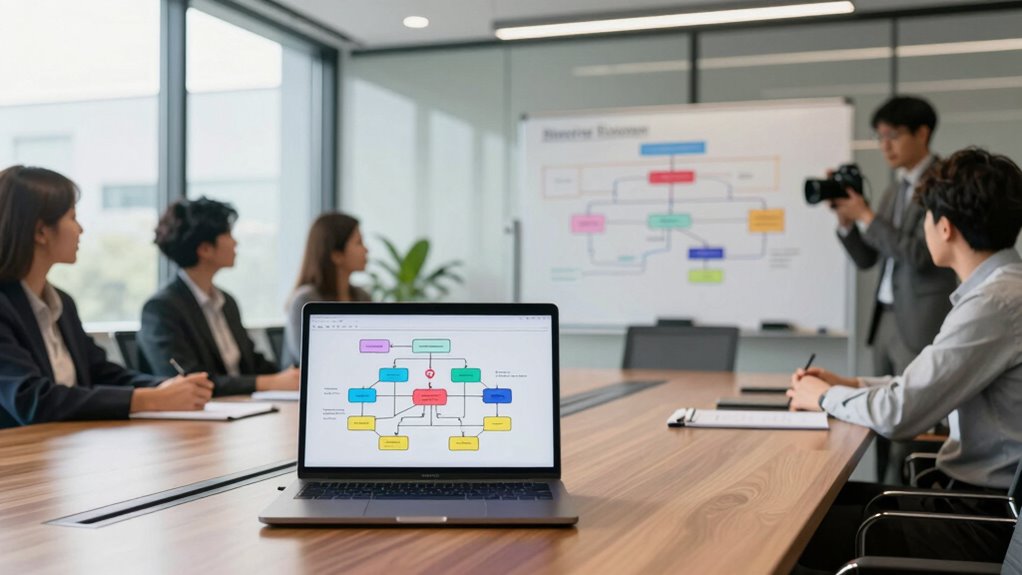

Event-Driven Architecture (EDA) is a way to design systems that react instantly to real-world events. Instead of traditional request-response communication, components produce, detect, and respond to events asynchronously. This approach allows for greater flexibility, scalability, and responsiveness, making it ideal for dynamic applications. If you want to understand how EDA enables systems to operate efficiently and adapt quickly, exploring further will give you deeper insights.
Key Takeaways
- EDA focuses on systems reacting to real-world events with asynchronous, loosely coupled components.
- Producers generate events, which are routed via brokers to interested consumers without direct requests.
- Events contain metadata and data payloads, enabling standardized communication across systems.
- Advantages include scalability, responsiveness, flexibility, and fault isolation; challenges involve complexity and consistency.
- It emphasizes real-time processing and decoupled system design over hype, providing practical, resilient architecture.

Have you ever wondered how modern systems respond instantly to real-world events? That’s the essence of event-driven architecture (EDA), a design paradigm where components communicate by producing, detecting, and reacting to events rather than relying on synchronous request-response interactions. Instead of tightly coupled processes, EDA promotes loose coupling, allowing systems to operate independently and scale efficiently. You’ll find EDA used in applications that demand real-time responsiveness, scalability, and flexibility.
Event-driven architecture enables systems to react instantly to real-world events with loose coupling and scalable responsiveness.
In EDA, the core components include event producers, event consumers, and event channels or brokers. Event producers generate and publish events representing significant state changes or actions. These might be sensors detecting a change, user interactions, or system alerts. Event consumers subscribe to relevant events and process them asynchronously, enabling the system to react without blocking other operations. Event brokers or buses act as middleware, routing, filtering, and delivering events to interested consumers, ensuring that messages reach the right destination. Event channels serve as messaging backbones, standardizing how events are transported across the system.
The structure of an event typically consists of a header and a payload. The header contains metadata like the event’s name, timestamp, and type, providing context for processing. The payload describes the specific state change or fact that occurred, without embedding reaction logic. Producers standardize data into this format, ensuring that diverse sources can communicate seamlessly. Events represent meaningful temporal states or facts sensed by producers, and brokers handle their distribution, ensuring they reach the appropriate consumers. This standardized format facilitates interoperability across diverse systems. Additionally, designing robust event schemas**** is crucial for maintaining compatibility and clarity as the system evolves.
Events flow through queues where clients send them to mediators before they’re processed. Stream processing components inspect, correlate, and filter events in real time, detecting patterns or anomalies. Complex event processing merges multiple events, enabling rapid decision-making or automated responses. Downstream activities include launching services, updating data stores, or notifying users. This flow allows systems to handle large volumes of events asynchronously, improving responsiveness and scalability.
Using EDA offers several advantages. It enables systems to scale independently because components can process events in parallel. Responsiveness improves as events are delivered and handled in near real time. The architecture also facilitates flexibility—adding new consumers doesn’t disrupt existing producers. Fault isolation becomes easier because transient failures in consumers don’t block event production, thanks to event queues. Additionally, storing events enhances operational visibility, allowing for debugging, auditing, and replaying past data.
However, implementing EDA isn’t without challenges. Ensuring correct event ordering and consistency across distributed consumers can be complex. The infrastructure—brokers, stream processors, monitoring tools—adds operational overhead. Designing stable, evolving schemas for events requires careful planning, and asynchronous flows can make tracing errors more difficult. Data duplication and eventual consistency issues may also arise, necessitating resilient application logic. To succeed, you should define clear event schemas, design idempotent consumers, choose appropriate technology, and prioritize observability to maintain a reliable, scalable system.
Learning Domain-Driven Design: Aligning Software Architecture and Business Strategy
As an affiliate, we earn on qualifying purchases.
As an affiliate, we earn on qualifying purchases.
Frequently Asked Questions
How Does EDA Compare to Traditional Request/Response Architectures?
You’ll find that EDA offers more flexibility and scalability compared to traditional request/response architectures. Instead of waiting for a direct reply, systems react asynchronously to events, enabling faster responses and better handling of high loads. This loose coupling allows you to add or update components without disrupting others. While request/response is straightforward and easier to debug, EDA excels in real-time responsiveness, fault tolerance, and supporting complex, distributed systems.
What Are the Best Tools for Implementing Event Brokers?
Imagine a busy marketplace with stall owners passing messages seamlessly; that’s what good event brokers do. You should consider tools like Apache Kafka, known for high throughput and durability, or RabbitMQ for flexible messaging and ease of use. AWS EventBridge offers cloud-native integration, while Azure Event Grid simplifies event routing in Microsoft environments. These tools help you build scalable, reliable, and decoupled event-driven systems efficiently.
How Do I Handle Event Schema Evolution Safely?
To handle event schema evolution safely, you should define clear schema versioning rules and maintain backward compatibility. Use schema registries to enforce schemas and validate messages. Implement field deprecation strategies and promote schema evolution practices like adding optional fields first. Test schema changes thoroughly with consumers. Additionally, communicate updates with your teams and document changes to guarantee smooth shifts, minimizing disruptions and data inconsistencies.
What Strategies Ensure Event Ordering Across Distributed Systems?
Imagine a well-choreographed dance where every step must follow the rhythm. To guarantee event ordering across distributed systems, you should use partition keys that keep related events on the same “dance floor,” preserving sequence. Implement sequence numbers within events, like a dance card, to track order. Additionally, employ idempotent consumers and leverage message brokers that guarantee ordered delivery, ensuring your system’s performance stays in perfect sync.
How Can I Improve Observability in an Event-Driven System?
To improve observability in your event-driven system, implement thorough tracing, metrics, and logging. Use distributed tracing tools to follow event flows across components, and monitor key performance indicators like latency and throughput. guarantee events are logged with detailed metadata for debugging and analysis. Incorporate alerting on anomalies, and maintain a centralized dashboard for real-time visibility. Regularly review logs and metrics to identify issues and optimize system performance effectively.
![WavePad Audio Editing Software - Professional Audio and Music Editor for Anyone [Download]](https://m.media-amazon.com/images/I/B1fcLEGCs6S._SL500_.png)
WavePad Audio Editing Software – Professional Audio and Music Editor for Anyone [Download]
Full-featured professional audio and music editor that lets you record and edit music, voice and other audio recordings
As an affiliate, we earn on qualifying purchases.
As an affiliate, we earn on qualifying purchases.
Conclusion
Think of event-driven architecture as the heartbeat of modern systems, pulsing with every actionable moment. It keeps your applications lively and responsive, like a well-choreographed dance where each step is triggered seamlessly. By understanding its core, you’re holding the conductor’s baton, guiding your tech symphony with precision and purpose. Embrace this approach, and watch your systems breathe, adapt, and thrive — turning complexity into a graceful, rhythmic flow.

Kafka for Architects: Event-driven architecture, logs, microservices, real-time event processing
As an affiliate, we earn on qualifying purchases.
As an affiliate, we earn on qualifying purchases.
Kafka for Architects: Event-driven architecture, logs, microservices, real-time event processing
As an affiliate, we earn on qualifying purchases.
As an affiliate, we earn on qualifying purchases.