
TL;DR

Get business pricing on networking and server gear
- Business-only prices and quantity discounts
- Tax-exempt purchasing
- Multiple users, one account, clear invoices
TIME named Qunnect’s Qu-MEM to its 2026 Best Inventions list in the Experimental category. The room-temperature quantum memory grew from patented Stony Brook University research and is being deployed on quantum-networking testbeds in New York and Europe; its selection does not establish that it is already used in commercial networks at scale.
TIME has named Qu-MEM, a room-temperature quantum memory developed by Qunnect from patented Stony Brook University research, to its Best Inventions of 2026 list. The device was recognized in the Experimental category, which the source describes as covering concepts and prototypes with future potential, drawing attention to a technology being tested for use in quantum networks.
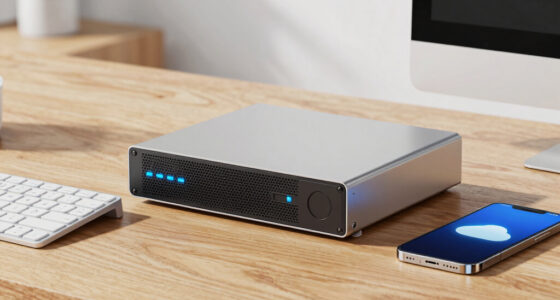
Qu-MEM is an on-demand quantum memory using warm vapor and neutral atoms, according to the source report and university announcement. It is designed to store and retrieve quantum information and fit into a standard server rack. Its developers say it is intended to work with existing fiber-optic infrastructure, a design that could help connect quantum devices over networks without requiring an entirely separate fiber system.
The technology originated in research led by Stony Brook physicist Eden Figueroa with former graduate students Mehdi Namazi and Mael Flament. Stony Brook licensed its patented technology to Qunnect, which commercialized the device. Figueroa co-founded the company with Namazi and Flament; the source identifies Namazi as Qunnect’s chief science officer and Flament as its chief technology officer.
The report says Qu-MEM systems are being deployed on quantum-networking testbeds across New York City, Long Island and Europe, and describes integration with the New York State Quantum Internet Testbed. That program includes Brookhaven National Laboratory, SUNY institutions and private universities. The supplied material does not provide deployment counts, performance measurements or independent technical evaluations.
A Memory Component for Quantum Networks
Quantum memories are intended to store quantum information and make it available later, rather than requiring a signal to pass directly from one point to another. In a network, that function could support coordination between distant quantum devices. The developers’ focus on room-temperature operation and compatibility with fiber infrastructure addresses two practical concerns for deploying such systems beyond specialized laboratory settings.
The recognition also highlights a route from university research to a commercial product: Stony Brook developed and patented the underlying technology, then licensed it to Qunnect. That pathway matters to research institutions and regional technology ecosystems, while the testbed deployments offer settings in which the device can be evaluated as part of a larger network.
Still, TIME’s selection is recognition, not evidence that a scalable quantum internet is already operating. The source materials describe testbed use and future potential; they do not establish broad commercial adoption or quantify how much Qu-MEM improves network performance.
As an affiliate, we earn on qualifying purchases.
From Stony Brook Lab to Testbeds
The device grew from work at Stony Brook led by Figueroa and his graduate researchers. According to the university announcement, the research was patented and licensed to Qunnect, linking the academic work to the company’s product. The source describes Qu-MEM as a commercial device, while TIME’s Experimental category signals that the award list also recognizes inventions whose wider potential is still developing.
The network effort cited by the university includes the New York State Quantum Internet Testbed and Stony Brook’s SCY-QNET. The university says its network communicates quantum information using entangled photons and has plans to expand it. Those descriptions are institutional claims; the material supplied does not provide independent verification of rankings such as “largest” or detailed measures of the network’s current reach.
Quantum networking research uses properties such as photon entanglement to connect devices and transmit information. Researchers see potential applications in secure communications, but the source does not report that Qu-MEM itself has demonstrated a particular security outcome or that it is protecting sensitive data in operational healthcare, finance or defense systems.
““Quantum memory is what turns theoretical concepts like ‘spooky action at a distance’ into practical, long-distance technology.””
— Eden Figueroa, Stony Brook professor and Qunnect co-founder
As an affiliate, we earn on qualifying purchases.
Performance and Scale Remain Open
The source materials do not report Qu-MEM’s storage duration, retrieval efficiency, error rates or operating capacity, nor do they give the number of devices installed at the named testbeds. They also do not specify what technical criteria TIME used to select the invention beyond identifying the Experimental category.
It remains unclear when or whether testbed deployments will lead to routine commercial use at larger scale. Claims in the university announcement about the device’s market status and the network’s size are not accompanied in the supplied material by independent comparisons or supporting measurements. The stated potential for secure communications should not be read as proof of a particular security benefit in deployed systems.
fiber optic quantum network components
As an affiliate, we earn on qualifying purchases.
As an affiliate, we earn on qualifying purchases.
Testbed Expansion and Evaluation
The immediate next step described in the source is continued deployment and testing on quantum-networking testbeds in New York and Europe. The university says it plans to extend its network beyond its current footprint, first toward upstate New York and later more broadly, but the supplied announcement gives no schedule, funding details or specific construction milestones.
Further reporting will be needed to establish how Qu-MEM performs in operating networks, how many systems are in use and whether the design can scale beyond testbeds. No additional TIME evaluation details or technical results were included in the source material.
quantum networking testbed equipment
As an affiliate, we earn on qualifying purchases.
As an affiliate, we earn on qualifying purchases.
Key Questions
What is Qu-MEM?
Qu-MEM is a quantum memory device developed by Qunnect from patented Stony Brook University research. The source describes it as an on-demand, warm-vapor system designed to store and retrieve quantum information.
Why did TIME recognize the device?
TIME included Qu-MEM in its Best Inventions of 2026 list in the Experimental category. The supplied report says that category recognizes concepts and prototypes showing future potential; it does not provide further selection criteria.
Where is Qu-MEM being tested?
The source says systems are being deployed on quantum-networking testbeds in New York City, Long Island and Europe, including work associated with the New York State Quantum Internet Testbed.
Does the TIME recognition mean Qu-MEM is widely used?
No. The available information describes testbed deployments, but gives no evidence of broad commercial adoption, deployment totals or performance results at scale.
Who developed the technology?
The underlying research was led by Stony Brook physicist Eden Figueroa with former graduate students Mehdi Namazi and Mael Flament. They later co-founded Qunnect, which commercialized the licensed technology.
Source: rss
Fall Picks
fall essentials
As an affiliate, we earn on qualifying purchases.