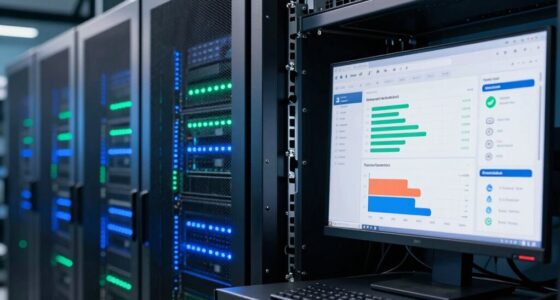
Implementing a smart storage tiering strategy helps you cut costs without disrupting workloads by automatically moving data to the most appropriate, cost-effective storage tiers based on access patterns and importance. Hot data stays on high-performance media like SSDs for speed, while cold data moves to cheaper options such as HDDs or cloud storage. This balance improves performance, reduces expenses, and supports workload stability. Keep exploring to learn how to optimize your data management for maximum efficiency.

Get business pricing on networking and server gear
- Business-only prices and quantity discounts
- Tax-exempt purchasing
- Multiple users, one account, clear invoices
Key Takeaways
- Implement automated data classification and policy-driven tiering to optimize storage placement and reduce costs.
- Prioritize hot data on high-performance media while migrating cold data to lower-cost storage tiers.
- Use tiering to extend the lifespan of aging devices by reallocating them to less critical, lower-cost tiers.
- Leverage real-time data movement based on usage patterns to prevent workload disruption.
- Integrate tiering with broader ILM strategies to ensure compliance, security, and cost efficiency.

Are you looking for a way to optimize your storage infrastructure? Storage tiering offers an intelligent approach by categorizing data into different tiers based on access patterns and characteristics. This method guarantees that hot data, which is accessed frequently, resides on high-performance media like SSDs, while cold data, accessed rarely, is stored on lower-cost options such as traditional HDDs or cloud storage. By matching data needs to the appropriate storage type, you can considerably improve performance and reduce costs simultaneously. Automated movement of data through policy-driven transfers makes this process seamless, adjusting data placement in real-time based on usage, age, or file type thresholds. This automation minimizes manual effort and guarantees your storage environment adapts dynamically, whether you operate on-premises, in hybrid setups, or in the cloud. It also aligns with broader data management strategies like Information Lifecycle Management (ILM), which emphasizes placing data where it adds the most value over its lifecycle. Data classification and tiering policies help ensure that data is stored optimally based on organizational priorities and compliance requirements.
The tier structure typically includes Tier 0 for mission-critical data on SSDs, Tier 1 for frequently accessed hot data, Tier 2 for warm data with moderate access, and Tier 3 for cooler data stored on lower-cost storage. Cold tiers serve as archival repositories for infrequently accessed or compliance-related data, often accounting for more than 70% of total data. By moving cold data to more affordable media, you can cut over 60% of storage costs, freeing up expensive resources for essential workloads. This strategy not only saves money but also extends the lifespan of aging devices by reusing them for lower tiers, avoiding unnecessary purchases. As a result, your ROI improves, and operational expenses decrease, especially in terms of licensing, maintenance, and capacity planning.
Performance benefits stem from placing hot data on fast media, which relieves the burden on high-performance tiers and enhances application speed. This setup allows your mission-critical systems to operate efficiently without being bogged down by low-value or infrequently accessed data. Additionally, reducing data volumes in primary tiers simplifies disaster recovery, enabling zero RTO scenarios, and enhances security by moving sensitive or compliance data offline. Managing data at scale becomes easier through systematic classification and lifecycle strategies, ensuring consistent adherence to policies. The overall result is a balanced environment where performance, cost, and compliance coexist, supporting your organization’s growth and operational resilience. Implementing best practices such as clear governance, continuous monitoring, and lifecycle considerations will maximize your storage investment and streamline your data management processes.
SSD storage drives for high performance
As an affiliate, we earn on qualifying purchases.
As an affiliate, we earn on qualifying purchases.
Frequently Asked Questions
How Is Data Classification Determined for Each Tier?
You determine data classification for each tier by analyzing access patterns, data age, and file types. You monitor how often data is accessed, how recently it was used, and its relevance to your workload. Based on this, you assign hot data to high-performance tiers like SSDs, warm data to mid-range tiers, and cold or archival data to lower-cost storage. Automated policies then move data accordingly, optimizing performance and costs seamlessly.
What Are the Risks of Automated Data Movement?
You risk data misclassification if automation relies solely on access patterns, potentially moving critical data to lower tiers, causing performance issues. If policies aren’t properly tuned, hot data might end up on slower storage, impacting workloads. Additionally, automation errors could lead to data loss or security breaches. To avoid these risks, regularly monitor and adjust policies, ensuring accurate classification and timely data movement aligned with your workload requirements.
How Does Tiering Impact Data Security and Compliance?
You might worry that tiering exposes sensitive data or complicates compliance, but careful policies can mitigate these risks. When you automate data movement, guarantee that security controls stay intact across all tiers, especially for cold or archived data. Regularly audit your classification and access permissions, and use encryption and robust monitoring. This way, you maintain security and compliance while benefiting from cost-effective storage tiering.
Can Storage Tiering Be Integrated With Existing Systems?
Yes, you can integrate storage tiering with your existing systems. You’ll want to assess your current infrastructure and verify compatibility with tiering policies. Use automation tools that support your storage environment to enable seamless data movement across tiers. By doing so, you’ll optimize performance and costs without disrupting your workflows, making the transition smooth and manageable. Proper planning and integration will maximize benefits while minimizing risks.
What Are the Best Practices for Setting Tiering Policies?
You should start by analyzing your data access patterns carefully. Set clear criteria for moving data between tiers based on frequency, age, or file type. Automate policy enforcement to guarantee real-time adjustments, and regularly review performance metrics. Keep thresholds flexible to adapt to changing workloads. Prioritize critical data for high-performance tiers and archive cold data cost-effectively. Consistent monitoring and fine-tuning help maximize savings without impacting workload performance.
enterprise HDDs for cold data storage
As an affiliate, we earn on qualifying purchases.
As an affiliate, we earn on qualifying purchases.
Conclusion
By adopting a thoughtful storage tiering strategy, you reduce costs, optimize performance, and enhance reliability. You prioritize data, categorize workloads, and automate shifts. You monitor, adjust, and refine your approach regularly. You balance speed with savings, flexibility with stability, and innovation with practicality. By doing so, you create a storage environment that’s efficient, resilient, and scalable—empowering your business to grow, adapt, and succeed without breaking a sweat.
cloud storage solutions for data tiering
As an affiliate, we earn on qualifying purchases.
As an affiliate, we earn on qualifying purchases.
automated data classification software
As an affiliate, we earn on qualifying purchases.
As an affiliate, we earn on qualifying purchases.
Halloween Picks
halloween
As an affiliate, we earn on qualifying purchases.