
TL;DR
Nvidia announced Rubin HPC on Nov. 16 at SC26, describing it as a GPU for scientific simulation, data processing and analytics that is expected in 2028. The company claims more than 50,000 CUDA cores per GPU and seventh-generation NVLink, but has not released key specifications or independent benchmark results.
Nvidia announced Rubin HPC at the SC26 supercomputing conference in Chicago on Nov. 16, describing it as a GPU for scientific simulation and data processing with more than 50,000 CUDA cores on a single chip. The accelerator is expected in 2028; Nvidia has not yet published performance benchmarks or several specifications needed to assess its cost and suitability for scientific computing.

Get business pricing on networking and server gear
- Business-only prices and quantity discounts
- Tax-exempt purchasing
- Multiple users, one account, clear invoices
The announcement appeared in a Nvidia blog post by Dan Ernst, senior director of supercomputing products. Nvidia said Rubin HPC is part of its Vera Rubin platform and is designed for science, engineering and analytics workflows. The company called the core count a record, but did not give an exact figure beyond more than 50,000 CUDA cores.
Nvidia also described a sparse data acceleration capability intended to keep the GPU’s cores supplied with data, alongside seventh-generation NVLink connections between GPUs. The post did not explain the sparse-data feature’s implementation or provide measured results showing how it affects performance. Nvidia’s current Vera Rubin platform uses sixth-generation NVLink, according to the company’s product information.
The announcement gives no figures for FP64 performance, memory capacity or bandwidth, power use, or price. Nvidia also did not name systems that will use Rubin HPC. Without those details or independent benchmarks, the core count alone cannot establish how quickly it will run scientific applications or how efficiently it will do so.
Simulation Speed for Research
Nvidia’s pitch centers on a research cycle in which an AI agent proposes a material, molecule or design, a simulation evaluates it, and researchers use the result to refine the next candidate. The company argues that faster simulation can shorten that cycle, potentially allowing more candidates to be evaluated before laboratory work or prototyping.
That could matter in fields such as climate modeling, engineering, genomics and financial risk analysis, where workloads combine large datasets with repeated calculations. But Nvidia has not supplied application-level results, so the announcement does not show how much faster Rubin HPC would make any particular task, or whether it would change research timelines in practice.
The missing specifications are central to the practical case. Scientific computing often depends on precision, memory and data movement as well as raw processing capacity. Until Nvidia releases details such as FP64 throughput, memory bandwidth and power consumption, researchers and computing centers cannot make a complete comparison with existing accelerators or estimate operating costs.
Products Worth Considering

Logitech MX Master 4 for Mac

Bose QuietComfort Ultra Earbuds (2nd Gen), Wireless Noise-Cancelling Earbuds, Black

Samsung Odyssey G55C 32-Inch QHD 1000R Curved Gaming Monitor
As an affiliate, we earn on qualifying purchases.
A New GPU in Vera Rubin
Rubin HPC is a new GPU within Nvidia’s Vera Rubin platform, announced during SC26, which runs in Chicago from Nov. 15 to 20, 2026. Nvidia’s blog post frames the chip around simulations and data processing for science and engineering, rather than focusing only on training or running AI models.
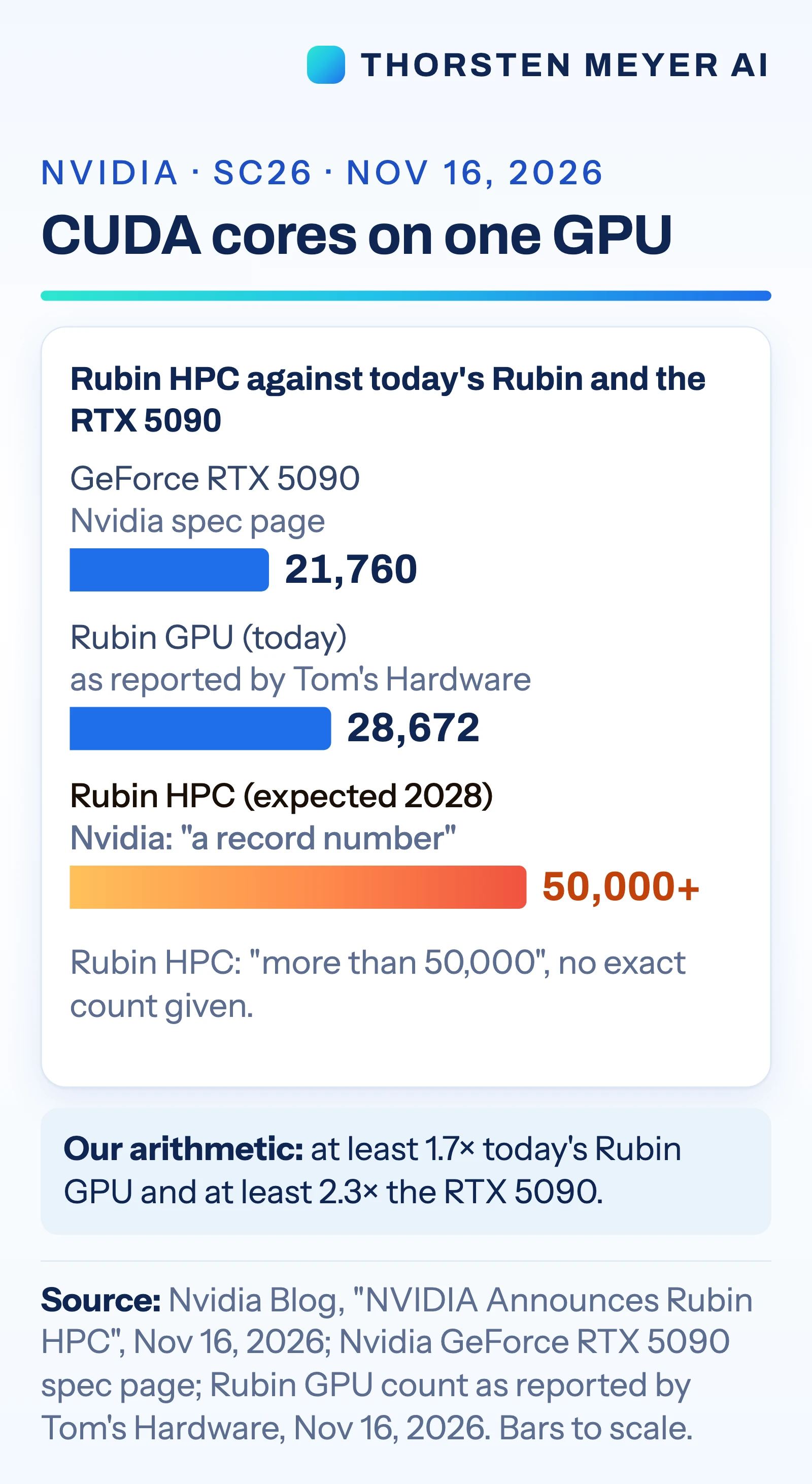
The source material compares the announced core count with two other Nvidia products. Tom’s Hardware reports that the existing Rubin GPU has 28,672 CUDA cores, while Nvidia lists 21,760 for the GeForce RTX 5090. Using Nvidia’s lower-bound figure of more than 50,000, those comparisons work out to at least roughly 1.7 times the reported Rubin count and 2.3 times the RTX 5090 count. These are arithmetic comparisons of core counts, not measures of performance; the chips target different uses, and Nvidia has not published an exact Rubin HPC count.
Tom’s Hardware suggested the number might point to a multi-die design resembling Rubin Ultra, while also reporting that Nvidia had not disclosed the chip’s physical layout. That remains an outside outlet’s inference, not a confirmed feature of Rubin HPC.
““A record number of CUDA cores — more than 50,000 on a single GPU.””
— Nvidia
Specifications Still Missing
Nvidia has not disclosed Rubin HPC’s exact core count, FP64 performance, memory capacity, memory bandwidth, power requirements or price. The company has not named systems that will incorporate the GPU, and no independent benchmarks are available in the supplied source material. It is also unclear how the sparse-data acceleration works or which applications will benefit most.
The announced core count does not by itself show how Rubin HPC will compare with other GPUs on scientific workloads. Those comparisons will depend on factors including precision, memory behavior, software support and system configuration. The suggested multi-die layout is speculation reported by Tom’s Hardware, not a confirmed Nvidia disclosure.
Details Ahead of 2028
Nvidia says Rubin HPC is expected to be available in 2028. The company has not given a more specific launch date. Further disclosures on hardware specifications, system partners, pricing and measured application performance will be needed before research organizations can assess deployment plans.
For now, the announcement establishes Nvidia’s intended direction: a GPU aimed at scientific and engineering workloads, with a high stated core count and new data movement and interconnect features. Whether those design claims translate into faster or more cost-effective research workloads remains to be seen.
Key Questions
What is Nvidia Rubin HPC?
It is a GPU Nvidia announced for science, engineering and analytics, including simulation and data processing. Nvidia says it is part of the Vera Rubin platform.
How many CUDA cores does Rubin HPC have?
Nvidia says it has more than 50,000 CUDA cores per GPU, but has not published an exact count.
When is Rubin HPC expected to be available?
Nvidia says the GPU is expected in 2028. No more specific date was provided in the announcement.
How much faster will it make scientific simulations?
That is not yet known. Nvidia has not published performance figures or independent benchmarks for Rubin HPC.
What key specifications are still unknown?
Nvidia has not released FP64 performance, memory capacity or bandwidth, power use, price, or named systems for the GPU.
Source: Thorsten Meyer AI