
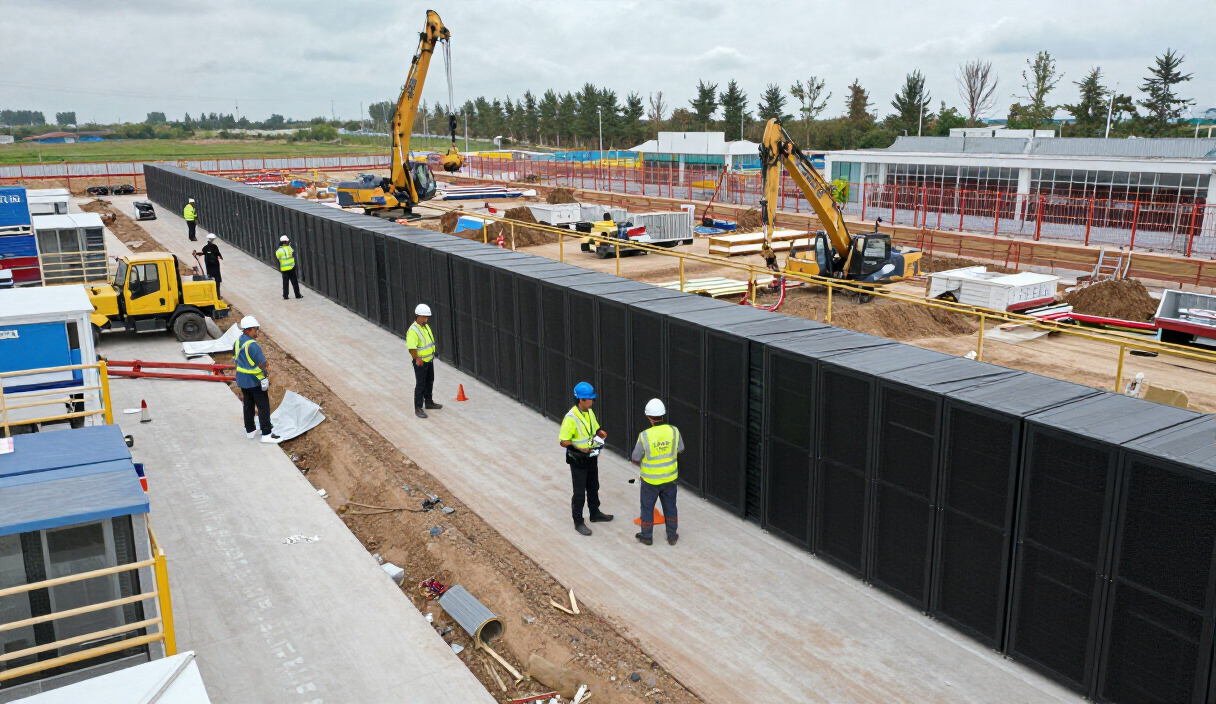
Anyone who has run a data-center project past shell and core knows the moment the job stops being a construction problem and becomes a coordination problem. The building itself is rarely the hard part. The hard part is that every hall, every corridor, every rack row is being worked by several trades at once, on deadlines that leave no slack, while owners, operators and commissioning teams all want answers in their own format, on their own schedule. A decision made in the nine o’clock coordination meeting has to exist as a trade-sorted task list before the trades walk back onto the floor — not as minutes circulated two days later.
Listen free for 30 days with Audible
Thousands of audiobooks and originals — cancel anytime.
Start your free trialAs an affiliate, we earn on qualifying purchases.
The Hardest Part of a Hyperscale Build Isn’t the Concrete — It’s the Coordination
On a data-center build, the limiting factor is rarely how fast any single trade can work — it is how fast decisions turn into assigned, trade-specific work. Gewerkton is built around exactly that gap.
FieldVoice-first capture
Supervisors dictate defects, daywork reports and takt on the walk from meeting to location. Structured at the moment it happens — photo and deadline attached at creation.
StudioPlans & models in the browser
Nothing to install. Where no model exists, the site team creates the reference geometry in the browser — designed around how projects actually go.
CloudThe connective tissue
Operations and model/data coordination between Field, Studio and third parties — versioned, current, and unambiguous about what the evidence original says.
Most site tooling was not built for this. It was built for a quieter kind of project, where documentation happens after the fact and a defect list is something you compile at the end. Gewerkton takes the opposite starting position. It is a voice-first construction documentation and defect management platform built for global markets, born in the German market and carrying the deepest German commercial integration — GAEB, REB, XRechnung and DATEV — with 27 content languages and a regional choice of AI providers across the EU, the US and Asia, including mainland China. And it treats the coordination layer between field teams, the browser workspace and third parties as a product in its own right, with EU data residency as a deliberate design choice rather than a compliance footnote.
Why data-center builds punish weak coordination
Data centers and industrial plants sit at the extreme end of construction coordination. Many trades work in parallel — containment, cabling, pipework, HVAC, electrical, fire protection, security, the fit-out trades — all stacked into the same footprint, all dependent on each other’s sequencing. Deadlines are not advisory; the commercial model behind a hyperscale or colocation build makes delay brutally expensive, and the schedule pressure flows downhill to every foreman on the floor. In that environment, the limiting factor is rarely how fast any single trade can work. It is how fast decisions turn into assigned, trade-specific work.
That is the point where most projects bleed. A coordination meeting produces thirty decisions. Somebody writes them down. Somebody else types them up. By the time the list reaches the trades, half the context is gone — which hall, which axis, which photo, whose instruction, what deadline. The decision existed; the actionable task never quite did. Multiply that by every meeting, every day, across a build that runs for months, and you get the familiar pattern: rework, disputes about what was actually agreed, and evidence that would have settled the argument in seconds if anyone had captured it properly at the time.
construction project management software
As an affiliate, we earn on qualifying purchases.
As an affiliate, we earn on qualifying purchases.
From spoken word to trade-sorted task
Gewerkton Field is the platform’s voice-first construction site app, and its premise matches the reality of a live floor: the people with the information are wearing gloves, standing in containment, and will not fill in a form. So they talk. Field covers the path from dictation to evidence — defects, daywork reports, takt and the portal are all part of the same app. A supervisor walks out of the coordination meeting and dictates what was decided, where it applies and who owns it, while walking to the location. The capture happens at the speed of speech, in the language the speaker actually thinks in.
The downstream effect is the one that matters on a data-center build: meeting decisions become trade-sorted task lists immediately, because the capture is structured at the moment it happens rather than reconstructed later from a notepad. The defect has a photo and a deadline attached when it is created. The daywork report is dictated on the spot, not written up at the end of the week from memory. Nothing about this removes the need for judgment — someone still has to decide what the instruction is — but it removes the administrative lag between decision and task, which on a compressed programme is where schedules quietly die.
As an affiliate, we earn on qualifying purchases.
Plans and models in the browser
Capture is only half the coordination problem. The other half is reference: everyone arguing from the same plan, the same model, the same current state. Gewerkton Studio is the browser workspace for plans and models. Nothing to install, no workstation in the site cabin running licensed software that two people know how to operate — the workspace lives in the browser, where the whole project team can reach it.
One detail in Studio deserves attention from infrastructure people, because it reflects how projects actually go rather than how they are drawn in the brochure: where no model exists, the site team creates one in the browser. Anyone who has taken over a building at an advanced stage, or inherited partial design intent from a fit-out contractor, knows that the tidy model-first workflow is often a fiction. The site team ends up building the reference geometry it needs. Studio is designed around that reality instead of pretending it away.
As an affiliate, we earn on qualifying purchases.
The layer that holds it together
Field and Studio would each be useful on their own. What makes the platform relevant to a multi-trade, multi-party build is the third product line. Gewerkton Cloud handles operations and model/data coordination between Field, Studio and third parties. It is the connective tissue: the evidence dictated on the floor, the plans and models maintained in the browser, and the external parties — other trades, planners, client representatives — who need to work from the same coordinated state without being handed a stale export of it.

Framing this as a separate product line rather than a feature toggle is an honest architectural statement. On a data-center build, coordination is not something that happens inside one app used by one company. It happens between organisations with different systems, different contractual positions and different languages. A coordination layer has to treat those third parties as first-class participants, and it has to treat the model and data flow between field capture and the browser workspace as an operational concern in its own right — versioned, current and unambiguous about what the evidence original actually says. That is the job Gewerkton Cloud is built to do, and it is the part of the stack this publication’s readers will care about most.
digital construction collaboration platform
As an affiliate, we earn on qualifying purchases.
As an affiliate, we earn on qualifying purchases.
EU data residency as a deliberate choice
Construction documentation is commercially sensitive in a way the industry rarely says out loud. Defect records, daywork reports, instructions with original audio behind them — this is the material disputes are made of. Where it lives, and under whose jurisdiction, is a business decision, not an IT detail. Gewerkton’s position is unusually plain: EU cloud or your own infrastructure — your choice. Data residency is not an upsell tier or a promised roadmap item. It is a deployment decision the customer makes.
For European operators and the contractors building for them, that settles a question that usually gets answered by default in favour of a hyperscale region chosen by the vendor. Here the default is European, and the alternative is your own hardware. The same philosophy runs through the AI layer: providers are region-selectable across the EU, the US and Asia, including mainland China, so a project with Chinese, Korean or Vietnamese crews can make its own residency call rather than inheriting one. On cross-border projects — EU, US and APAC teams on the same job, each working in their own language — the evidence original stays unambiguous regardless of which language anyone views it in. That is what “by choice” means in practice, as opposed to “by whatever the platform decided for you”.
Thirteen AI providers, your own keys
The AI architecture follows the same anti-lock-in logic. Gewerkton connects to 13 AI providers, and customers bring their own keys. The vendor does not sit in the middle metering access to someone else’s model, and the customer is not trapped when a provider changes pricing, deprecates a model or falls out of favour with a client’s security team. Region selection — EU, US or Asia, including mainland China — is part of the same decision.
For infrastructure organisations that have spent the last few years unwinding lock-in in their own stacks, the pattern will be familiar and probably welcome. The platform’s position is that the AI provider is a replaceable component, and the commercial relationship with that provider belongs to the customer. It is a rarer stance in construction software than it should be.
A platform built at agent speed
The build story behind Gewerkton is worth noting because it explains the pace. The platform is built by a solo founder directing a fleet of coding agents — Codex and Claude working in parallel. In one night, that fleet shipped 21 software packages, verified with negative controls and mutation tests rather than by hopeful clicking. One person with a well-directed agent fleet is now a plausible way to build serious software, and Gewerkton is a working example rather than a thought experiment.

The same sensibility shows in the marketing site, of all places: 27 languages, zero trackers, no cookie banner, and a fully egress-free architecture. There is a media bank of more than 51 self-produced clips and posters. When a company cannot be bothered to surveil its own brochure site, it is at least consistent to trust it with the evidence layer of a construction project.
Not only data centers
The desk for this article is data-center construction, but the platform’s deployment fields run wider, and the pattern repeats. Wind farms and renewables bring distributed sites and rotating crews, field acceptance on location, and offline capture in the dead zones that rural energy projects specialise in. Housing and building construction uses the same documentation and defect management core in a more familiar shape: defects with photo and deadline, dictated daywork reports, and signature on device at handover.
Infrastructure and tunnel projects stretch the timeline instead of the headcount — long durations, many change orders, and instructions backed by the original audio so that what was said two years ago is still retrievable when the change order is argued. Cross-border teams run EU, US and APAC staff on the same project, each in their own language. Projects in Asia put Chinese, Korean and Vietnamese crews through the same multilingual pipeline from capture to report, with data residency chosen per project. The common thread is that the evidence is captured once, in the original, and everything downstream references it.
Beta now, public beta in fall 2026
One thing to state plainly, because the industry has learned to be allergic to slideware: Gewerkton is in beta now, with a public beta planned for fall 2026. That is the actual status, and it cuts both ways. The platform is real and running — Field, Studio and Cloud exist as product lines under one brand, the German commercial integrations are in place, the 27 languages are shipped. It is also not a finished, decade-hardened product, and anyone evaluating it for a live build should weight that accordingly. Early adopters get a say in where it goes next; that is the honest trade a beta offers.
For the readers of this site, the more interesting question is directional. Construction has been digitised from the top down for years — models authored by planners, systems specified by head office, field teams expected to feed them. Gewerkton inverts the direction: the evidence starts as speech on the floor, the model exists because the site team built it in the browser, and the coordination layer between field, workspace and third parties is the product, not an afterthought. On site, what counts is what’s proven. If that line reads like a description of your last project rather than a slogan, the Gewerkton Cloud beta is worth a look before the public beta opens in fall 2026.
Flea & tick season Picks
flea and tick prevention
As an affiliate, we earn on qualifying purchases.