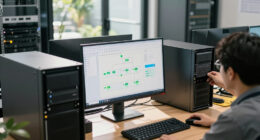

Logs simply capture events, errors, and user actions, but they often lack context and are limited to past incidents. They don’t reveal the triggers or root causes behind problems, making it hard to understand true system behavior. Since logs are reactive and can be voluminous, analyzing them alone can be time-consuming and incomplete. To gain a clearer picture of how your system really behaves, exploring other monitoring methods can be helpful—more insights await if you look further.

Get business pricing on networking and server gear
- Business-only prices and quantity discounts
- Tax-exempt purchasing
- Multiple users, one account, clear invoices
Key Takeaways
- Logs are reactive and only record past events, lacking real-time insights into system health.
- They often contain voluminous, poorly structured data, making analysis time-consuming.
- Logs do not reveal triggers or root causes behind system issues or anomalies.
- They provide limited context, missing broader system behavior and environmental factors.
- Relying solely on logs delays detection of issues that could be caught earlier with monitoring tools.

Ever wondered how system administrators quickly identify and troubleshoot issues? It’s often through real time monitoring that they get a clear picture of what’s happening on a system. Logs are essential, but relying solely on them rarely provides the full story. While logs capture events, errors, and user actions, they don’t always reveal the underlying causes of system behavior. This is where anomaly detection becomes vital. By analyzing data streams in real time, administrators can spot unusual patterns or deviations from normal operations that logs alone might miss.
Real-time monitoring and anomaly detection provide crucial insights beyond logs for faster troubleshooting and proactive system management.
Logs tend to be reactive; they record what has already happened. When something goes wrong, you can sift through logs to find error messages or failed transactions, but this process can be time-consuming and often yields incomplete insights. For example, a log might indicate a server crash, but it doesn’t necessarily explain what triggered it. Without additional context, you might struggle to pinpoint root causes, especially if the logs are voluminous or poorly structured. This limitation highlights why logs alone rarely tell the full story of system behavior.
In contrast, real time monitoring tools continuously analyze system metrics, network traffic, CPU load, and memory usage, providing instant feedback on the system’s health. When coupled with anomaly detection, these tools can automatically flag unusual activity, such as a sudden spike in traffic or a drop in response times, even before errors appear in logs. This proactive approach allows you to respond swiftly, often preventing minor issues from escalating into major outages. Anomaly detection algorithms learn what normal behavior looks like and then alert you when deviations occur, giving you a much more dynamic understanding of your system’s state. Incorporating real time data analysis is crucial for staying ahead of potential problems in complex environments.
The combination of logs and real time monitoring enhances your ability to troubleshoot efficiently. Logs offer detailed records that help understand specific events, while monitoring and anomaly detection provide the broader context, catching issues early. Relying solely on logs is like trying to fix a problem after it happens, but integrating real time insights allows you to anticipate and prevent issues before they affect users. This holistic approach is essential in today’s complex, fast-paced environments, where understanding system behavior requires both historical data and real-time analysis. In short, logs are valuable, but when you complement them with real time monitoring and anomaly detection, you gain a powerful toolkit for maintaining system stability and performance.
real-time system monitoring tools
As an affiliate, we earn on qualifying purchases.
As an affiliate, we earn on qualifying purchases.
Frequently Asked Questions
How Do Logs Integrate With Other Monitoring Tools?
You can integrate logs with other monitoring tools by connecting them to platforms that support real-time visualization and anomaly detection. This setup lets you see system behavior instantly, identify unusual patterns, and respond quickly. By combining logs with metrics and alerts, you get an all-encompassing view of your system, making it easier to troubleshoot issues before they escalate. This integration improves overall system health and reliability effectively.
What Are Alternative Methods to Analyze System Issues?
To analyze system issues effectively, you should use alternative methods like behavior pattern analysis and anomaly detection. These techniques help you identify unusual activities or deviations from normal operation that logs might miss. By monitoring real-time data, network traffic, and system performance metrics, you can quickly spot issues, diagnose root causes, and prevent future problems, ensuring a more thorough understanding of your system’s behavior.
How Can Log Data Be Securely Stored and Managed?
Think of your log data as fragile treasures, best kept in a vault of encrypted storage to shield against prying eyes. You should implement strong access controls, like guards at every gate, ensuring only authorized personnel can access the secrets within. Regularly audit these protections, and keep backups in secure locations. This approach safeguards your logs, maintaining their integrity while allowing safe, controlled access when needed.
What Are Common Challenges in Log Analysis?
You often face challenges in log analysis because logs can be overwhelming and lack contextual insights, making it hard to interpret the data accurately. Recognizing patterns requires sophisticated tools and expertise, which aren’t always available. Additionally, logs may be incomplete or inconsistent, complicating pattern recognition. These issues hinder your ability to quickly identify root causes and understand system behavior, emphasizing the need for better analysis strategies.
How Do Logs Differ Across Various System Architectures?
Think of logs as different languages spoken across architectures. In monolithic systems, logs are straightforward, like a clear conversation, while microservices sprinkle logs across multiple sources, creating a tangled web. Architecture differences cause log format variations—some use JSON, others plain text—making it tricky to piece together the story. You need to understand these variations to interpret logs effectively, like translating dialects in a multilingual dialogue.
anomaly detection software for servers
As an affiliate, we earn on qualifying purchases.
As an affiliate, we earn on qualifying purchases.
Conclusion
Remember, logs are like breadcrumbs in a vast forest—they guide you, but they don’t tell the whole story. To truly understand your system’s behavior, you need to piece together multiple clues, look beyond the surface, and consider the unseen forces at play. Think of logs as the stars in the night sky—beautiful but limited. Only by connecting these stars can you navigate the complex universe of your system’s true nature.
As an affiliate, we earn on qualifying purchases.
system health monitoring devices
As an affiliate, we earn on qualifying purchases.
As an affiliate, we earn on qualifying purchases.
Columbus Day / Indigenous Peoples' Day Picks
long weekend sales
As an affiliate, we earn on qualifying purchases.