

During outages, you’ll notice that runbooks guide you through precise, step-by-step actions, helping you act quickly and confidently with automation-ready instructions. Playbooks, on the other hand, provide strategic guidance, clarifying goals, decision points, and team roles, which helps your team stay coordinated and focused amid complexity. Understanding how these tools shape your response can make a big difference. Keep exploring how integrating both approaches can optimize your incident management.

Get business pricing on networking and server gear
- Business-only prices and quantity discounts
- Tax-exempt purchasing
- Multiple users, one account, clear invoices
Key Takeaways
- Runbooks enable teams to quickly execute technical fixes, reducing confusion and stress during outages.
- Playbooks guide strategic decision-making, helping teams stay organized and focused amid complex incidents.
- Runbooks foster confidence through clear, step-by-step instructions that support automation and rapid response.
- Playbooks promote calm and coordination by clarifying roles, escalation paths, and communication strategies.
- Together, they create a balanced response environment, minimizing errors and improving team resilience during outages.
IT incident response runbook software
As an affiliate, we earn on qualifying purchases.
As an affiliate, we earn on qualifying purchases.
Clarifying the Core Purpose of Runbooks and Playbooks

Understanding the core purpose of runbooks and playbooks is essential for effective incident response and operations. Runbooks provide detailed, step-by-step instructions for executing specific tasks or remediations, aiming for consistency, repeatability, and automation. They’re designed for technical operators and automation tools to quickly address known issues, reducing cognitive load during high-pressure situations. Incorporating standard operating procedures into runbooks ensures that responses are uniform and efficient across different team members and scenarios. Additionally, well-structured runbooks can facilitate process automation, minimizing manual intervention and speeding up resolution times. Playbooks, on the other hand, offer strategic guidance, outlining goals, roles, decision points, and escalation paths across complex scenarios. They help coordinate cross-functional teams, clarify responsibilities, and align responses during outages. While runbooks focus on “how” to fix, playbooks focus on “what” to achieve and “who” makes critical decisions. Together, they form a comprehensive framework that guides both tactical actions and strategic coordination, incorporating pool terminology to streamline processes and improve clarity.
incident management playbook templates
As an affiliate, we earn on qualifying purchases.
As an affiliate, we earn on qualifying purchases.
How Granularity Shapes Response During Incidents

The level of detail in runbooks and playbooks directly influences how effectively teams respond during incidents. Runbooks offer granular instructions, including exact commands, parameters, and verification steps, enabling quick, precise actions. This detailed approach minimizes errors and reduces cognitive load during high-pressure moments. Additionally, passive voice detection can help clarify instructions, making them more actionable and easier to follow. Conversely, playbooks focus on broader strategic guidance, outlining goals, decision points, and roles through scenarios and branching paths. Their less granular nature helps teams understand the bigger picture, make informed decisions, and adapt to unexpected changes. The appropriate level of granularity ensures responders have the right information at the right time—runbooks speed up technical remediation, while playbooks support coordination and strategic adjustments. Incorporating standardized procedures can further improve consistency and effectiveness during critical moments. Moreover, understanding the importance of clear communication enhances team coordination and reduces misunderstandings under stress. Recognizing the role of structured workflows can streamline incident management processes and improve overall response efficiency. Philosophical insights on authenticity and existence can deepen understanding of team dynamics and decision-making under stress.
As an affiliate, we earn on qualifying purchases.
Automation Readiness and Its Impact on Speed

Automation potential directly influences how quickly you can respond to incidents by removing manual delays. Runbooks, with their detailed, scripted steps, are well-suited for automation, speeding up remediation efforts. In contrast, playbooks often require human judgment, which can slow down responses but provide necessary flexibility for complex situations.
Automation Potential Drives Speed
Leveraging automation in incident response can substantially accelerate resolution times, especially when procedures are structured for automation readiness. When your runbooks clearly specify exact commands, API calls, and verification steps, you enable quick execution by scripts or orchestration tools. This reduces manual effort, minimizes human error, and speeds up recovery, particularly during high-pressure outages. Automation-ready runbooks allow your team to implement consistent, repeatable actions without delays. They also facilitate seamless integration with SOAR platforms, enabling faster decision-making and action execution. By designing procedures with automation in mind, you ensure that routine remediation steps are streamlined, freeing your team to focus on complex, strategic tasks. This proactive approach directly impacts your incident response speed, shortening downtime and limiting business impact.
Manual vs. Automated Response
Automating incident response steps can substantially cut down resolution times by enabling rapid, consistent execution of routine tasks. When you automate, you remove delays caused by manual intervention, ensuring fixes happen swiftly and reliably. Automated runbooks can run scripts, trigger API calls, and verify system states without human input, reducing errors and freeing your team to focus on complex decisions. However, not all responses lend themselves to automation—playbooks often require human judgment for decision points and coordination across teams. Combining automation with manual oversight allows you to balance speed and accuracy, especially during high-pressure outages. This hybrid approach accelerates incident resolution, minimizes human error, and ensures your team acts swiftly while maintaining oversight for complex or unpredictable scenarios.
team coordination incident playbooks
As an affiliate, we earn on qualifying purchases.
As an affiliate, we earn on qualifying purchases.
Decision-Making Frameworks: Step-by-Step vs. Scenario Mapping
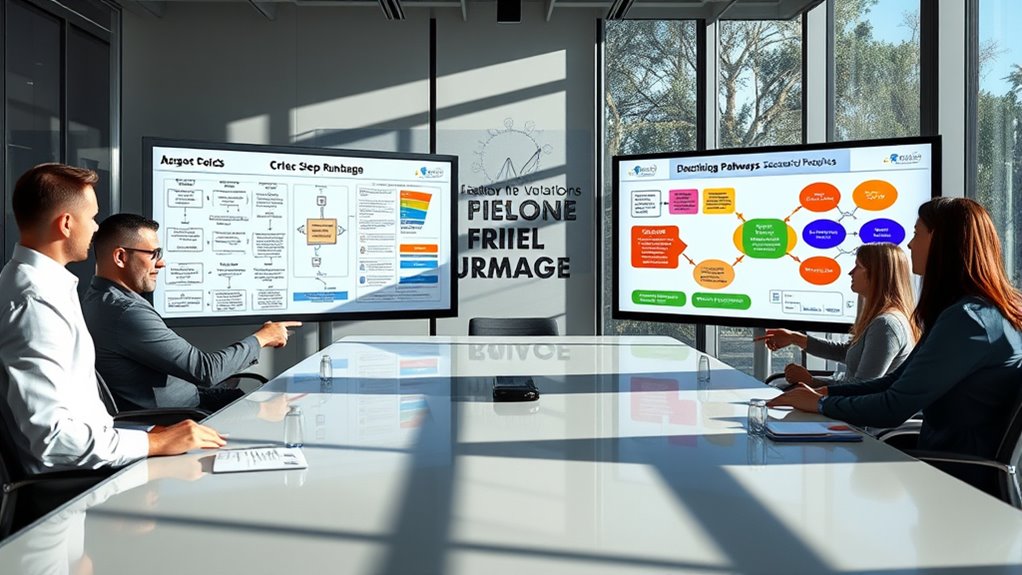
Decision-making frameworks in runbooks and playbooks differ markedly in structure and approach. Runbooks follow a step-by-step process, guiding you through exact actions for predictable tasks. Playbooks, however, use scenario mapping, outlining multiple paths based on incident context. This flexibility helps you adapt to complex, uncertain situations. Key points include:
Runbooks provide clear steps for predictable tasks; playbooks adapt with scenario-based decision trees.
- Clarity vs. Flexibility: Runbooks deliver clear instructions; playbooks offer adaptable decision trees.
- Linear vs. Branched: Runbooks follow a linear sequence; playbooks branch based on scenario outcomes.
- Automation potential: Step-by-step guides are ideal for automation; scenario maps support strategic decision-making.
- Context sensitivity: Playbooks prioritize context, guiding you through different paths; runbooks assume a predefined environment.
Understanding these frameworks helps you choose the right approach based on incident complexity and predictability.
Human Factors: Reducing Stress and Aligning Teams

During high-pressure incidents, clear and structured guidance from runbooks and playbooks can considerably reduce stress by providing teams with confidence and direction. Runbooks offer precise, step-by-step instructions that help operators focus on tasks without overthinking, lowering cognitive load. Playbooks, on the other hand, clarify roles, decision points, and communication channels, ensuring everyone understands their part and reducing confusion across teams. This alignment minimizes friction and fosters trust, enabling responders to act swiftly and cohesively. When teams know exactly what to do and who’s responsible, tensions decrease, and situational clarity improves. Ultimately, these tools create a calmer environment, helping teams stay focused, coordinated, and effective during critical moments.
Tools, Observability, and the Path to Effective Response

Effective incident response relies on integrating the right tools and observability to inform decisions quickly. Automation and tool integration enable faster remediation, especially when runbooks are connected to monitoring systems. Observability-driven decision support helps you verify outcomes and maintain confidence in your response efforts.
Automation and Tool Integration
Automation plays a crucial role in enhancing incident response by transforming runbooks into executable workflows that speed up remediation and reduce human error. When integrated with your tools and observability systems, automation streamlines the response process. Here are key points to contemplate:
- Automation-ready runbooks contain scripts, API calls, and commands for quick deployment.
- Tool integrations enable automated verification of remediation success through monitoring and metrics.
- Orchestrating runbooks with automation tools allows semi-automated workflows, balancing speed and human judgment.
- Automated audit trails ensure compliance, providing detailed records of executed steps for review.
- Incorporating responsible use and privacy considerations ensures that automation adheres to ethical standards and safeguards user data during incident handling.
Observability-Driven Decision Support
Integrating observability tools into incident response enhances decision support by providing real-time insights and contextual data. With dashboards, logs, metrics, and tracing, you gain immediate visibility into system behavior, helping you pinpoint issues faster. These tools allow you to correlate data across services, making it easier to determine root causes and assess impact. When a fault occurs, observability enables you to verify whether remediation steps are effective, reducing guesswork. By embedding monitoring and alerting into your response workflows, you can make informed decisions quickly, avoiding unnecessary escalation or delays. This observability-driven approach fosters a proactive mindset that anticipates potential issues before they escalate. This proactive approach streamlines triage, helps prioritize tasks, and supports precise execution—ultimately reducing outage duration and improving response confidence. Utilizing system metrics further enhances your ability to predict and prevent future outages by identifying patterns early. Observability-driven decision support turns complex incidents into manageable, data-backed processes.
Maintaining and Evolving Runbooks and Playbooks Over Time
Maintaining and evolving runbooks and playbooks requires a disciplined approach to guarantee they stay accurate, relevant, and effective amidst ongoing organizational and technical changes. To do this effectively, consider these key practices:
- Regularly schedule technical reviews of runbooks, especially after deployments or infrastructure updates.
- Conduct periodic strategic reviews of playbooks to reflect organizational or process shifts.
- Assign clear ownership—technical owners for runbooks and cross-functional leaders for playbooks—to ensure accountability.
- Incorporate testing through tabletop exercises and live drills to validate updates and identify gaps.
- Ensuring consistent updates aligns with content quality and topical authority, helping your documentation stay trustworthy and effective over time.
Staying disciplined with updates and reviews ensures your documentation remains useful, reduces errors, and supports rapid incident response over time.
The Interplay Between Technical Precision and Strategic Oversight

Balancing technical precision with strategic oversight is essential for effective incident response, as each addresses different but interconnected needs. You rely on runbooks for exact steps and verification, ensuring quick, repeatable fixes during outages. Meanwhile, playbooks provide high-level guidance, helping you navigate complex scenarios, prioritize actions, and coordinate teams. When technical details are accurate, automation becomes possible, speeding recovery. Strategic oversight ensures you don’t lose sight of broader goals, stakeholder communication, and risk management. You need both: runbooks enable immediate remediation, while playbooks shape the overall response strategy. This interplay reduces errors, improves decision-making, and ensures a cohesive response. By integrating detailed procedures with overarching plans, your team can respond swiftly and effectively, minimizing downtime and impact. Furthermore, clear documentation fosters consistent procedures, which is vital for maintaining reliability and continuous improvement during incident management.
Frequently Asked Questions
How Do Runbooks and Playbooks Integrate for Comprehensive Incident Management?
You integrate runbooks and playbooks by referencing runbooks within your playbooks to provide detailed, step-by-step actions for specific tasks. During an incident, your playbook guides decision-making, escalation, and coordination, while runbooks execute precise remediation steps. This synergy guarantees your team responds quickly and effectively, with strategic guidance from the playbook and operational accuracy from the runbooks, streamlining your incident management process.
What Are Common Pitfalls When Designing Effective Runbooks and Playbooks?
A stitch in time saves nine, so avoid common pitfalls when designing runbooks and playbooks. You might overcomplicate your runbooks, making them too rigid or hard to update, or create vague playbooks that lack clear decision points. Make certain your procedures are precise yet adaptable, and your strategic guides include clear roles and escalation paths. Regular reviews, testing, and stakeholder input help prevent these issues, keeping your incident response effective and resilient.
How Do Organizations Balance Automation With Manual Decision-Making?
You should balance automation with manual decision-making by automating predictable, repetitive tasks through runbooks, freeing your team for complex decisions. For less certain scenarios, rely on playbooks to guide human judgment, escalation, and coordination. Embed decision points within automation workflows, allowing semi-automated responses that require human input when needed. This approach minimizes errors, speeds response, and guarantees your team maintains control over critical, nuanced decisions during outages.
When Should Teams Update or Retire Outdated Runbooks and Playbooks?
You should update or retire outdated runbooks and playbooks whenever they no longer reflect current systems, procedures, or organizational goals. Regular reviews guarantee accuracy, relevance, and effectiveness, preventing errors and confusion. When technology changes, workflows evolve, or lessons learned highlight gaps, it’s time to revise. If a document becomes redundant or causes more harm than good, retire it altogether. Consistent updates keep your team aligned, confident, and prepared during outages.
What Training Best Practices Ensure Effective Use of Both Tools During Outages?
You should train your team with scenario-based exercises that simulate real outages, emphasizing when to follow runbooks for quick fixes and when to consult playbooks for strategic decisions. Reinforce understanding through regular drills, role-specific walkthroughs, and debriefs to clarify decision points. Encourage hands-on practice with both tools, fostering confidence and clarity. Continuous feedback and refresher sessions help embed best practices, ensuring your team responds effectively under pressure.
Conclusion
Understanding the difference between runbooks and playbooks isn’t just academic; it’s your secret weapon during outages. While runbooks offer precise steps, playbooks provide strategic guidance. Combining them reduces stress and speeds response. Remarkably, teams that blend both tend to recover faster—suggesting that embracing both technical detail and strategic oversight truly enhances resilience. So, next time crisis hits, remember: the right mix of tools keeps your team confident and in control.
Evergreen bestsellers Picks
bestsellers
As an affiliate, we earn on qualifying purchases.