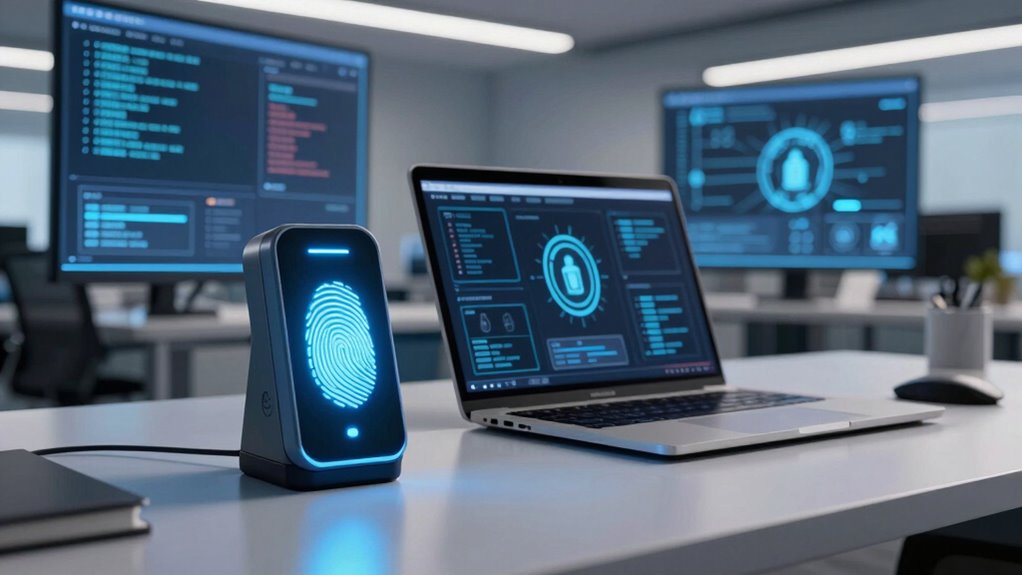

While MFA adds a crucial security layer, it’s no longer enough on its own. Attackers exploit vulnerabilities like session hijacking, social engineering, and AI-driven impersonations, bypassing simple MFA protections. Weak fallback options and vulnerable channels like SMS also increase risks. To better protect your organization, you need additional layers such as hardware security keys, biometric verification, and adaptive authentication. Stay ahead by learning how these next-tier defenses can strengthen your identity security.

Get business pricing on networking and server gear
- Business-only prices and quantity discounts
- Tax-exempt purchasing
- Multiple users, one account, clear invoices
Key Takeaways
- MFA alone cannot prevent sophisticated attacks like session hijacking, deepfakes, or credential theft; additional safeguards are essential.
- Implementing risk-based or adaptive authentication enhances security by adjusting challenges based on contextual signals.
- Hardware security keys and biometric solutions provide stronger, phishing-resistant layers beyond traditional MFA.
- Continuous monitoring, asset inventories, and threat intelligence help detect and respond to MFA bypass attempts effectively.
- Hardening helpdesk workflows and enforcing MFA for high-risk accounts reduce vulnerabilities exploited through fallback methods.

Is multi-factor authentication (MFA) truly enough to secure your digital assets? While MFA adds a valuable layer of protection, relying on it alone leaves gaps that attackers can exploit. Many organizations depend on push notifications, one-time passwords, or biometric verification to prevent credential theft. However, attackers have developed sophisticated methods to bypass these measures. Session hijacking, MFA fatigue, and AI-driven impersonations allow malicious actors to access accounts without triggering security prompts. For example, AI-generated deepfakes can trick employees into approving fraudulent transactions, and adversary-in-the-middle attacks intercept MFA tokens, rendering traditional safeguards ineffective.
MFA alone isn’t enough; attackers bypass prompts through session hijacking, deepfakes, and man-in-the-middle attacks.
You might think MFA is a silver bullet, but the reality is more complex. Studies reveal that despite high adoption rates—about 70% workforce MFA coverage—nearly one-third of users lack any MFA protection altogether. Smaller organizations, especially those with fewer than 25 employees, show even lower adoption rates, around 27%. Meanwhile, the proliferation of legacy applications and inconsistent MFA deployment create exploitable exceptions. Attackers target these gaps, especially legacy protocols that lack MFA support, and often focus on service accounts or weak fallback mechanisms like email resets or helpdesk overrides. These weak points are often overlooked, giving attackers an easier route to breach your systems.
Weak channels such as SMS for MFA are also vulnerable. SIM swapping, where attackers hijack your phone number, has compromised high-profile accounts, including Twitter’s CEO. Push notification fatigue, where users receive repeated prompts, can lead to accidental approvals—an attack vector that exploits human error. AI-generated deepfake audio can also manipulate employees into approving malicious requests, bypassing MFA altogether. According to recent reports, token theft and OAuth abuse enable lateral movement without triggering MFA challenges, especially when session tokens are compromised or API keys leak in public datasets. Furthermore, the increasing use of legacy protocols that do not support modern MFA methods leaves critical vulnerabilities open to exploitation.
Despite these threats, MFA remains effective against most automated attacks. Block rates of over 99.9% have been reported in some cases. Still, 28% of MFA-enabled users face targeted bypass techniques, and nearly 80% of business email compromise incidents occur despite MFA protections. To enhance security, organizations are adopting phishing-resistant methods like hardware security keys using FIDO2 or WebAuthn. These solutions greatly reduce the risk of MFA bypasses. Complementing this, risk-based or adaptive MFA adjusts challenges based on contextual signals—like device posture or geolocation—making unauthorized access even harder. Furthermore, the adoption of biometric solutions such as fingerprint or facial recognition can provide an additional secure layer that’s difficult for attackers to replicate or bypass.
You should also implement operational controls such as enforcing MFA for all high-risk accounts, hardening helpdesk workflows, and maintaining comprehensive asset inventories. Continuous monitoring for suspicious activity, abnormal login patterns, and credential leaks is essential. Threat intelligence, simulated attacks, and incident response playbooks help detect and respond swiftly to MFA bypass attempts. Remember, MFA is an essential step, but it’s no longer enough on its own. Elevating your security strategy with advanced authentication layers, rigorous policies, and proactive monitoring is fundamental to truly protect your digital assets in today’s evolving threat landscape.
hardware security keys for multi-factor authentication
As an affiliate, we earn on qualifying purchases.
As an affiliate, we earn on qualifying purchases.
Frequently Asked Questions
How Effective Are Biometric Authentication Methods Against Advanced Spoofing Attacks?
Biometric authentication methods can be quite effective, but advanced spoofing attacks challenge their reliability. Attackers use high-quality fake fingerprints, facial masks, or voice synthesis to fool sensors. While biometric systems often include liveness detection, sophisticated techniques can sometimes bypass them. To stay protected, you should combine biometrics with other security measures like hardware security keys and risk-based authentication, ensuring multiple layers defend against advanced spoofing.
What Are the Best Practices for Securing Legacy Systems Without MFA?
Secure your systems by segmenting, scrutinizing, and strengthening legacy access. You should replace outdated protocols with modern, MFA-compatible solutions or isolate legacy systems from critical networks. Enforce strict policies, perform regular patches, and prioritize persistent monitoring to identify anomalies early. By applying adaptive access controls and auditing all activity, you prevent breaches, bolster defenses, and keep legacy vulnerabilities securely tucked away, thwarting threats before they strike.
How Can Organizations Detect and Prevent MFA Push Bombing in Real Time?
To detect and prevent MFA push bombing in real time, you should monitor for patterns like repeated approval prompts from the same user or device. Implement anomaly detection that flags unusual approval activity, such as multiple prompts within a short period. Use adaptive MFA that challenges suspicious requests more rigorously and employ threat intelligence to identify known attack behaviors. Rapidly revoke compromised tokens and alert users when suspicious activity occurs to prevent successful attacks.
What Role Does Behavioral Analytics Play in Enhancing MFA Security?
Behavioral analytics enhances MFA security by continuously monitoring user activities for anomalies, like unusual login times, locations, or device usage. You can detect signs of compromise or suspicious behavior early, prompting additional verification or blocking access. This proactive approach helps prevent attacks such as session hijacking or MFA fatigue exploits, making your security more adaptive and reducing false positives while ensuring legitimate users aren’t inconvenienced.
How Should Incident Response Plans Adapt to MFA Bypass Scenarios?
You should update your incident response plans to include specific procedures for MFA bypass scenarios. Act quickly by revoking compromised tokens, resetting affected credentials, and isolating impacted systems. Document attack patterns, identify root causes, and analyze how bypass techniques were used. Collaborate with security teams to refine detection rules, strengthen controls, and prevent recurrence. Regularly test your response capabilities through simulated MFA bypass incidents to guarantee readiness and minimize damage.
biometric authentication devices
As an affiliate, we earn on qualifying purchases.
As an affiliate, we earn on qualifying purchases.
Conclusion
You know MFA alone isn’t enough—think of it like locking your front door but leaving a window wide open. To truly protect your digital world, you need an extra layer of security, like a sturdy security system. Just as no lock is perfect, no single method can guard everything. Embrace multi-layered defenses, stay vigilant, and keep your identity safe. Because in today’s threat landscape, a single lock simply isn’t enough to keep intruders out.
adaptive authentication software
As an affiliate, we earn on qualifying purchases.
As an affiliate, we earn on qualifying purchases.
security tokens for account protection
As an affiliate, we earn on qualifying purchases.
As an affiliate, we earn on qualifying purchases.
Columbus Day / Indigenous Peoples' Day Picks
long weekend sales
As an affiliate, we earn on qualifying purchases.