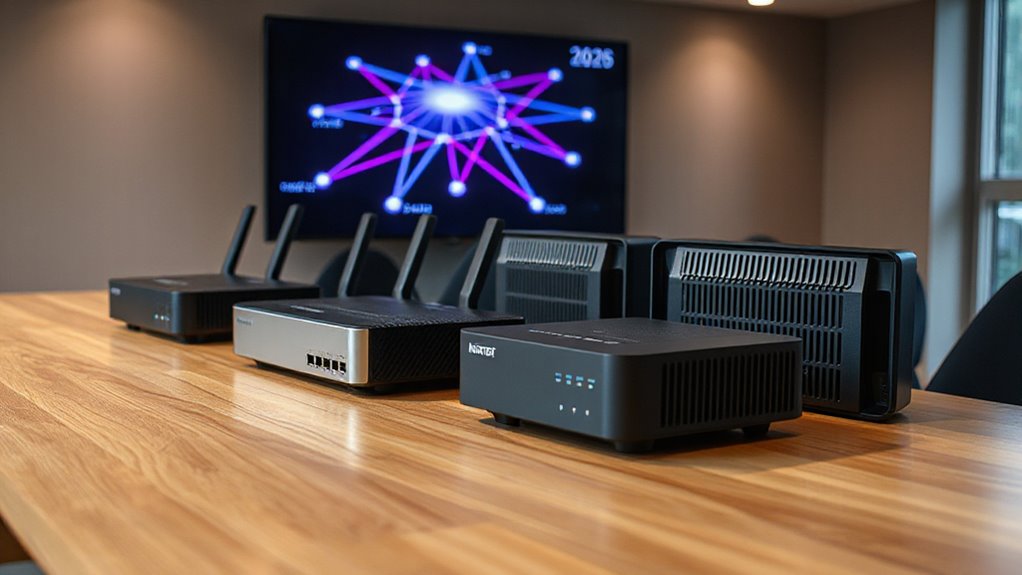

If you’re searching for a router for site to site VPN, you’re likely balancing security, speed, and ease of deployment. The TP-Link ER605 V2 stands out as the overall best choice thanks to its robust multi-WAN support and enterprise features. For portability and flexibility, the GL.iNet GL-SFT1200 Opal offers a compact, open-source solution suitable for remote sites. The main challenge lies in finding a router that combines reliable VPN performance with straightforward setup—many options excel in one area but fall short in another. Keep reading for a detailed look at the best choices and what makes each ideal for different scenarios.

Get business pricing on networking and server gear
- Business-only prices and quantity discounts
- Tax-exempt purchasing
- Multiple users, one account, clear invoices
Key Takeaways
- The best routers balance high VPN throughput with easy configuration, especially for multi-site setups.
- Port flexibility, such as dual or multi-Gigabit ports, is a key factor for scalability and future-proofing.
- OpenWrt support enhances customization but may increase setup complexity for less technical users.
- Security features like integrated firewalls and multi-WAN support are standard across top models, ensuring reliable site-to-site connections.
- Price varies widely; premium models offer advanced features, while budget options focus on core VPN functionality.
| TP-Link ER605 V2 Wired Gigabit VPN Router with Multiple WAN Ports |  | Best Overall for Small to Medium Business VPN Needs | Number of Gigabit Ports: 5 (1 WAN, 2 WAN/LAN, 2 LAN) | USB WAN Port: Yes | VPN Support: Up to 20 LAN-to-LAN IPsec, 16 OpenVPN, 16 L2TP, 16 PPTP | VIEW ON AMAZON | See Our Full Breakdown |
| GL.iNet GL-SFT1200 Opal Travel Router, AC1200 Dual-Band Wi-Fi, OpenWrt with VPN, Portable |  | Best for Portable, On-the-Go VPN Access | Wireless Speed: 300 Mbps (2.4GHz) + 867 Mbps (5GHz) | Ports: 2 Gigabit LAN, 1 Gigabit WAN | Weight: 145g | VIEW ON AMAZON | See Our Full Breakdown |
| Omada ER7412-M2 Multi-Gigabit VPN Router with Quad-Core Processor and Dual 2.5G Ports |  | Best for High-Speed, Multi-WAN, Enterprise-Grade VPN | WAN Ports: 2× 2.5G RJ45, 8× Gigabit RJ45, 2× SFP | LAN Ports: 8× Gigabit RJ45, 2× 2.5G RJ45 | Processor: Quad-core | VIEW ON AMAZON | See Our Full Breakdown |
| Grandstream GWN7003 11-Port Wired Gigabit VPN Router with Dual PoE Output Ports |  | Best for Multi-Location, PoE-Enabled Networks | Number of Ports: 11 | Port Type: Gigabit Ethernet | PoE Output Ports: 2 | VIEW ON AMAZON | See Our Full Breakdown |
| TP-Link ER7206 Multi-WAN VPN Router with Omada SDN, Gigabit Ports, and Security Features |  | Best for High-Capacity, Centralized Management | Number of WAN Ports: 4 (1 SFP, 1 Gigabit, 2 WAN/LAN) | Maximum Clients: 700 | Maximum Devices: 150,000 | VIEW ON AMAZON | See Our Full Breakdown |
| ASUS ExpertWiFi EBG15 Gigabit VPN Wired Router |  | Best for Small to Midsize Business Networking and Security | Network Standard: IEEE 802.1p,q/802.3,ab,i,u,x/IPv4, IPv6 | Frequency Band: Single-Band | Wireless Compatibility: 802.11a | VIEW ON AMAZON | See Our Full Breakdown |
More Details on Our Top Picks
TP-Link ER605 V2 Wired Gigabit VPN Router with Multiple WAN Ports
The TP-Link ER605 V2 stands out for its multiple WAN ports, supporting load balancing and backup, making it ideal for businesses that require reliable connectivity. Unlike the GL.iNet GL-SFT1200, which focuses on portability and wireless VPN, this router is wired-only, offering robust security features and extensive VPN support, including IPsec and OpenVPN. The complexity of setup might challenge non-technical users, but it excels in environments needing multiple internet links and advanced security. It doesn’t include Wi-Fi, so it’s not suited for wireless needs. Compared to others, its wired-only design and focus on business-grade features make it a strong pick for network stability over wireless flexibility.
Pros:- Supports load balancing and WAN failover for high availability
- Multiple VPN protocols including IPsec, OpenVPN, L2TP, PPTP
- Advanced security features like SPI Firewall and DoS defense
- USB port for mobile broadband backup
Cons:- Setup can be complex and daunting for non-technical users
- Limited to wired connections without Wi-Fi capabilities
Best for: Small to medium-sized businesses needing reliable, multi-WAN VPN routing with load balancing
Not ideal for: Home users seeking wireless connectivity or simple VPN setup, as it lacks Wi-Fi and has a complex configuration process
- Number of Gigabit Ports:5 (1 WAN, 2 WAN/LAN, 2 LAN)
- USB WAN Port:Yes
- VPN Support:Up to 20 LAN-to-LAN IPsec, 16 OpenVPN, 16 L2TP, 16 PPTP
- Security Features:SPI Firewall, DoS Defense, IP/MAC/URL filtering
- Standards and Protocols:IEEE 802.3, 802.3u, 802.3ab, 802.3x, 802.1q
Our verdict“This router is best suited for businesses with multiple internet connections seeking a secure, wired VPN solution.”
GL.iNet GL-SFT1200 Opal Travel Router, AC1200 Dual-Band Wi-Fi, OpenWrt with VPN, Portable
The GL.iNet GL-SFT1200 Opal is designed for travelers needing secure internet access on the move. Its dual-band AC1200 Wi-Fi supports speeds up to 867 Mbps on the 5GHz band, making it faster than many basic travel routers like the TP-Link ER605 V2, but it is limited to wireless connectivity and doesn’t support multiple WAN links. The device is lightweight and portable, with open-source firmware enabling custom VPN setups including WireGuard and OpenVPN. However, configuring VPN toggles can be non-intuitive and speed varies with network conditions, making it less reliable for stable business VPNs. Compared to wired routers, this model prioritizes mobility and security for individual users or small groups.
Pros:- Portable and lightweight, ideal for travel
- Supports dual-band Wi-Fi with fast speeds
- Pre-installed VPN support with OpenWrt firmware
- Gigabit ports for wired connections
Cons:- Limited to wireless connectivity, not suitable for wired multi-WAN setup
- VPN toggle requires configuration, not user-friendly for all
Best for: Frequent travelers or remote workers needing portable, VPN-secured Wi-Fi access
Not ideal for: Offices requiring wired, multi-WAN load balancing or high-speed wired connections, as it lacks multiple Ethernet ports and wired VPN support
- Wireless Speed:300 Mbps (2.4GHz) + 867 Mbps (5GHz)
- Ports:2 Gigabit LAN, 1 Gigabit WAN
- Weight:145g
- Features:OpenWrt, OpenVPN, WireGuard, IPv6
Our verdict“This travel router excels for individuals needing secure, portable Wi-Fi with VPN support but isn’t suited for complex business networks.”
Omada ER7412-M2 Multi-Gigabit VPN Router with Quad-Core Processor and Dual 2.5G Ports
The Omada ER7412-M2 offers powerful hardware with a quad-core processor and dual 2.5G ports, making it suitable for demanding networks that need fast, load-balanced internet across multiple WAN links. Unlike the TP-Link ER605 V2, which is more straightforward for small businesses, this model is designed for larger, high-traffic environments requiring advanced security and multi-WAN management. The setup can be intimidating for less experienced users, and it lacks integrated Wi-Fi, focusing solely on wired infrastructure. Its support for multiple VPN protocols and security features makes it ideal for secure, high-capacity networks but overkill for simple home use. This pick is best for network administrators managing multi-site, high-speed VPNs in enterprise contexts.
Pros:- Dual 2.5G ports for ultra-fast wired connectivity
- Supports load balancing across up to 11 WAN connections
- Extensive security features including IPSec, WireGuard, DoS protection
- Multiple Gigabit and SFP ports for versatile network design
Cons:- Setup complexity demands technical expertise
- No built-in Wi-Fi, limiting wireless flexibility
Best for: IT professionals managing large, multi-WAN networks with high-speed requirements
Not ideal for: Small offices or home users seeking simple VPN routers with plug-and-play ease, due to complex setup and no Wi-Fi
- WAN Ports:2× 2.5G RJ45, 8× Gigabit RJ45, 2× SFP
- LAN Ports:8× Gigabit RJ45, 2× 2.5G RJ45
- Processor:Quad-core
- USB Ports:1× USB 3.0
- Load Balancing:Yes, on up to 11 WAN ports
Our verdict“This is an ideal choice for enterprise-level networks requiring high-speed, multi-WAN VPN with robust security features.”
Grandstream GWN7003 11-Port Wired Gigabit VPN Router with Dual PoE Output Ports
The Grandstream GWN7003 offers an extensive port array and PoE output, making it ideal for multi-location setups that require wired and wireless connectivity. Its 11 ports support flexible configurations, and Wi-Fi 6 compatibility ensures fast wireless speeds if needed. Unlike the TP-Link ER605 V2, which is primarily a wired VPN router, the GWN7003 integrates Wi-Fi 6, suitable for environments that combine wired and wireless demands. The setup process can be complex, especially for non-technical users, and it lacks detailed info on included accessories. Its focus on multi-port, PoE, and Wi-Fi makes it a versatile choice for larger business networks. This model fits well where wired PoE and Wi-Fi are both required at multiple sites.
Pros:- 11 gigabit ports and PoE output for flexible deployments
- Supports Wi-Fi 6 for high-speed wireless connectivity
- Built-in firewall and VPN support enhance security
- Ideal for multi-location, PoE-enabled environments
Cons:- Setup can be complicated for less experienced users
- Limited details on included accessories or mounting options
Best for: Multi-site business environments needing PoE and Wi-Fi 6 support for wired and wireless devices
Not ideal for: Home users or small offices without multi-port or PoE needs, due to its complexity and enterprise focus
- Number of Ports:11
- Port Type:Gigabit Ethernet
- PoE Output Ports:2
- Wi-Fi Compatibility:Wi-Fi 6 (802.11ax)
- Security Protocols:WPA2-PSK, WPA3
Our verdict“This router is best suited for larger, multi-site business networks requiring PoE and Wi-Fi 6 support in a wired infrastructure.”
TP-Link ER7206 Multi-WAN VPN Router with Omada SDN, Gigabit Ports, and Security Features
The TP-Link ER7206 is tailored for networks demanding high capacity and centralized control, supporting up to 700 clients and 150,000 devices. Its multiple WAN ports, including SFP, make it comparable to the Omada ER7412-M2, but with an emphasis on SDN integration for easier management of complex setups. While the ER7206 offers robust security and VPN options similar to the ER605, its high capacity makes it more suitable for large-scale deployments rather than small offices. The setup may be intricate, especially for those unfamiliar with SDN, but it excels when managing multiple sites and large user bases. This router is a strong candidate for enterprise networks needing centralized management and high throughput.
Pros:- Supports up to 700 clients and 150,000 devices
- Multiple gigabit and SFP WAN ports for high throughput
- Seamless SDN integration for centralized management
- Robust security and VPN support
Cons:- Setup complexity and need for SDN knowledge
- Limited detailed user reviews available
Best for: Large organizations managing multiple sites with high device counts and requiring SDN integration
Not ideal for: Small businesses or home users with basic VPN needs, due to its complexity and capacity overkill
- Number of WAN Ports:4 (1 SFP, 1 Gigabit, 2 WAN/LAN)
- Maximum Clients:700
- Maximum Devices:150,000
- VPN Support:LAN-to-LAN IPsec, OpenVPN, L2TP, PPTP
- Security Features:Firewall, DoS defense, IP/MAC/URL filtering
Our verdict“This router is ideal for large-scale networks requiring centralized control, extensive VPN options, and high device capacity.”
ASUS ExpertWiFi EBG15 Gigabit VPN Wired Router
The ASUS ExpertWiFi EBG15 stands out for its focus on business-grade security and scalability. Unlike the TP-Link ER605 V2, which emphasizes multi-WAN load balancing for high availability, the ASUS model prioritizes VLAN security and remote management, making it ideal for small to midsize offices needing secure, flexible connectivity. Its support for multiple WAN ports with load balancing ensures stable internet, but the single-band Wi-Fi limits coverage, which could be a drawback compared to multi-band options like the GL.iNet GL-SFT1200. Setup complexity might challenge non-technical users, especially since environmental factors can influence performance. Overall, this router excels for businesses seeking advanced security and remote management—if wireless coverage isn’t your top priority, it delivers reliable, scalable VPN support.
Pros:- Supports multiple WAN ports with load balancing for reliable internet connectivity.
- Includes advanced security features like intrusion prevention, VPN support, and VLAN security.
- Easy setup via web browser or mobile app, with Bluetooth configuration options.
Cons:- Limited wireless coverage due to single-band design, which may not suit larger or complex layouts.
- Setup can be complicated for non-technical users, especially if unfamiliar with enterprise features.
- Performance may fluctuate based on environmental factors and network traffic loads.
Best for: Small to midsize business owners needing secure, scalable VPN connectivity with remote management capabilities.
Not ideal for: Home users or environments that require broad wireless coverage or simple plug-and-play setup without technical expertise.
- Network Standard:IEEE 802.1p,q/802.3,ab,i,u,x/IPv4, IPv6
- Frequency Band:Single-Band
- Wireless Compatibility:802.11a
- Connectivity Technology:Ethernet
- Antenna Type:Internal
- Operating System:ASUSWRT
- Security Protocols:AiProtection, SSH, Firewall, DNS-over
Our verdict“This router is ideal for small to midsize businesses prioritizing security and remote management, but less suited for environments needing extensive wireless coverage or simple deployment.”

How We Picked
The products in this roundup were selected based on their ability to reliably handle site-to-site VPN connections, considering performance, ease of setup, and build quality. We prioritized routers with dedicated VPN features, multi-WAN support, and good security options. Usability was a key factor, especially for users who may not be network experts. The ranking reflects a balance between value, feature set, and overall reliability for VPN deployment in professional or remote office environments.Factors to Consider When Choosing Router For Site To Site Vpn
Choosing the right router for site-to-site VPN involves more than just matching features. It’s essential to consider the network size, security requirements, and future scalability. A router that handles high throughput without sacrificing security can be a cost-effective investment, but overpaying for features you won’t use might not be worthwhile. Compatibility with existing infrastructure and ease of setup are also critical, especially if you need a quick deployment or limited technical support. Understanding these broader considerations can help you avoid common pitfalls and select a router that truly fits your needs.Performance and VPN Throughput
Look for routers that specify VPN throughput capabilities that match or exceed your expected data load. Many models advertise maximum speeds, but real-world performance depends on hardware and encryption overhead. Overestimating your needs can lead to unnecessary costs, while underestimating can cause bottlenecks. High-performance routers ensure stable, fast connections between sites, especially when transmitting large files or running high-bandwidth applications.
Port Flexibility and Network Scalability
Multi-Gigabit ports, such as 2.5G or 10G, provide room to grow as your network demands increase. Consider whether the router supports multiple WAN ports, which can improve reliability through load balancing or failover. While more ports add cost, they can simplify network management and reduce the need for additional hardware later. Skipping this consideration might lead to bottlenecks or complex reconfigurations down the line.
Ease of Setup and Management
User-friendly interfaces and clear documentation save time and reduce frustration, especially if you lack extensive networking experience. Open-source firmware like OpenWrt offers customization but requires technical skill, which might not suit every user. Managed options with centralized control features streamline ongoing maintenance and updates, making them attractive for larger or evolving networks. Avoiding overly complex setups ensures consistent VPN stability and security.
Security Features and Reliability
Robust security is non-negotiable for site-to-site VPNs. Look for routers with integrated firewalls, VPN protocols, and features like intrusion detection. Multi-WAN support enhances reliability by providing failover options, ensuring continuous site connectivity even during outages. Consider whether the router supports recent standards and encryption methods to keep your data protected from evolving threats.
Price and Value
Premium models offer advanced features like multi-Gigabit ports, higher VPN throughput, and enterprise-grade security, but come at a higher cost. Budget options may suffice for small networks with light VPN traffic but could fall short in performance or security for larger deployments. Balancing features with your budget involves assessing your current needs and future growth plans, avoiding overspending on unnecessary capabilities.
Frequently Asked Questions
Can I use a consumer-grade router for site-to-site VPNs?
While some consumer-grade routers support VPN features, they often lack the performance, security options, and multi-WAN support needed for reliable site-to-site connections. These routers may be suitable for small or temporary setups but can struggle under higher loads or with complex network configurations. For consistent, secure, and high-speed VPN links, investing in a business-grade router with dedicated VPN hardware or advanced firmware is advisable.
What is the typical VPN throughput I should look for?
VPN throughput needs vary based on your data volume, but generally, a router capable of delivering at least 100-200 Mbps VPN speeds is suitable for most small to medium businesses. Larger organizations or those transmitting large files should consider models with higher throughput ratings, ideally exceeding 500 Mbps or more. Always check real-world performance reviews, as advertised speeds often differ from actual results.
Is open-source firmware necessary for VPN performance?
Open-source firmware like OpenWrt provides extensive customization options that can optimize VPN performance and security. However, it requires technical knowledge for setup and maintenance. If you prefer a plug-and-play solution, many commercial routers now include robust VPN features with user-friendly interfaces. The choice depends on your comfort with networking configuration and the level of control you need.
How important are multi-WAN ports for site-to-site VPNs?
Multi-WAN ports significantly improve reliability and load balancing, especially for critical site-to-site VPN links. They allow automatic failover if one internet connection drops, maintaining continuous connectivity. For networks with high availability requirements, multi-WAN support is worth the extra investment. However, for small or low-priority sites, a single WAN port might suffice, saving costs.
Should I prioritize security features over speed?
Security features are fundamental when establishing site-to-site VPNs, but they should be balanced with performance. Advanced encryption and security protocols can impact throughput, so choose a router that offers a good compromise—robust security without sacrificing too much speed. For high-volume data transfers, selecting a router with dedicated hardware acceleration for VPNs can help maintain both security and performance.
Conclusion
For most users seeking a dependable, straightforward setup, the TP-Link ER605 V2 offers excellent performance and value as the best overall choice. Those needing portability or a flexible, open-source environment may prefer the GL.iNet GL-SFT1200 Opal. Organizations prioritizing high throughput and enterprise features should consider the Omada ER7412-M2 or the Grandstream GWN7003. Beginners or small offices with limited budgets will find the ASUS ExpertWiFi EBG15 a practical entry point. Ultimately, your decision hinges on your network size, security needs, and future growth plans—match these factors carefully to the right model.Fall Picks
fall essentials
As an affiliate, we earn on qualifying purchases.