

The best NAS devices for Plex balance playback needs, storage capacity, and setup complexity. I’d put the UGREEN DXP4800 Plus first for its four-bay flexibility and broad appeal, while the Synology DS225+ stands out for buyers prioritizing a Plex-friendly Intel platform and a straightforward media-server setup. For creators who want fast, quiet solid-state storage, the Asustor Flashstor 6 offers a distinct all-SSD approach. The main tradeoffs are hardware transcoding support, how many drives you can fit, and whether you prefer a polished appliance or a more customizable system. Read on for the full breakdown and guidance on matching a NAS to your Plex library and playback habits.

Get business pricing on networking and server gear
- Business-only prices and quantity discounts
- Tax-exempt purchasing
- Multiple users, one account, clear invoices
Key Takeaways
- Four-bay models lead this group for growing libraries: the UGREEN DXP4800 Plus, Asustor Lockerstor 4 Gen2+ and Synology DS925+ offer more room to add drives than the two-bay picks.
- Transcoding needs can change the ranking: the Synology DS225+ is a more direct fit for buyers who expect Plex hardware transcoding, while a NAS used mainly for direct play can prioritize storage and software preference.
- The lineup splits between simple media appliances and flexible systems: Synology models emphasize an established NAS experience, while UGREEN, Asustor and the DIY-oriented LincStation N2 appeal to buyers who want different hardware and software tradeoffs.
- The Flashstor 6 and LincStation N2 serve different fast-storage needs: the Flashstor is an all-SSD design, while the LincStation combines SATA bays with M.2 slots and 10GbE.
- Entry-level two-bay models involve a capacity tradeoff: devices such as the Synology DS223j and QNAP TS-233 can suit modest libraries, but offer less room for drive expansion than the four-bay options.




| NAS devices for Plex | Drive bays | Processor | Warranty | Memory |
|---|---|---|---|---|
| UGREEN DXP4800 Plus 4-Bay NAS | 4 | 5-core Intel CPU | 2 years | 8GB DDR5 |
| Asustor Drivestor 2 Pro Gen2 A | 2 | Realtek quad-core | 3 years | 2GB DDR4 |
| UGREEN NAS DH4300 Plus 4-Bay N | 4 | — | — | — |
| Asustor Lockerstor 4 Gen2+ AS6 | 4 | Intel Celeron N5105 quad-core | — | — |
| Asustor Drivestor 4 Gen 2 AS12 | 4 | Realtek RTD1619B 1.7GHz quad-core | — | 1GB DDR4 |
| Asustor Flashstor 6 FS6706T 6- | 6 M.2 NVMe SSD slots | Intel Celeron N5105 quad-core | 3 years | 4GB DDR4 |
| Synology DiskStation DS223j 2- | 2 | — | 2 years | — |
| Synology 4-Bay DiskStation DS9 | 4 | — | 3 years | — |
| Synology DS425+ Private Cloud | 4 | — | 3 years | — |
| Synology DS423 4-Bay Diskless | 4 | — | 2 years | — |
| UGREEN NAS DXP4800 GT 4-Bay fo | 4 SATA bays | AMD Ryzen Embedded R2514, 4 cores, up to 3.70GHz | — | 8GB DDR4, expandable to 64GB |
| UGREEN NAS DXP2800 2-Bay for A | 2 SATA bays | Intel N100 quad-core | 2 years | 8GB DDR5 |
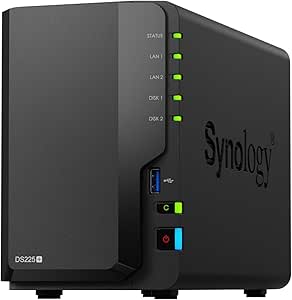
| Synology DS225+ Private Cloud | 2 | Intel CPU | 3 years | — |
| LincStation N2 6-Bay NAS Serve | — | Intel Alder Lake-N N100 | 2 years | 16GB LPDDR5 |
| QNAP TS-233-US 2-Bay Desktop N | 2 | ARM Cortex-A55 quad-core | — | 2GB RAM |
More Details on Our Top Picks
UGREEN DXP4800 Plus 4-Bay NAS for Families, Creators & Small Teams
The UGREEN DXP4800 Plus is my strongest all-round pick here for a Plex library that may grow beyond basic direct play. Its five-core Intel CPU, 8GB of DDR5 memory, and support for Docker and virtual machines give it more room for additional services than the entry-level UGREEN NAS DH4300 Plus. Four drive bays and stated support for up to 144TB also leave more capacity for a growing media collection than the two-bay Asustor Drivestor 2 Pro Gen2.
Its 10GbE and 2.5GbE ports can help with fast transfers on a suitably equipped wired network, while HDMI adds a local display option. The tradeoff is a more involved setup than a simple home backup box; drives are not included, and Plex transcoding performance is not specified in the supplied product details. I’d pick it for flexibility and headroom, not as a guarantee of a particular number of simultaneous transcodes.
Pros:- Four bays and stated support for up to 144TB provide room for a substantial media library.
- Five-core Intel CPU and 8GB DDR5 memory offer more headroom for multiple services than the entry-level DH4300 Plus.
- 10GbE and 2.5GbE ports support fast transfers on a compatible wired network.
- Docker and virtual-machine support make it useful beyond Plex and file storage.
Cons:- Diskless design means drives must be selected and purchased separately.
- Setup may be demanding for users unfamiliar with NAS administration.
- The supplied product details do not specify Plex hardware-transcoding capability.
Best for: Plex users building a large, expandable home media server who also want room for Docker, virtual machines, and other services.
Not ideal for: Beginners seeking a simple plug-and-play Plex box, or buyers who need confirmed hardware-transcoding performance before choosing.
- Drive bays:4
- Stated maximum storage:144TB
- Processor:5-core Intel CPU
- Memory:8GB DDR5
- Network ports:1 x 10GbE, 1 x 2.5GbE
- Drive interface:Serial ATA
- Additional features:Docker, virtual machines, AI photo organization
- Warranty:2 years
Our verdict“Choose the DXP4800 Plus if you want a four-bay Plex server with strong networking and room for extra services, and can handle a more technical setup.”
Asustor Drivestor 2 Pro Gen2 AS3302T v2 2-Bay NAS – Home Cloud Backup
The Asustor Drivestor 2 Pro Gen2 suits a home Plex setup where a smaller library and straightforward hardware matter more than future expansion. Its hardware-accelerated 4K transcoding is a specific media advantage over the UGREEN DXP4800 Plus, whose supplied details list a stronger feature set for general workloads but do not state Plex transcoding support. The quad-core processor and 2GB of DDR4 memory are aimed at home use, while 2.5GbE gives compatible networks more bandwidth than standard Gigabit Ethernet.
Two bays keep the unit compact and simpler to populate, but they also impose a lower ceiling for storage growth than the four-bay DXP4800 Plus or Asustor Lockerstor 4 Gen2+. Tool-free bays make drive installation less fussy, though the NAS is sold diskless. I’d choose it for a modest media collection and a clear transcoding use case, not for a large library or heavy multitasking.
Pros:- Hardware-accelerated 4K transcoding is a clear media-focused feature.
- 2.5GbE provides faster wired networking than standard Gigabit Ethernet on compatible equipment.
- Tool-free drive bays simplify installation and replacement.
- Quad-core processor is suited to home NAS services and media use.
Cons:- Two bays limit capacity and expansion compared with the four-bay models in this roundup.
- Only 2GB of DDR4 memory may constrain heavier multitasking.
- Drives are not included.
Best for: Plex households with a modest media collection that want a compact two-bay NAS and stated hardware-accelerated 4K transcoding.
Not ideal for: Media collectors expecting rapid storage growth, or users who need multiple drive bays and substantial capacity headroom.
- Drive bays:2
- Processor:Realtek quad-core
- Memory:2GB DDR4
- Network:2.5GbE
- Media feature:Hardware-accelerated 4K transcoding
- Drive configuration:Diskless
- Enclosure material:Metal
- Warranty:3 years
Our verdict“Pick this Asustor for a compact Plex server with stated 4K transcoding support, but choose a four-bay model if your library is likely to expand.”
UGREEN NAS DH4300 Plus 4-Bay Network Attached Storage for Home and Small Business
The UGREEN NAS DH4300 Plus is the storage-first choice for home Plex users who want four bays without needing the broader compute features of the DXP4800 Plus. Its stated 128TB capacity, automatic photo backups, and AI photo organization make it a practical hub for media and personal files. It also supports Docker, but not virtual machines, so it is less suited to running a wider set of demanding services than the UGREEN DXP4800 Plus.
The listed read and media speeds are 312MB/s, well below the DXP4800 Plus’s stated 1250MB/s figures; real Plex playback still depends on the network, files, and client devices. HDMI provides a local video output, but the supplied details do not confirm hardware transcoding, so I would not select it on that assumption. It is a sensible fit for local storage and direct-play libraries, with a simpler feature ambition than the higher-performance options.
Pros:- Four bays and stated support for up to 128TB suit sizeable home libraries.
- Automatic photo backup and AI organization add value beyond media storage.
- Docker support allows some additional services without moving to the DXP4800 Plus.
- HDMI output offers a local display connection.
Cons:- Virtual machines are not supported.
- The stated 312MB/s read and media speeds are lower than the DXP4800 Plus figures.
- Drives are sold separately, and Wi-Fi is not supported.
Best for: Home Plex users who prioritize four-bay local storage, photo backup, and a straightforward media library over virtual machines or advanced workloads.
Not ideal for: Buyers who need confirmed Plex hardware transcoding, virtual machines, or higher stated transfer speeds.
- Drive bays:4
- Stated maximum storage:128TB
- Drive interface:Serial ATA
- Stated read speed:312MB/s
- Stated media speed:312MB/s
- Virtualization:Docker supported; virtual machines not supported
- Video output:HDMI
- Drive configuration:Diskless
Our verdict“Choose the DH4300 Plus for four-bay home storage and basic Plex duties, but look to the DXP4800 Plus for more compute headroom or the Lockerstor for specified 4K transcoding.”
Asustor Lockerstor 4 Gen2+ AS6704T v2 4 Bay NAS for Content Creators
The Asustor Lockerstor 4 Gen2+ is the strongest fit here for users who want specifically stated media features alongside a flexible storage layout. Its Intel Celeron N5105 and hardware 4K transcoding give Plex users a clearer media-performance case than the UGREEN DXP4800 Plus, whose supplied listing does not name transcoding support. Four SATA bays, up to four NVMe cache slots, and memory expandable to 16GB also make it more adaptable than the two-bay Drivestor 2 Pro Gen2.
Dual 5GbE ports and HDMI add useful options for fast wired transfers and local display, while RAID 0/1/5/6/JBOD lets owners choose a storage arrangement around capacity or redundancy. This flexibility brings more setup decisions, and the unit ships without drives. I’d favor it over the simpler DH4300 Plus for transcoding and expansion, but it may be more NAS than a direct-play-only household needs.
Pros:- Hardware 4K transcoding is explicitly listed for media streaming.
- Dual 5GbE ports provide substantial wired-network capacity.
- Four SATA bays plus up to four NVMe cache slots offer flexible storage options.
- Memory can be expanded from 4GB to 16GB, with multiple RAID modes available.
Cons:- The diskless unit requires separate drive purchases and installation.
- Advanced storage, RAID, and networking features add setup complexity.
- Its extra capabilities may go unused in a basic direct-play Plex setup.
Best for: Plex users who want stated hardware 4K transcoding, four drive bays, NVMe cache options, and room to expand memory.
Not ideal for: Beginners who want a low-complexity media server, or direct-play users who will not use its extra networking and storage features.
- Drive bays:4
- Processor:Intel Celeron N5105 quad-core
- Installed memory:4GB DDR4
- Maximum memory:16GB DDR4
- Network:Dual 5GbE
- NVMe cache slots:Up to 4
- Video output:HDMI
- RAID modes:RAID 0/1/5/6/JBOD
Our verdict“Choose the Lockerstor 4 Gen2+ if you want a four-bay Plex NAS with specified 4K transcoding and expansion options, and are comfortable managing a more advanced system.”
Asustor Drivestor 4 Gen 2 AS1204T 4-Bay NAS Personal Cloud Backup
The Asustor Drivestor 4 Gen 2 offers four bays and 2.5GbE in a more modest hardware package than the Lockerstor 4 Gen2+. That makes it appealing for a Plex library where storage capacity and RAID choices matter more than high-end networking, NVMe cache, or expandable memory. Its Realtek quad-core processor and listed 4K media streaming support cover home media use, while RAID 0/1/5/6/10 provides several ways to balance space and drive protection.
The key compromise is 1GB of DDR4 RAM, far below the Lockerstor’s 4GB base memory and 16GB ceiling. I would treat this as a media-and-backup NAS rather than a server for many concurrent services. Its 2.5GbE connection is faster than Gigabit Ethernet on a compatible network, but it cannot match the Lockerstor’s dual 5GbE ports. Drives are not included, and Plex transcoding capability is not specified in the supplied details.
Pros:- Four bays provide more storage room than the two-bay Drivestor 2 Pro Gen2.
- 2.5GbE supports faster wired transfers than standard Gigabit Ethernet on compatible networks.
- RAID 0/1/5/6/10 offers several storage and redundancy configurations.
- Three USB ports provide additional connection options.
Cons:- 1GB of DDR4 RAM is limited for intensive multitasking.
- The supplied details do not specify Plex hardware-transcoding support.
- The diskless unit requires separate drive purchases.
Best for: Home users who want four drive bays, 2.5GbE, and flexible RAID for a Plex library plus personal backups.
Not ideal for: Plex users planning heavy multitasking, multiple server applications, or hardware transcoding that must be confirmed before purchase.
- Drive bays:4
- Processor:Realtek RTD1619B 1.7GHz quad-core
- Memory:1GB DDR4
- Network:2.5GbE Ethernet
- Supported RAID:0/1/5/6/10
- USB ports:3
- Drive configuration:Diskless
- Case type:Desktop
Our verdict“Pick the Drivestor 4 Gen 2 if you want four-bay storage and flexible RAID for home Plex use, but choose the Lockerstor for more memory, NVMe options, and stated hardware transcoding.”
Asustor Flashstor 6 FS6706T 6-Bay All-SSD NAS for Content Creators
The Flashstor 6 FS6706T is the specialist pick here: six M.2 NVMe slots favor fast, quiet storage over the large-capacity hard-drive setup offered by the Synology DS925+. That makes it a strong fit for a Plex library built around frequent reads, creative files, or a studio where drive noise matters. Its Intel Celeron N5105 supports hardware transcoding, which can help serve compatible streams when a client cannot play a file directly. Dual 2.5GbE also gives it more network headroom than a basic gigabit setup, provided the rest of your network can use it. The tradeoff is cost and capacity: NVMe drives are not included, and six SSD slots may be less economical for a very large media archive. Its listed 4GB of memory is another limit for heavier multitasking.
Pros:- Six M.2 NVMe slots provide all-flash storage without spinning-drive noise.
- Intel Celeron N5105 supports hardware transcoding for compatible Plex workloads.
- Dual 2.5GbE can improve network throughput with suitable network equipment.
- HDMI and USB connections add flexibility for local media and peripherals.
Cons:- Diskless configuration means the NVMe drives must be purchased separately.
- All-flash storage can make high-capacity media libraries expensive to build.
- The listed 4GB RAM may constrain heavier server and multitasking workloads.
Best for: Plex users with a modest-to-medium library who prioritize quiet operation, responsive SSD storage, and creative-workflow performance.
Not ideal for: Budget-focused collectors seeking the most terabytes per drive bay, or users who need verified memory expansion details before buying.
- Processor:Intel Celeron N5105 quad-core
- Drive bays:6 M.2 NVMe SSD slots
- Memory:4GB DDR4
- Network:Dual 2.5GbE
- Hardware transcoding:Supported
- Data transfer rate:295 MB/s
- Connections:Ethernet, HDMI, USB
- Warranty:3 years
Our verdict“Choose the Flashstor 6 if quiet, fast NVMe storage matters more to your Plex setup than low-cost bulk capacity.”
Synology DiskStation DS223j 2-Bay NAS (Diskless)
The Synology DS223j is the straightforward, two-bay choice for someone who wants a small home file server alongside Plex, not a machine selected for demanding transcoding. Its appeal is Synology’s private-cloud and backup ecosystem: it can keep media and personal files organized across devices, while the two drive bays allow a mirrored setup for drive-failure protection. Compared with the four-bay Synology DS423, it takes up less space and needs fewer drives to get started, but offers less room to grow. The supplied details do not identify a processor, memory amount, or hardware-transcoding support, so I would not choose it on the assumption that Plex conversion workloads will be handled well. It is diskless, and setup may take more effort for a first-time NAS owner.
Pros:- Two bays offer a compact starting point for a home media and backup server.
- Synology private-cloud tools support file access and sharing across devices.
- Automated backup features cover computers and mobile devices.
- IP camera support adds a home-security use beyond Plex.
Cons:- Only two drive bays limit capacity and future storage growth.
- Diskless configuration requires separate drive purchases.
- Provided product details do not establish hardware-transcoding support or processor performance.
Best for: First-time NAS owners who want Synology backup and file-sharing tools with a small Plex library, especially when clients can play media directly.
Not ideal for: Users who expect frequent Plex transcoding, need a large expandable library, or want documented hardware-transcoding capability.
- Model:DS223j
- Drive bays:2
- Configuration:Diskless NAS
- Warranty:2 years
- Backup features:Automated backup for Macs, PCs, and mobile devices
- File access:Private cloud and multi-platform file sharing
- Surveillance support:IP cameras
Our verdict“Pick the DS223j for basic Plex storage and Synology’s home backup tools, but not for a transcoding-heavy media server.”
Synology 4-Bay DiskStation DS925+ (Diskless)
For a Plex collection that is outgrowing a two-bay enclosure, the Synology DS925+ offers four drive bays and dual 2.5GbE ports, making it a more expandable storage base than the DS223j. Its stated sequential read and write figures suggest strong throughput for file serving, though they do not establish how many Plex streams it can transcode. That distinction matters: the supplied product details list no processor, memory, or hardware-transcoding capability, so I would judge this primarily as a high-throughput NAS rather than assume it is a Plex conversion specialist. Synology’s data-management, protection, and virtualization features broaden its use beyond media. The tradeoffs are a diskless start and a setup experience that may feel involved to beginners; buyers should verify Plex compatibility against their specific transcoding needs.
Pros:- Four drive bays provide more storage flexibility than two-bay options such as the DS223j.
- Dual 2.5GbE ports support faster networking with compatible equipment.
- Published sequential throughput figures offer useful context for file-transfer workloads.
- Data protection and management features suit use beyond Plex.
Cons:- Diskless configuration requires separate drive purchases.
- Processor, memory, and hardware-transcoding details are not provided in the supplied specs.
- Feature-rich setup may be challenging for less experienced NAS owners.
Best for: Plex households with a growing media library that want four-bay storage, faster networking, and Synology data-management features.
Not ideal for: Buyers who need confirmed hardware-transcoding performance, want a simple plug-and-play setup, or prefer an enclosure with drives included.
- Drive bays:4
- Network ports:2 x 2.5GbE
- Sequential read throughput:522 MB/s
- Sequential write throughput:565 MB/s
- Configuration:Diskless
- Warranty:3 years
- Additional capabilities:Data protection, virtualization, and surveillance features
Our verdict“Choose the DS925+ when four-bay growth and faster network transfers matter, after confirming its Plex transcoding fit for your workload.”
Synology DS425+ Private Cloud Media Server – 4-Bay Diskless NAS
The Synology DS425+ fits buyers who want four drive bays in a compact desktop enclosure, with data sharing, backups, and surveillance alongside Plex. Its listed dimensions and 2.18 kg weight make it easier to place on a shelf or desk than a larger storage system, while multi-user access suits a household that shares files as well as media. Compared with the DS925+, the supplied network-speed figure is lower, and the DS425+ has no stated dual-port network configuration or sequential read/write figures here. The product information also does not specify its processor or hardware-transcoding support, so Plex buyers should verify those details rather than infer performance from the “media server” label. It ships without drives, and the stated capacity limit leaves less headroom for collectors seeking a very large archive.
Pros:- Four bays support a larger storage pool than two-bay models such as the DS223j.
- Compact dimensions and low listed weight suit desk or shelf placement.
- Multi-user access supports shared media and files across compatible devices.
- RAID and snapshots add data-protection options.
Cons:- Diskless setup requires buying compatible drives separately.
- Processor and hardware-transcoding details are not included in the supplied specs.
- The stated storage ceiling is 80 TB, with no expansion option listed.
Best for: Home users who want a compact four-bay Synology for Plex, shared files, backups, and surveillance in one desktop enclosure.
Not ideal for: Plex users whose priority is documented transcoding performance, maximum network throughput, or storage beyond the stated 80 TB limit.
- Model:DS425+
- Drive bays:4
- Configuration:Diskless
- Network speed:278 MB/s
- Stated storage volume:80 TB
- Dimensions:8.78 x 7.83 x 6.54 in
- Weight:2,180 g
- Warranty:3 years
Our verdict“Choose the DS425+ for a compact four-bay Synology that combines Plex storage with everyday backup and sharing, not for unverified transcoding demands.”
Synology DS423 4-Bay Diskless NAS for Backup, File Sharing, Photo Vault & Video Surveillance
The Synology DS423 makes the most sense when Plex is one job among several: its four bays can hold a media collection while Synology’s backup, file-sync, photo, and surveillance tools serve the rest of the household. That broader role distinguishes it from the SSD-focused Asustor Flashstor 6, which prioritizes fast flash storage and lists hardware transcoding. The DS423’s supplied details do not name its processor, memory, network speed, or Plex transcoding support, so I would not rank it as a performance-first Plex server without checking those points. Its four-bay layout is a useful step up from the two-bay DS223j, but the diskless configuration means extra drive purchases, and deploying all of its services can take technical patience. Surveillance also requires separate camera licenses.
Pros:- Four bays provide more room for a media collection than the two-bay DS223j.
- Built-in backup and file-sync tools broaden its usefulness beyond Plex.
- Photo management and surveillance support make it a versatile household server.
- Data-protection and malware-resistance features support safer file storage.
Cons:- No drives are included, so storage must be added separately.
- Processor, network speed, and hardware-transcoding specifications are not supplied here.
- Surveillance use requires separate camera licenses, and setup can be complex.
Best for: Households that want a four-bay NAS for Plex storage plus automated backups, photo organization, file sharing, and surveillance.
Not ideal for: Users choosing mainly for hardware transcoding or maximum network speed, since those capabilities are not specified in the supplied product data.
- Model:DS423
- Drive bays:4
- Configuration:Diskless NAS
- Warranty:2 years
- Dimensions:9 x 6.6 x 7.24 in
- Weight:2,210 g
- Mounting type:Tabletop
- Enclosure material:Metal
Our verdict“Pick the DS423 if you want Plex as part of a broader four-bay home backup and media hub rather than a NAS selected for stated transcoding performance.”
UGREEN NAS DXP4800 GT 4-Bay for Creators, Tech Enthusiasts, and Office Teams
I’d choose the DXP4800 GT when a Plex library is only one part of a demanding home or office server. Its four-core Ryzen Embedded R2514 and 8GB of RAM give it more room for concurrent services than the two-bay DXP2800, while the dual 10GbE ports can speed up transfers on a suitably equipped network. Four SATA bays provide a practical path to a large media library, with NVMe and M.2 slots for additional SSD storage. The tradeoff is complexity: its many storage and networking options ask more of the person setting it up, and the supplied RAM is non-ECC. For Plex buyers who want a simpler, compact system, the Synology DS225+ is a more straightforward alternative, though it offers fewer bays and less expansion headroom.
Pros:- Four SATA bays support a larger Plex library than the two-bay DXP2800 or Synology DS225+
- Ryzen Embedded quad-core processor and expandable memory provide room for multitasking
- Dual 10GbE ports support fast transfers on compatible network equipment
- NVMe and M.2 slots add SSD storage options, alongside built-in surveillance features
Cons:- Diskless configuration means the buyer must supply and configure drives
- Advanced storage and networking features can make setup challenging for beginners
- Included RAM is non-ECC; an ECC upgrade requires compatible memory
Best for: Plex owners who also run several services, manage large media files, or need fast network transfers for a small office
Not ideal for: First-time NAS buyers seeking a simple two-bay Plex setup, or anyone who does not need its advanced networking and storage expansion
- Processor:AMD Ryzen Embedded R2514, 4 cores, up to 3.70GHz
- Memory:8GB DDR4, expandable to 64GB
- Drive bays:4 SATA bays
- SSD slots:2 U.2 NVMe slots and 2 M.2 SSD slots
- Maximum stated capacity:Up to 144TB
- Networking:Dual 10GbE ports with link aggregation support
- Connectivity:USB 3.2, USB-C, HDMI, and SD card slot
- Security:TLS/SSL, RSA, AES, SHA-512, and RAID support
Our verdict“Choose the DXP4800 GT if Plex shares a powerful, expandable server with other demanding workloads and you are comfortable configuring it.”
UGREEN NAS DXP2800 2-Bay for Advanced Home Users, Remote Workers & Creators
The DXP2800 suits Plex households that want capable hardware in a two-drive setup rather than the four-bay footprint of the DXP4800 GT. Its Intel N100 quad-core processor and 8GB DDR5 RAM are a stronger starting point for media management and concurrent tasks than the QNAP TS-233’s 2GB of memory. The stated capacity reaches 80TB, but that figure depends on the installed drives; this NAS ships without them. The two-bay design keeps the system focused, yet gives less room to grow than the DXP4800 GT or LincStation N2, whose additional storage slots better suit expanding libraries. I’d shortlist the DXP2800 for an advanced home user who values a modern x86 platform and can handle setup, not for someone seeking a plug-and-play Plex appliance.
Pros:- Intel N100 quad-core processor and 8GB DDR5 RAM provide a capable base for media and multitasking
- Two SATA bays support a stated capacity of up to 80TB with suitable drives
- AI-powered surveillance features add a use beyond Plex and file storage
- x86 hardware platform supports a range of media and home-server workloads
Cons:- Diskless configuration requires separate drive purchases and installation
- Two bays offer less expansion room than the DXP4800 GT or LincStation N2
- Setup and configuration may be challenging for buyers new to NAS systems
Best for: Advanced home Plex users and remote workers who want a two-drive NAS with x86 hardware for media and other services
Not ideal for: Beginners who want guided, minimal configuration, or Plex collectors who need more than two drive bays for future expansion
- Processor:Intel N100 quad-core
- Memory:8GB DDR5
- Drive bays:2 SATA bays
- Maximum stated capacity:Up to 80TB
- Hardware platform:x86
- Connectivity:Ethernet, SATA 6.0 Gb/s, and USB
- Drive form factor:3.5-inch
- Warranty:2 years
Our verdict“Pick the DXP2800 if you want a capable two-bay Plex server and can configure the system and supply your own drives.”
Synology DS225+ Private Cloud Media Server – 2-Bay Diskless NAS with Intel CPU for Hardware Transcoding
I’d favor the Synology DS225+ for a modest Plex library when a compact two-bay system and familiar media-server features matter more than high capacity. Its listing specifies an Intel CPU and hardware transcoding, which can help with compatible playback situations where a Plex client cannot directly play a file. The compact enclosure and automated backup features also make it a natural fit for a home media and file hub. Compared with the UGREEN DXP2800, it is presented as a more focused media-server option, but its stated maximum capacity is lower and it has no additional bays for a growing collection. It is diskless, so drives are a separate purchase, and the provided CPU details are limited; buyers with heavier workloads should compare it with the Ryzen-based DXP4800 GT.
Pros:- Hardware transcoding support is aimed at media playback across compatible Plex clients
- Compact two-bay enclosure fits a home media and backup setup
- Automated backups and data-protection features add utility beyond streaming
- Supports up to 30 IP cameras according to the product description
Cons:- Diskless configuration requires separate drive purchases
- Two bays and a stated maximum capacity of 40TB limit room for a large or growing library
- CPU details provided are limited, making performance comparisons harder for demanding Plex workloads
Best for: Home Plex users who want a compact two-bay media and backup server with stated hardware transcoding support
Not ideal for: Large-library owners needing many drive bays, or power users who need detailed, higher-performance processor specifications for multiple workloads
- Processor:Intel CPU
- Drive bays:2
- Maximum stated capacity:40TB
- Transcoding:Hardware transcoding support stated in product description
- Dimensions:9.14 × 4.25 × 6.5 inches
- Weight:1300g
- Surveillance support:Up to 30 IP cameras
- Warranty:3 years
Our verdict“Choose the DS225+ for a compact, focused Plex and backup system, but look to a larger-bay NAS if your media library is likely to grow substantially.”
LincStation N2 6-Bay NAS Server, Intel N100 16GB LPDDR5 RAM, 10GbE, 2 SATA Bays, 4 M.2 NVMe Slots, DIY NAS for Plex, Docker, Private Cloud, Unraid Starter License Included, Diskless
The LincStation N2 takes a different route from the larger, conventional four-bay DXP4800 GT: it pairs two SATA bays with four M.2 NVMe slots in a compact enclosure. That layout suits a DIY Plex server where SSD storage and a small footprint matter more than filling a chassis with hard drives. Its Intel N100 and 16GB LPDDR5 memory provide a stronger memory allowance than the DXP2800, while 10GbE supports fast transfers on a compatible network. The included Unraid starter license gives technically confident buyers flexibility over storage management, but this is not the simplest path into Plex. It ships without drives, and its two SATA bays limit conventional hard-drive expansion compared with the four-bay UGREEN models.
Pros:- Four M.2 NVMe slots complement two SATA bays for flexible storage layouts
- Intel N100 and 16GB LPDDR5 RAM provide a capable base for Plex and other services
- 10GbE networking supports fast transfers with compatible network equipment
- Includes an Unraid OS starter license for DIY storage management
Cons:- Diskless system requires the buyer to source and install storage
- Only two SATA bays limit conventional hard-drive expansion compared with the DXP4800 GT
- DIY operating-system and storage configuration can be demanding for beginners
Best for: Technically confident Plex builders who want a compact system with NVMe-heavy storage, 10GbE, and Unraid
Not ideal for: Beginners seeking a guided, low-maintenance NAS, or buyers planning to expand a large library mainly with SATA hard drives
- Processor:Intel Alder Lake-N N100
- Memory:16GB LPDDR5
- Storage bays:2 SATA bays and 4 M.2 NVMe slots
- Networking:10GbE
- Operating system:Unraid OS starter license included
- Dimensions:5.9 × 8.2 × 1.5 inches
- Weight:800g
- Warranty:2 years
Our verdict“Choose the LincStation N2 if you want a compact DIY Plex server built around NVMe storage and are comfortable managing Unraid.”
QNAP TS-233-US 2-Bay Desktop NAS with ARM Cortex-A55 Quad-core Processor and 2 GB RAM
The QNAP TS-233 is the simple home-media pick in this group, with a compact two-bay design and features for organizing photos and streaming media. Its ARM Cortex-A55 quad-core processor and hardware-accelerated transcoding support provide a media-focused feature set, but the 2GB of RAM makes it a less suitable choice for running Plex alongside numerous other services. Compared with the Intel-based Synology DS225+, the QNAP has less listed memory and is better treated as a modest household server than a multitasking hub. It also has only two bays and arrives without drives, so buyers with large collections may be better served by the four-bay DXP4800 GT. The product data does not specify a clear usable storage ceiling or detailed Plex transcoding compatibility, so check those needs before choosing.
Pros:- Compact two-bay design suits a home media and storage setup
- Hardware-accelerated transcoding is listed among its media features
- AI-powered image recognition supports photo organization
- Snapshot protection and secure remote access add data-management features
Cons:- 2GB of RAM limits headroom for Plex alongside heavier multitasking
- Diskless configuration requires separate drive purchases
- Two bays provide less room for library growth than four-bay options such as the DXP4800 GT
Best for: Households seeking a compact two-bay NAS for a modest Plex library, media organization, and basic home storage
Not ideal for: Plex users running many concurrent services, building a large media library, or needing clearly documented transcoding performance
- Processor:ARM Cortex-A55 quad-core
- Memory:2GB RAM
- Drive bays:2
- Drive interface:Serial ATA-600
- Transcoding:Hardware-accelerated transcoding listed
- Connectivity:SATA and USB
- Media speed:125 MB/s
- Platform:ARM
Our verdict“Pick the TS-233 for a modest home Plex and media setup, not for a large library or a server running many demanding services.”

How We Picked
I ranked these NAS devices around the demands of a Plex setup: whether the hardware is suited to direct play or transcoding, how much storage flexibility the enclosure provides, and how approachable the system is to configure and maintain. I also weighed connectivity, memory and processor class where specified, noise and power implications of different drive approaches, and whether a model leaves room for a library to grow. A Plex label alone does not guarantee that every format or stream will transcode smoothly; the server’s hardware, Plex settings, client device and media format all affect the result.
The order reflects the balance of those factors for the widest range of Plex households, not a claim that one model suits every library. Four-bay systems rank well for expandable storage, while the DS225+ earns attention for its stated hardware-transcoding focus and the Flashstor 6 for all-SSD use. Simpler two-bay units remain relevant for direct-play libraries and first NAS setups, but rank below more capable or expandable options when judged as long-term Plex servers. I treat diskless products as requiring a separate drive purchase.
Factors to Consider When Choosing Best NAS Devices For Plex
Choosing a Plex NAS starts with how your household actually watches media, not with the biggest processor specification. I’d settle the playback and storage questions first, then compare software, networking and maintenance needs.
Do You Need Transcoding, or Will Direct Play Work?
Direct play sends a compatible media file from the NAS to the client without converting it, which places far less demand on the server. Transcoding can be needed when a client cannot handle a file’s codec, bitrate, subtitles or resolution, and that workload may determine which NAS makes sense. Check the devices people use to watch Plex and the formats in your library before choosing hardware. Subtitle burn-in and multiple simultaneous streams can add demands that a casual single-screen setup avoids. A common mistake is buying around a headline processor feature without checking whether Plex and your intended configuration can use it. If you expect frequent conversions, favor a model with suitable hardware support; if your clients mostly direct play, storage layout and ease of management may matter more.
How Much Storage and Drive Flexibility Do You Need?
Count the space your current library occupies, then account for new additions, backups and any non-media files sharing the NAS. Two bays can be enough for a smaller collection, but they limit the number of drives and may force a storage rebuild sooner as the library expands. Four bays offer more options for combining capacity and redundancy, though adding bays does not replace a separate backup. RAID or similar drive protection can help a NAS stay available after a drive failure, but it is not a substitute for another copy of important files. Also check drive compatibility and the enclosure’s supported storage arrangements before buying disks. Choose bay count for your likely growth, rather than assuming the first capacity estimate will remain fixed.
Choose Between Hard Drives, SSDs and NVMe Carefully
Hard drives usually suit large media libraries because they offer a practical path to high capacity, while SSD-based systems can reduce mechanical noise and improve responsiveness for other NAS tasks. Plex video playback itself often does not need an all-SSD pool, so paying for flash storage may not improve ordinary streaming. SSDs can make more sense when quiet operation, frequent file access or creator workloads share the system with Plex. NVMe slots may serve as storage or cache depending on the NAS and its software; do not assume they automatically speed up every Plex stream. Compare total usable capacity, drive costs, heat and replacement options before picking an all-flash layout. The Flashstor 6 and LincStation N2 illustrate that compact, fast storage comes with a different capacity and configuration tradeoff than a conventional multi-drive hard-disk NAS.
Match Network Speed to the Rest of Your Setup
A faster network port only helps when the NAS, switch or router, and playback devices can use a compatible connection. For typical home streaming, the network’s stability and the client’s connection can matter more than chasing the highest port specification. Higher bandwidth becomes more useful when several people stream at once, large files move between computers, or a creator workflow shares the NAS. Wi-Fi conditions and router placement can be bottlenecks even when the NAS has a fast Ethernet port. Before paying for advanced networking, identify which devices would connect at that speed and whether you need a suitable switch or cabling. This keeps a network upgrade from becoming an expensive feature that sits unused.
Weigh Software Simplicity Against Customization
A NAS operating system affects setup, updates, user permissions, storage management and the time required to keep Plex running. Buyers who prefer an appliance-style experience may value a familiar interface and a clear path for routine maintenance. Those comfortable configuring containers or alternative NAS software may appreciate more flexibility, but should account for the learning and troubleshooting involved. Check how Plex is installed on the system you are considering and whether the required app or deployment method fits your skills. Also review how updates are handled, since a media server is a long-running service rather than a one-time setup. The right balance is the system you can maintain confidently, not simply the one with the most configurable options.
Budget for Drives, Backup and Ongoing Upkeep
Most models in this roundup are sold without drives, so the enclosure is only part of the total system you need to plan. Add compatible disks, a backup destination and any network gear required for your home setup to your budget. Media that can be replaced may not need the same backup priority as personal videos, photos or project files, but a single NAS should not be treated as a complete backup plan. Think about drive replacement, firmware updates, dust, heat and where the unit will sit before committing to a larger system. A higher-capacity NAS can delay expansion, yet it can also bring more drives, power use and maintenance. Buy capacity and features for the workload you expect, while leaving room for the files you cannot replace.
Frequently Asked Questions
Is a NAS with hardware transcoding necessary for Plex?
No. If your playback devices can handle the files in your library, Plex can often use direct play and the NAS may not need to transcode video. Hardware transcoding becomes more relevant when clients need media converted, when bandwidth limits require a lower bitrate, or when several users watch incompatible formats. Check Plex’s support and configuration requirements for the specific NAS and server setup before relying on that feature. A transcoding-capable model is a safer choice for mixed devices, but it does not remove the need to check codecs, subtitles and stream count.
Should I choose a two-bay NAS or a four-bay NAS for a Plex library?
Choose based on how quickly your library may grow and how much drive flexibility you want, rather than only the size of today’s collection. A two-bay system can suit a modest library and a simpler setup, but it gives you fewer drive arrangements and less room to expand internally. Four bays offer more scope to add capacity over time, although they require more drives and do not automatically provide a backup. Consider whether you will store family files or work projects alongside media, since those may increase your capacity needs. If you expect steady growth, starting with four bays can reduce the chance of replacing the enclosure early.
Can I use an all-SSD NAS for Plex, or are hard drives a better fit?
Either can host a Plex library, but the best fit depends on capacity, noise and other workloads. Hard drives are often the practical choice for large collections because they let you build capacity across multiple bays. An all-SSD system can be attractive when quiet operation or fast access for creative work matters, but Plex playback does not automatically benefit from flash storage if the network and client are the limiting factors. Compare the storage you can afford and maintain, not just the speed of the drive type. Also check whether the NAS supports the exact SSD arrangement you plan to use.
Will a faster Ethernet port improve Plex streaming on my home network?
Only when the rest of the path can use that speed and your workload benefits from the extra bandwidth. A compatible switch, cabling and client connection may be needed, and ordinary streaming can be limited by Wi-Fi quality or the playback device instead. Faster Ethernet is more compelling for several concurrent streams, large transfers or creator files moving between computers and the NAS. A single-user direct-play setup may gain little from a high-speed port. Check the connection speeds of your router and key devices before choosing a NAS for networking alone.
Do I still need a separate backup if my NAS has drive redundancy?
Yes. Drive redundancy can keep a system available after some drive failures, but it does not protect files from accidental deletion, malware, theft, fire or damage to the NAS itself. Keep another copy of important personal media and work files on a separate device or backup service. You can prioritize replaceable Plex media differently from family recordings, photos and documents that cannot be recreated. Test that you can restore files from the backup rather than assuming it is working. Factor the backup destination and routine into your setup from the start.
Conclusion
For the broadest mix of Plex use and storage growth, I’d choose the UGREEN DXP4800 Plus as the best overall pick. The Synology DS225+ is the better fit for buyers who specifically want a two-bay Synology with an Intel platform and a stated hardware-transcoding focus, while the UGREEN DXP2800 is a sensible value-oriented option for a smaller library and a compact setup. Beginners should look closely at Synology’s simpler two-bay choices, especially the DS223j if their playback is mostly direct play and they do not need a more capable server. For a premium, expandable four-bay setup, compare the Asustor Lockerstor 4 Gen2+ and Synology DS925+ against your preferred software and hardware needs. Choose the Asustor Flashstor 6 for an all-SSD approach, or the LincStation N2 if its mix of SATA, NVMe and 10GbE matches a more hands-on setup. Whichever NAS you pick, match its transcoding ability to your clients and keep a separate backup for files you cannot replace.
Fall Picks
fall essentials
As an affiliate, we earn on qualifying purchases.