
To determine if a workload fits on a tower or rack server, consider your space, scalability needs, and power efficiency. If you need easy access and upgrades for a smaller setup, a tower server works well. For high-density environments with heavy processing or future growth, rack servers are better due to their compact size and scalability features. Understanding your workload demands helps you pick the right option, and exploring further will give you more tailored insights.
Key Takeaways
- Assess workload processing power and storage needs to determine if high expansion or intensive tasks require a tower or rack server.
- Consider space availability; larger physical spaces suit tower servers, while limited space favors rack servers.
- Evaluate energy efficiency requirements; rack servers typically consume less power for high-density deployments.
- Determine future scalability needs; rack servers support easier expansion for growing workloads.
- Review maintenance and management complexity; tower servers are better for standalone, simple setups, while rack servers suit data centers.

Choosing between a tower and a rack server depends on your workload’s specific requirements, as each has distinct advantages. When evaluating which type fits best, consider factors like power consumption and physical footprint. Tower servers are typically larger and resemble traditional desktop computers, making them suitable for environments where space isn’t severely limited. They often have higher power consumption because they house more components and provide greater expandability. If your workload involves less frequent maintenance or occasional upgrades, a tower server’s size and design can be advantageous, offering easy access and flexibility without needing specialized racks or mounting hardware.
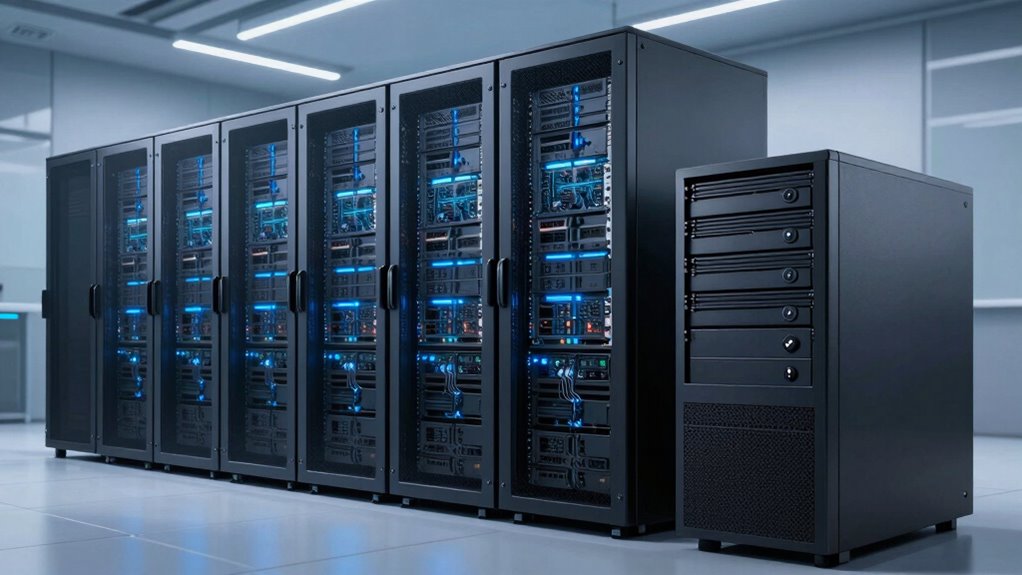
In contrast, rack servers are designed to fit into data centers or environments with limited space. Their compact, standardized form factor allows you to maximize physical footprint efficiency, stacking multiple servers in a single rack. This setup is ideal if you need to scale your infrastructure or manage many servers within a confined area. Rack servers typically consume less power per unit because of their streamlined design, which emphasizes energy efficiency and better airflow. This can reduce overall energy costs, especially when deploying multiple units. Additionally, rack servers are built for high-density environments, so they often include features like hot-swappable drives and redundant power supplies that support continuous operation with minimal downtime. energy efficiency is an increasingly important factor in choosing server types, especially as data centers seek to reduce operational costs. Furthermore, the physical footprint of a server influences how well it integrates with existing infrastructure, making it essential to consider when planning growth or upgrades.
Considering future scalability is also crucial because deploying a server that can adapt to your evolving needs can save significant time and resources later. Selecting the right server type also involves evaluating workload demands, ensuring your infrastructure can grow seamlessly as your needs evolve.
It is also important to think about management and maintenance requirements, as these can differ significantly between tower and rack servers, impacting operational efficiency over time. Your workload’s nature plays a critical role in this decision. If your applications demand intensive processing, high storage capacity, or significant hardware expansion, a tower server’s larger physical footprint and capacity could be beneficial. However, if you prioritize space efficiency, energy savings, and ease of management, a rack server’s streamlined design aligns better with those goals. Think about your current infrastructure and future growth plans. Will you need to add more servers down the line? Will space constraints limit your options? These questions help determine whether the larger, versatile tower or the space-saving, scalable rack server fits your needs.
Ultimately, understanding how each server type impacts power consumption and physical footprint helps you make an informed choice. Tower servers may be more suitable for smaller, standalone setups, while rack servers excel in data centers or environments where space and energy efficiency are top priorities. By aligning your workload’s demands with these hardware characteristics, you guarantee ideal performance, manageability, and cost-effectiveness for your infrastructure.

Hewlett Packard Enterprise ProLiant MicroServer Gen11 Tower Server, Intel Xeon 6315P Processor, 16GB Memory, External 180W US Power Supply (HPE Smart Choice P86811-005)
MODEL P86811-005: HPE ProLiant MicroServer Gen11 preconfigured with Intel Xeon 6315P 2.80GHz 4-core processor, ideal for small business…
As an affiliate, we earn on qualifying purchases.
As an affiliate, we earn on qualifying purchases.
Frequently Asked Questions
What Are the Cost Differences Between Tower and Rack Servers?
Rack servers usually cost more upfront due to their advanced hardware compatibility and higher performance capabilities, but they can save money long-term through easier scalability and maintenance. Tower servers are generally cheaper initially, with simpler setup and less specialized hardware, but may lead to higher costs over time if you need to upgrade or expand. Your choice depends on balancing initial investment versus ongoing operational expenses and setup complexity.
How Does Maintenance Differ Between Tower and Rack Servers?
Did you know that rack servers often have 20% easier maintenance due to remote management capabilities? You’ll find rack servers designed for quick physical accessibility, making component swaps faster in data centers. Tower servers, however, may require more effort since they’re usually set up in fixed locations, needing physical access for upgrades or repairs. Your choice impacts how smoothly you manage updates, repairs, and troubleshooting over time.
Which Server Type Offers Better Scalability Options?
Rack servers generally offer better scalability options because they support extensive hardware customization and easier cloud integration. You can add more modules, storage, or processing power to meet growing demands. Tower servers are more limited in expansion, making them suitable for smaller workloads. If you anticipate needing significant upgrades or cloud adaptability, rack servers are your best choice, providing flexibility to scale efficiently as your workload increases.
Are Rack Servers More Energy-Efficient Than Tower Servers?
Rack servers are generally more energy-efficient than tower servers because they optimize space and cooling, reducing overall energy consumption. Their design allows for better airflow and easier power management, which improves power efficiency. If you’re concerned about minimizing energy use and maximizing power efficiency, rack servers are often the better choice, especially in data center environments where energy costs and efficiency are critical factors.
How Do Noise Levels Compare Between Tower and Rack Servers?
Noise levels differ distinctly between tower and rack servers. Tower servers tend to produce louder, more noticeable noise, impacting acoustic performance in quiet environments. Rack servers often operate more quietly due to streamlined cooling and design efficiency, making them better suited for noise-sensitive spaces. For peace and quiet, rack servers typically offer a quieter noise comparison, while towers may generate more disruptive noise, especially under heavy workloads.

Tecmojo 4U Wall Mount Rack,4U Rack 14 inch Depth,19" Network Rack for Shallow Server and IT Equipment, Network Switches,Patch Panel Bracket,110lbs(50kg) Weight Capacity,Black
Sturdy:4u server rack is construct from cold rolled steel, with a weight capacity of 110lbs(50kg); Electrostatic powder coat…
As an affiliate, we earn on qualifying purchases.
As an affiliate, we earn on qualifying purchases.
Conclusion
Choosing the right server type depends on your workload needs and space constraints. Remember, rack servers are ideal for scalability and high-density environments, while tower servers suit small offices or less intensive tasks. Notably, a recent survey shows that 65% of data centers now prefer rack servers for their efficiency. By understanding your workload requirements, you can confidently select the best fit, ensuring peak performance and future growth.

1U Brush Panel (2 Pack) 19 inch Rackmount Strip Cable Management Spacer for Network Server Rack Cabinet Enclosure – High Density Filler (Increased Airflow – Decreased Dust Accumulation) Tupavco TP1710
[Cable Management] 1U Brush panel will complement your rackmount gear and make cable management look organized and professional.
As an affiliate, we earn on qualifying purchases.
As an affiliate, we earn on qualifying purchases.

Advanced Concepts for Renewable Energy Supply of Data Centres
As an affiliate, we earn on qualifying purchases.
As an affiliate, we earn on qualifying purchases.