
To prove where your data came from, you need to track its full lifecycle through data lineage. This involves documenting data’s origin, transformations, and movement across systems using automated tools, logs, or metadata. By establishing a clear map of data flow, you can demonstrate its source and how it’s been modified, ensuring transparency and compliance. Continuing further will help you understand how to effectively implement and leverage data lineage in your environment.
Key Takeaways
- Use automated tools to extract and record data transformations, movements, and dependencies from code, logs, and metadata.
- Maintain detailed documentation of data sources, processing steps, and system interactions to establish provenance.
- Implement standardized metadata and telemetry (e.g., OpenLineage) to track data flow consistently across systems.
- Combine automated lineage capture with manual annotations for complex or custom data processes.
- Regularly audit and verify lineage records to ensure accuracy and demonstrate data origin for compliance and trust.
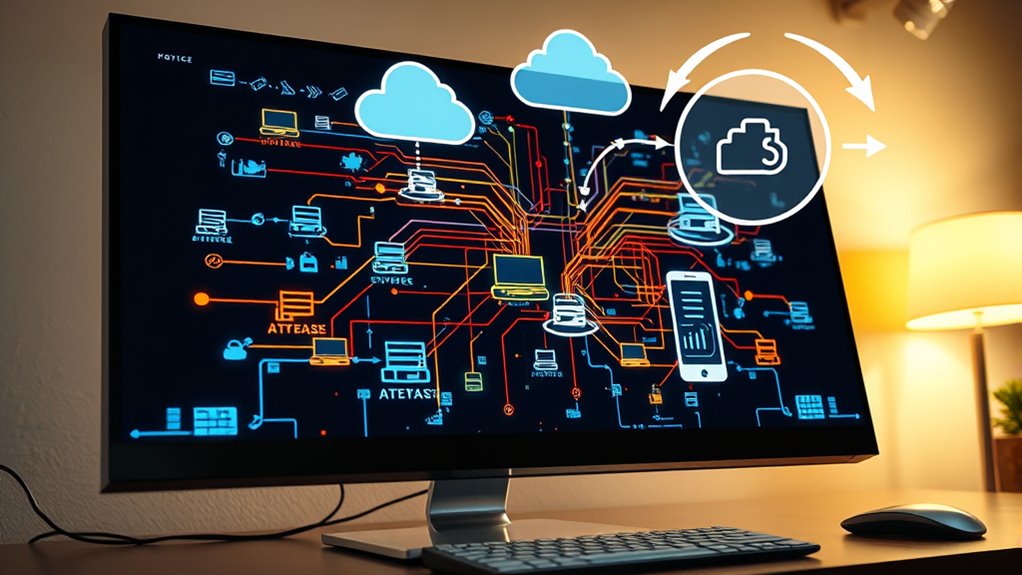
Understanding data lineage is essential for tracing the journey of data across your systems. It documents the full lifecycle of a dataset, from its origin to its final use, capturing every transformation, movement, and dependency along the way. When you look into data lineage, you’re fundamentally creating a clear map that shows where data starts, how it’s processed, and where it ends up. This visibility is critical for understanding data flow, diagnosing issues, and ensuring trustworthiness in your analytics and reporting. Data lineage also helps organizations meet compliance requirements by providing detailed records of data handling processes. Data lineage tracks metadata about sources, transformations, and destinations, often modeling datasets, jobs, and execution instances to illustrate the flow of data. It can be viewed at different levels of detail. For high-level impact analysis, table-level lineage maps relationships between datasets, showing how data moves between tables and systems. For more precise tracking, column-level lineage follows individual fields through complex workflows, capturing specific transformations like joins, calculations, and aggregations. This detailed view lets you pinpoint exactly how particular data attributes are altered or combined during processing. The primary goal of data lineage is to provide transparency and confidence. It helps you perform root-cause analysis by tracing errors or inconsistencies back to their source, whether that’s a particular transformation, data source, or system. When a report shows an unexpected result, you can follow the lineage to find the exact step where data diverged from expectations. This capability guarantees you can quickly locate and fix issues, reducing downtime and improving data quality. Data lineage also supports compliance and auditability. By maintaining an auditable trail of data movement and transformations, you can demonstrate adherence to regulatory requirements and internal controls. This is especially important when handling sensitive data or meeting industry standards. Additionally, understanding data dependencies through lineage enables safer schema changes or pipeline updates. You can identify downstream consumers affected by modifications, minimizing risks and disruptions. Methods for capturing data lineage include automated extraction from code, logs, and metadata, as well as manual annotations where automatic tools fall short. Hybrid approaches combine both, ensuring comprehensive and accurate lineage mapping. Standards-based telemetry, like OpenLineage, helps standardize data flow models across tools, making it easier to integrate and analyze lineage information. Incorporating automated tools that leverage machine learning can further enhance the accuracy and completeness of data lineage documentation, making the process more efficient and reliable.
Frequently Asked Questions
How Does Data Lineage Differ From Data Cataloging?
Data lineage shows you the data’s journey, including its origins, transformations, and destinations over time. It provides detailed, often visual, tracking of data’s lifecycle, helping you understand how data changes and flows across systems. Data cataloging, on the other hand, organizes metadata about datasets, making it easy to find, understand, and manage data assets. While lineage focuses on data movement, catalogs focus on metadata organization and data discovery.
What Are Common Challenges in Implementing Automated Data Lineage?
You might think implementing automated data lineage is straightforward, but it’s often challenging. You’ll face issues like inconsistent metadata, difficulty integrating diverse systems, and keeping lineage updated as data flows evolve. Automated tools can struggle with complex transformations and unstructured data. To succeed, you need clear standards, continuous monitoring, and collaboration across teams, ensuring lineage remains accurate and useful amid rapid changes.
How Does Data Lineage Support Compliance With Data Regulations?
Data lineage helps you stay compliant by providing a clear, auditable trail of your data’s origin, transformations, and usage. You can easily prove data was handled according to regulations, identify any unauthorized changes, and demonstrate transparency to auditors. By visualizing and documenting data flows, you guarantee adherence to privacy laws, security standards, and regulatory requirements, reducing the risk of penalties and building trust with stakeholders.
Can Data Lineage Be Integrated With Existing Data Governance Tools?
Seventy percent of organizations report that integrating data lineage with governance tools improves compliance. You can easily connect data lineage with your existing governance platforms by leveraging metadata, APIs, or automation tools. This integration allows you to visualize data flows, track changes, and enforce policies seamlessly. By doing so, you enhance transparency, streamline audits, and reduce risks, making your data management more efficient and compliant without overhauling your current system.
What Are the Best Practices for Maintaining Up-To-Date Lineage Records?
To keep your lineage records current, you should automate data flow extraction whenever possible, integrating lineage tools with your data pipelines. Regularly review and update metadata manually for complex or critical data. Establish clear ownership and documentation standards, and set up alerts for changes in data sources or transformations. Consistently monitor and validate lineage accuracy through audits, ensuring your records reflect real-time data processes for reliable governance and troubleshooting.
Conclusion
Understanding data lineage helps you trace data origins effortlessly, ensuring transparency and trust. Did you know that organizations with clear data lineage are 50% more likely to comply with regulatory requirements? By mastering these basics, you can confidently prove where your data came from, making audits smoother and decisions more reliable. Keep focusing on data lineage—it’s your key to data integrity and operational excellence.