
Your UPS runtime calculations often fall short because you overlook key factors like battery aging, temperature effects, and fluctuating loads. These elements cause actual runtime to differ markedly from simple theoretical estimates. Battery capacity declines over time, and real-world conditions impact performance heavily. Relying solely on straightforward formulas ignores these nonlinear factors. To get accurate predictions, you need to contemplate these influences and do real-world tests. Keep going to learn more about refining your calculations effectively.

Get business pricing on networking and server gear
- Business-only prices and quantity discounts
- Tax-exempt purchasing
- Multiple users, one account, clear invoices
Key Takeaways
- Simplified formulas often assume linear load-to-runtime relationships, ignoring nonlinear factors like battery aging and temperature effects.
- Actual UPS runtime is heavily influenced by environmental conditions and fluctuating load demands, not just rated capacity.
- Battery degradation over time reduces effective capacity, making theoretical calculations overly optimistic without real-world data.
- Power scaling and load variability cause runtime to differ significantly from static, simplified estimates.
- Real-world testing provides more accurate runtime assessments by accounting for nonlinear influences and aging factors.
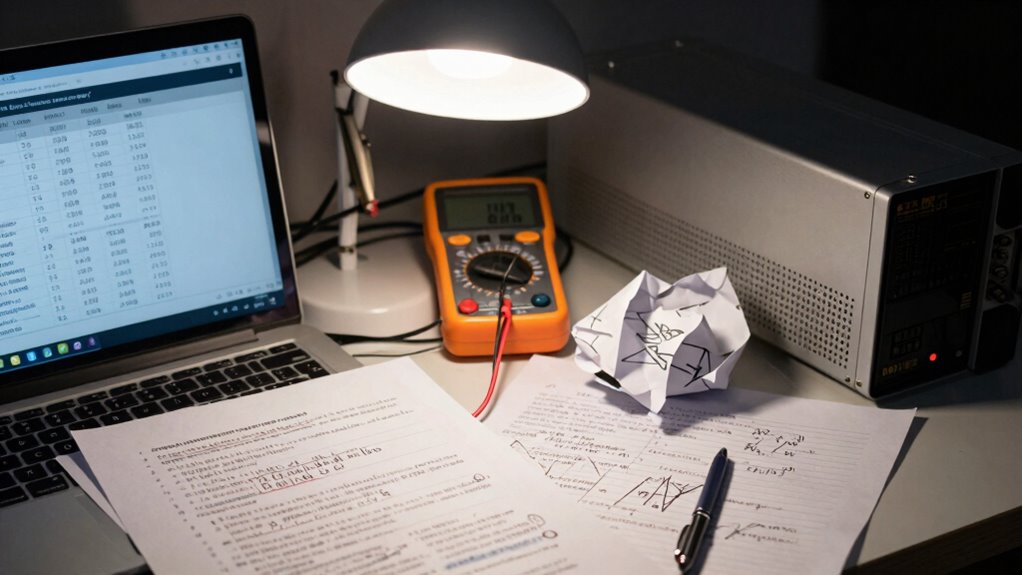
Ever wondered how long your uninterruptible power supply (UPS) can keep your devices running during an outage? Many people think they know, but the reality is that calculating UPS runtime isn’t as straightforward as it seems. It hinges on understanding key factors like battery efficiency and power scaling, which are often misunderstood or overlooked. When teams perform UPS runtime calculations, they frequently make mistakes because they ignore how these elements influence performance. Knowing the true capacity of your UPS isn’t just about reading the specs; it’s about understanding how efficiently the system uses its battery and how the load impacts runtime. Additionally, environmental conditions such as temperature can significantly affect battery performance, further complicating accurate calculations. Battery efficiency is a crucial component in these calculations. It’s tempting to assume the battery will deliver its full rated capacity, but in reality, batteries degrade over time and under different loads. Battery efficiency refers to how well your UPS’s battery converts stored energy into usable power. As efficiency drops, the runtime shortens, sometimes considerably. This is especially true when the battery is old or has been subjected to frequent cycles. Teams often overlook this factor, assuming the battery’s rated capacity remains consistent, which leads to overly optimistic estimates of runtime. Power scaling is another essential concept that complicates UPS runtime math. Power scaling refers to how the UPS handles varying load demands. A system rated for a certain capacity may perform differently under different loads. For example, if your load exceeds the UPS’s ideal operating range, the runtime decreases disproportionately. Conversely, under lighter loads, you might see longer runtime than expected. But many calculations assume a static load, ignoring how real-world power demands fluctuate. This oversight results in inaccurate predictions, leaving you unprepared when your UPS doesn’t last as long as expected during a blackout. When performing these calculations, it’s essential to consider how factors like battery degradation and load variability influence actual performance. A comprehensive understanding of battery aging and its impact on capacity can help improve accuracy. Additionally, understanding real-world testing can provide more reliable estimates than theoretical models. When teams try to calculate UPS runtime, they often rely on simplified formulas that don’t account for battery efficiency degradation or dynamic power scaling. They assume linear relationships between load and runtime, which isn’t accurate. Real-world performance is more complex, involving nonlinear factors influenced by battery age, temperature, and load variability. To get a true estimate, you need to take these factors into account and perform real-world testing rather than relying solely on theoretical calculations. Otherwise, you risk underestimating how quickly your UPS’s power will run out during an outage, leaving your critical systems vulnerable. Understanding these nuances helps you make smarter decisions about capacity planning and ensures your backup power truly meets your needs when it counts.
As an affiliate, we earn on qualifying purchases.
Frequently Asked Questions
How Do Temperature Variations Affect UPS Runtime Calculations?
Temperature fluctuations and thermal effects markedly impact UPS runtime calculations. When temperatures rise, batteries may degrade faster, reducing runtime, while colder conditions can slow chemical reactions, also decreasing efficiency. You should account for these thermal effects because they cause the UPS’s actual runtime to deviate from calculations made under standard conditions. Monitoring temperature and adjusting your expectations accordingly ensures more accurate planning and reliable backup performance.
What Are Common Mistakes in Estimating UPS Runtime?
You often make mistakes estimating UPS runtime by neglecting battery maintenance and power fluctuations. Poor battery upkeep causes inaccurate capacity readings, leading to overestimations. Ignoring power fluctuations can skew runtime calculations since sudden surges drain the battery faster. Always guarantee batteries are properly maintained and account for potential power fluctuations. Regular testing and adjustments based on real-world conditions help improve the accuracy of your UPS runtime estimates.
How Accurate Are Manufacturer-Provided UPS Runtime Specs?
Manufacturer-provided UPS runtime specs can be misleading, often overestimating actual performance. You should consider factors like battery lifespan and power efficiency, which impact real-world runtime. While specs give a useful baseline, they don’t account for aging batteries or varying loads. To get a more accurate picture, test your UPS under typical conditions and monitor battery health regularly, ensuring reliable backup power when you need it most.
Can Battery Aging Significantly Impact Runtime Predictions?
Yes, battery aging considerably impacts runtime predictions. As batteries degrade over time, their capacity decreases due to aging effects and battery degradation. This means your UPS might not deliver the expected runtime, especially if it’s been used for years. You should regularly check battery health and replace aging batteries to guarantee accurate runtime predictions and reliable backup power when needed.
What Tools Can Improve UPS Runtime Estimation Accuracy?
You can improve UPS runtime estimation accuracy by utilizing tools like battery calibration and load testing. Battery calibration guarantees your battery’s actual capacity matches the system’s readings, preventing overestimations. Load testing evaluates how your UPS performs under real or simulated loads, revealing potential issues. Together, these tools help you get a more precise understanding of your UPS’s runtime, reducing errors caused by aging batteries or inaccurate assumptions.
As an affiliate, we earn on qualifying purchases.
Conclusion
Now that you’ve seen how easy it is to trip up on UPS runtime calculations, don’t throw in the towel just yet. Getting the math right might seem like a tall order, but with a little attention to detail, you’ll avoid barking up the wrong tree. Remember, even the best of us make mistakes—what matters is learning from them. Keep your eye on the prize, and you’ll have those runtime numbers down pat in no time.
As an affiliate, we earn on qualifying purchases.
UPS environmental temperature sensor
As an affiliate, we earn on qualifying purchases.
As an affiliate, we earn on qualifying purchases.
Columbus Day / Indigenous Peoples' Day Picks
long weekend sales
As an affiliate, we earn on qualifying purchases.