
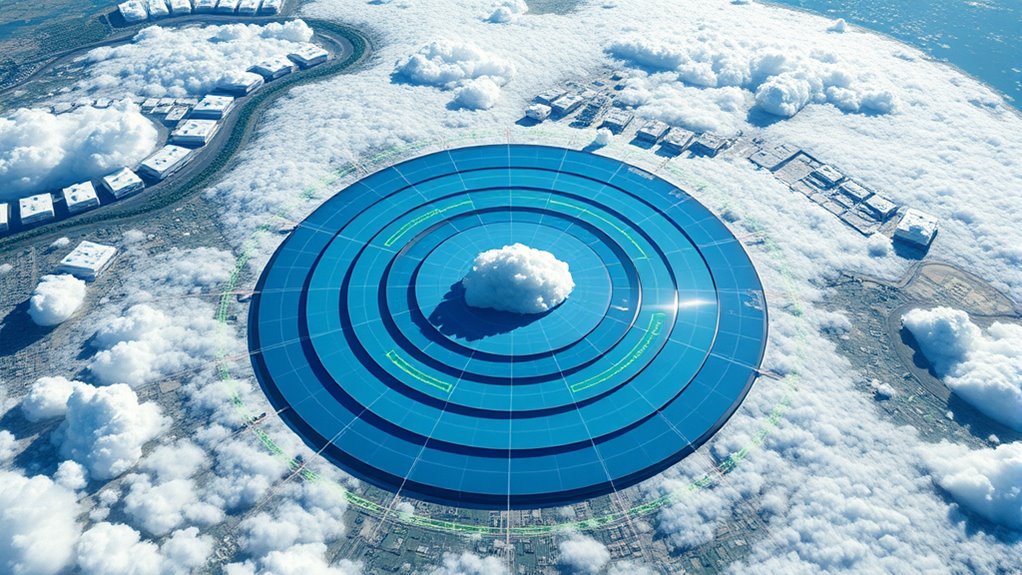
A diagram that explains cloud infrastructure shows how regions represent large geographic areas with multiple availability zones, which are isolated data centers connected by low-latency links for fault tolerance. It also highlights local and wavelength zones near end users for low latency and edge locations that cache content globally. This visual helps you understand how the different components work together to provide reliable, low-latency cloud services; the details get even clearer as you explore further.

Get business pricing on networking and server gear
- Business-only prices and quantity discounts
- Tax-exempt purchasing
- Multiple users, one account, clear invoices
Key Takeaways
- Cloud regions are geographic areas with multiple isolated data centers called availability zones for fault tolerance.
- Availability zones within a region are interconnected with low-latency links to ensure regional high availability.
- Local and Wavelength Zones extend core cloud infrastructure closer to users for ultra-low latency applications.
- Edge locations serve as points of presence for content delivery, caching content near users worldwide.
- The diagram integrates regions, zones, local, wavelength, and edge locations to illustrate their roles in scalable, resilient cloud architecture.
cloud region and zone architecture book
As an affiliate, we earn on qualifying purchases.
As an affiliate, we earn on qualifying purchases.
Understanding Cloud Regions and Their Role

Cloud regions are geographic areas that host multiple data centers, providing the foundation for cloud infrastructure around the world. They are designed to be completely isolated from each other to guarantee fault tolerance and resilience. Each region typically contains three or more availability zones, which are physically separated data centers within the region. These regions support low-latency access and compliance with local regulations, making them ideal for hosting sensitive or latency-critical applications. They connect via public internet or private links to enable data replication and synchronization across zones. By distributing resources across different regions, you can improve your application’s availability and disaster recovery capabilities. Overall, cloud regions form the global backbone of cloud infrastructure, ensuring your services are reliable, compliant, and close to your users. Understanding cloud regions and their role is essential for designing resilient and compliant cloud architectures. Additionally, choosing the right region placement can significantly impact your application’s performance and compliance requirements. Recognizing the importance of fault tolerance helps in designing systems that can withstand failures without service disruption.
edge content delivery network device
As an affiliate, we earn on qualifying purchases.
As an affiliate, we earn on qualifying purchases.
Exploring Availability Zones and Their Connectivity
Availability zones are isolated data center locations within a cloud region, designed to enhance fault tolerance and high availability. Each zone operates independently with its own power, cooling, and networking, reducing the risk of outages affecting the entire region. These zones are physically separated, often miles apart, to prevent localized failures from spreading. They’re connected through low-latency private fiber optic links, enabling quick data transfer and synchronization. This connectivity allows you to deploy applications across multiple AZs, ensuring continuous operation even if one zone experiences issues. You can distribute resources like virtual machines, storage, and databases among AZs, providing resilience and minimizing downtime. Understanding how these zones are interconnected helps you design robust, fault-tolerant architectures that maintain high performance and availability. Additionally, awareness of load balancing techniques can optimize resource use across zones for better reliability. Recognizing the importance of fault tolerance helps in creating systems that can withstand unexpected failures without service disruption, and leveraging redundancy strategies further enhances system resilience. Moreover, effective capacity planning is essential for scaling resources efficiently across multiple zones to meet fluctuating demand.
As an affiliate, we earn on qualifying purchases.
The Function and Placement of Local and Wavelength Zones

Local and Wavelength Zones extend the core cloud infrastructure closer to end users, optimizing latency and performance. They serve specific needs by placing compute and storage resources nearer to where users are, reducing delay. Local Zones are ideal for applications requiring single-digit millisecond latencies, often supporting real-time data processing or interactive services. Wavelength Zones integrate directly with 5G networks, enabling ultra-low latency for mobile devices and IoT applications. They are strategically placed within network edge locations to handle high-throughput, latency-sensitive workloads. Both zones help improve user experience by minimizing lag and enhancing responsiveness. Key points include:
- Support for latency-critical applications
- Proximity to end users and devices
- Integration with 5G networks for Wavelength Zones
- Limited availability in select areas
- Understanding cloud zones can help optimize deployment strategies for specific use cases. For example, edge placement ensures resources are located sufficiently close to users to meet latency requirements.
cloud infrastructure monitoring tools
As an affiliate, we earn on qualifying purchases.
As an affiliate, we earn on qualifying purchases.
How Edge Locations Enhance Content Delivery

Ever wonder how your favorite websites load so quickly no matter where you are? That’s thanks to edge locations, which are points of presence for content delivery networks like CloudFront. These locations cache copies of your website’s content close to your physical location, reducing the distance data travels. When you request a webpage, the content comes from the nearest edge location, minimizing latency and speeding up load times. With over 200 edge locations worldwide, content is delivered efficiently across the globe. Edge locations also support services like Lambda@Edge, enabling you to run code closer to your users for dynamic content or personalized experiences. By placing caches strategically, edge locations ensure faster, more reliable content delivery, enhancing your browsing experience regardless of where you are. Smart Home Technology is increasingly integrating content delivery solutions to support seamless device interactions and real-time updates within modern homes. This integration helps improve network efficiency, reduces delays in device communication, and supports reliable streaming for various applications. Additionally, the strategic placement of edge locations is vital for content delivery networks, which optimize the distribution of digital content worldwide.
Key Differences and Relationships Between Cloud Infrastructure Components

Understanding the key differences and relationships between cloud infrastructure components helps you grasp how cloud providers deliver reliable, low-latency services. Regions are large, isolated geographic areas hosting multiple data centers, ensuring fault tolerance and compliance. Within regions, Availability Zones (AZs) are physically separated data centers with redundant power and networking, connected by low-latency links. Local Zones extend regions closer to users for faster access, supporting low-latency applications. Wavelength Zones deploy services at the edge of 5G networks for ultra-low latency, mainly in select regions. Edge Locations act as points of presence for content delivery, caching data worldwide. These components work together to optimize performance, resilience, and user experience: cloud infrastructure components provide the foundation for scalable, reliable cloud services. – Regions provide global coverage and fault isolation – AZs enable regional fault tolerance and low latency – Local and Wavelength Zones focus on latency-sensitive applications – Edge Locations ensure fast content delivery worldwide. Additionally, edge computing plays a crucial role in processing data closer to users, reducing latency and bandwidth costs, which is essential for supporting the growth of real-time applications in today’s digital landscape.
Frequently Asked Questions
How Do Cloud Regions Differ in Compliance Requirements Worldwide?
You need to understand that cloud regions have different compliance requirements worldwide, depending on local laws and regulations. When you choose a region, you guarantee data residency, security standards, and privacy rules align with regional mandates. This helps you avoid legal issues and meet industry standards. Always verify that your selected region complies with relevant regulations like GDPR in Europe or HIPAA in the US, ensuring your data stays protected and lawful.
What Are the Cost Implications of Deploying Across Multiple AZS?
Deploying across multiple AZs increases your costs because you pay for additional resources, data transfers, and fault tolerance features. You’ll incur charges for running extra instances, storage, and networking between AZs. However, this setup boosts your application’s availability and resilience. To manage costs, monitor usage closely, optimize resource allocation, and consider balancing performance needs with budget constraints, ensuring you get the best value for your multi-AZ deployment.
Can Local Zones Be Used Independently Without a Main Region?
Yes, you can use local zones independently, but they’re designed to extend existing regions, like a satellite orbiting a planet. Think of them as nearby outposts that bring low latency closer to users. While they offer flexibility for specific applications, they’re most effective when connected to a main region. Using them alone limits some capabilities, but they’re perfect for ultra-low latency needs without full regional deployment.
How Do Wavelength Zones Impact 5G Network Security?
Wavelength Zones enhance 5G network security by bringing compute resources closer to the edge of telecom networks, reducing data transit across broader networks. This proximity minimizes exposure to potential threats and lowers latency, making security measures more effective. You benefit from faster, more secure data processing, especially for sensitive applications like IoT and real-time services, ensuring your 5G network remains protected while delivering ultra-low latency connectivity.
Are Edge Locations Shared Across Multiple Cloud Providers?
Imagine a bustling marketplace where vendors share stalls, yet each maintains unique offerings. Edge locations are often dedicated to a specific cloud provider, functioning like these stalls, mainly serving that provider’s customers. While some providers might share physical infrastructure, generally, your content delivery points are owned and operated by your chosen cloud vendor. So, in most cases, edge locations aren’t shared across multiple providers—they’re tailored to support each cloud’s network.
Conclusion
Now, picture yourself standing at the heart of a vast, interconnected cloud landscape. Regions form the sprawling continents, zones are the bustling cities within, and edge locations act like vibrant street corners delivering content swiftly to your doorstep. Understanding this diagram is like holding a map to a seamless digital world, where every part works together to keep your data flowing smoothly. With this clarity, you’re ready to navigate the cloud’s expansive, dynamic terrain with confidence.
Fall Picks
fall essentials
As an affiliate, we earn on qualifying purchases.