
To practice incident response efficiently, focus on targeted, manageable scenarios aligned with real risks. Use modular drills or tabletop exercises to test specific skills without disrupting operations. Establish clear objectives, roles, and success metrics to keep activities focused. Coordinate with partners and leverage simulations to boost realism while saving time. Regularly assess performance and adjust plans accordingly. By following these steps, you’ll enhance readiness without wasting resources—continue exploring for even more effective strategies.
Key Takeaways
- Define clear objectives and success criteria to focus drills and avoid unnecessary procedures.
- Use modular, scenario-specific exercises like tabletop or partial drills to target key skills efficiently.
- Schedule drills during off-peak hours and limit participant numbers to reduce operational impact.
- Incorporate virtual simulations or inject-based scenarios for quick, cost-effective practice.
- Regularly review performance metrics and feedback to refine drills and prevent repetition of ineffective exercises.
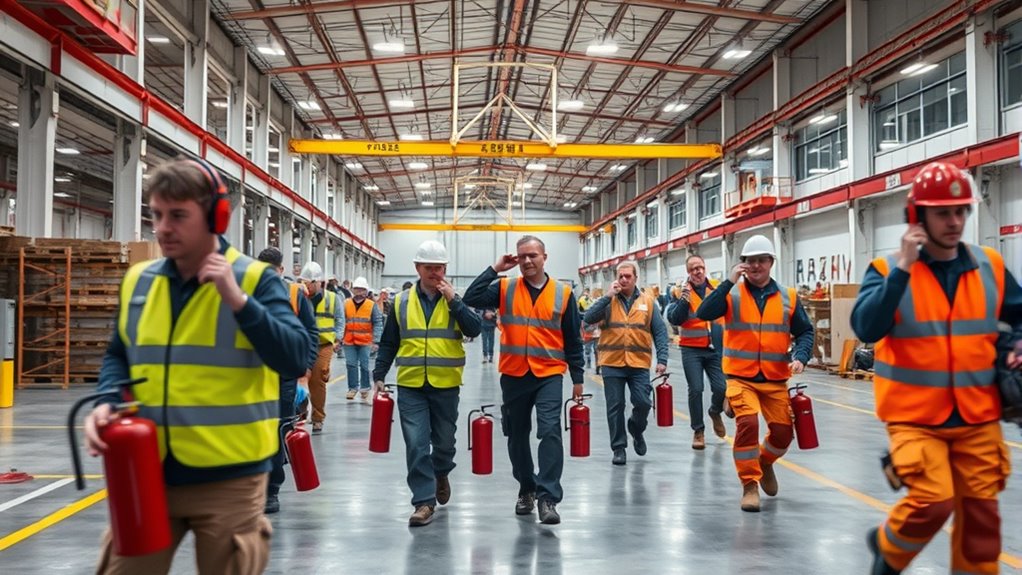
Have you ever wondered how organizations guarantee their incident response plans really work? The key lies in well-designed incident drills. These exercises give you a chance to rehearse critical actions, identify gaps, and build confidence without risking real damage. To make your drills effective and efficient, start with clear objectives tied to measurable outcomes. For example, set targets for evacuation times, notification latency, or role adherence. This way, everyone knows what success looks like and can focus on specific improvements. Select scenarios that reflect your actual risk profile—fire, active assailant, chemical spill, or IT outage—so that your team practices what they’re most likely to face. Choose the type of drill based on your goals: tabletop exercises help with decision-making, while full-scale drills test operations under realistic conditions. Keep the scope manageable to avoid unnecessary disruption. For large sites, consider floor-by-floor or time-boxed evolutions that still feel authentic but don’t overwhelm your resources. Before running the drill, establish clear success criteria and KPIs, like response times, time-to-control, and communication effectiveness. This guarantees you can objectively evaluate performance afterward.
Design your scenarios for realism, incorporating injects like simulated smoke, role-play victims, or timed communications to drive decision points. Assign clear roles—incident commander, floor wardens, liaisons, safety officers—and provide documented task lists to prevent confusion. Build escalation thresholds and decision checkpoints into your scenarios, ensuring your team practices command and control transitions. Safety remains paramount; include safety controls and exclusion zones, and avoid drills requiring unauthorized personnel when policies restrict them. Use predefined assessment methods—observer checklists, video recordings, or telemetry—to capture objective data. Incorporate navigation and mapping techniques to simulate real-world complexities within your drills for more effective training.
Create realistic scenarios with injects, clear roles, escalation points, and safety controls for effective incident drills.
Tracking KPIs during drills is essential. Measure response times for notification, team response cohesion, and time-to-incident-control. Leverage digital tools or recordings to analyze performance down to the second. Collect qualitative metrics too—role adherence, communication clarity, procedural deviations, and participant confidence. After the drill, produce structured after-action reports that link performance to objectives and highlight corrective actions. Comparing results over time helps you spot trends and gauge ongoing improvement.
To maximize efficiency, run modular drills focusing on specific components like notification or evacuation instead of always conducting full-scale exercises. Schedule drills during off-peak hours or staggered shifts to minimize operational impact. Use virtual simulations or tabletop exercises to validate plans quickly before committing to resource-heavy field drills. Limit participant numbers to essential personnel for faster evaluation and more focused skill validation. Automate reporting and KPI calculations via drill-management platforms to shorten after-action turnaround.
Collaboration enhances your drills’ value. Coordinate with local emergency services to align expectations, share injects, and test communication interoperability. Including community or regulatory stakeholders ensures compliance and broadens learning. Conduct joint debriefs to highlight inter-agency handoffs, resource requests, and logistical issues. Sustainment involves establishing a regular drill cadence—annual baseline plus more frequent tabletop or module drills—supported by secure funding and equipment. Implement a corrective-action tracking system to guarantee ongoing improvements. Rotate scenario types and increase complexity over time to prevent complacency and address emerging threats. Regular evaluation through surveys and metrics helps you refine your training approach, ensuring your incident response remains sharp without wasting time or resources.
incident response tabletop exercise kits
As an affiliate, we earn on qualifying purchases.
As an affiliate, we earn on qualifying purchases.
Frequently Asked Questions
How Do I Prioritize Drill Scenarios Based on Risk Assessment?
You prioritize drill scenarios by first conducting a thorough risk assessment to identify the most probable and impactful incidents. Then, select scenarios that reflect those risks, focusing on high-likelihood or high-consequence events like fires or active assailants. Allocate resources and planning time accordingly, ensuring your drills target these critical risks. Regularly review and update your priorities based on evolving threats and incident data to keep your preparedness relevant and effective.
What Are the Best Tools for Real-Time Data Collection During Drills?
During drills, you can use digital tools like observer checklists on tablets, which streamline data collection. For example, in a recent simulation, responders tracked response times and communication clarity in real-time with a mobile app. This method captures objective metrics instantly, allowing for quick analysis. Automating data entry reduces errors and saves valuable time, so you can focus on evaluating performance and improving future drills efficiently.
How Can I Ensure Stakeholder Engagement and Collaboration Effectively?
You guarantee stakeholder engagement by clearly communicating objectives and involving them early in planning. Schedule joint meetings to align expectations and share scenario details, fostering collaboration. Use shared tools or platforms for updates and feedback, and involve external responders to test communication and coordination. Keep stakeholders informed of progress through regular reports and debriefs, and encourage their input to refine scenarios, maintaining buy-in and active participation throughout the process.
What Is the Optimal Frequency for Different Types of Incident Drills?
You should schedule incident drills based on risk level and operational needs. For high-risk scenarios like fires or active assailants, conduct drills annually or biannually to maintain preparedness. Medium-risk drills, such as IT outages or chemical spills, can be quarterly or semi-annual. Low-risk or routine exercises may occur once a year or as part of ongoing training. Adjust frequency depending on past performance, regulatory requirements, and emerging threats to guarantee continuous improvement.
How Do I Quantify and Track Improvement Over Multiple Drills?
You can quantify and track improvement by establishing clear KPIs like response times, communication accuracy, and procedural adherence before each drill. Use digital tools or recordings to analyze performance objectively, noting trends over multiple exercises. Compare data points to identify areas of progress or decline, and produce detailed after-action reports with corrective actions. Regularly review these reports to measure long-term improvements and adjust training plans accordingly, ensuring continuous growth.

EFQKLPY Professional Adult CPR Training Manikin First Aid Rubber 20.53 Inch
- Airway Simulation: Realistic human airway form for training
- Breath Practice: Supports rescue breathing exercises
- Chest Movement: Visible chest response for feedback
As an affiliate, we earn on qualifying purchases.
As an affiliate, we earn on qualifying purchases.
Conclusion
Just like Odysseus navigated treacherous seas with careful plans, your incident drills keep your team prepared without wasting precious time. When you practice efficiently, you’re not just avoiding chaos—you’re steering your ship clear of storms. Remember, the key isn’t just in the drills themselves but in how swiftly and confidently you respond. Stay sharp, stay ready, and turn every practice into a voyage of resilience that guides you safely through any crisis.

Risk Centric Threat Modeling: Process for Attack Simulation and Threat Analysis
As an affiliate, we earn on qualifying purchases.
As an affiliate, we earn on qualifying purchases.

MFASCO Complete Emergency Response First Aid Kit Trauma Bag, Red
- Complete Emergency Response Kit: 415 essential medical supplies included
- Emergency Preparedness: Organized for quick first aid response
- High Visibility Design: Reflective striping and vibrant orange color
As an affiliate, we earn on qualifying purchases.
As an affiliate, we earn on qualifying purchases.