
TL;DR

Get business pricing on networking and server gear
- Business-only prices and quantity discounts
- Tax-exempt purchasing
- Multiple users, one account, clear invoices
Fireworks AI’s November 9 update says an October security incident reached account and billing information and, for a limited set of accounts, secrets, datasets and incomplete models. Notion says chat transcripts from its AI Insights feature may have been in an accessed dataset, affecting fewer than 1% of workspaces. The provider has not named the third-party cloud company or disclosed how many customers were affected.
Fireworks AI said in a November 9 update that an October security incident affected account and billing information and, for a limited set of accounts, secrets, datasets and incomplete models. The update broadens the company’s October disclosure and adds a second route attackers used to reach development machines, raising questions for businesses that stored data or credentials with the AI platform.
Fireworks’ first bulletin, published October 9, said someone had used internal company credentials to read environment variables from a limited number of customer evaluation jobs. Environment variables can contain settings and credentials used by software. At the time, Fireworks said it had not detected unauthorized access to customer models, datasets, training data, inference traffic or personal information. Its November update says the investigation later found access to account and billing information, plus secrets, datasets and incomplete models belonging to a limited set of accounts.
The company describes a second path through a third-party cloud provider that hosted Fireworks research and development machines. Fireworks says the provider experienced a security incident on October 23. On October 24, an unauthorized party used that access to reach Fireworks development machines and run an unauthorized workload that led to additional customer data impact. Fireworks says it detected the activity that day and has seen no further successful unauthorized access on the platform customers use since October 25.
Fireworks lists exposed resource metadata, billing information and, for certain customers, subsets of datasets and incomplete model weights. The billing categories it names include billing and shipping addresses, invoice and payment history, account balances and credit usage. It says it does not store payment card numbers and that those numbers were not affected. It also says it has detected no impact to Inference, Training SDK or Nexus, which it describes as zero data retention by default. Those statements reflect the company’s findings so far; it says the investigation is ongoing.
Notion separately said transcripts from its Notion AI Insights feature were in a dataset attackers may have accessed. Notion put the share of potentially affected workspaces at fewer than 1%. It said Fireworks first contacted it about a dataset on November 2, initially describing synthetic test data; on November 6, Fireworks said customer data may have been accessed, and confirmed the dataset on November 8.
What Customers Should Review
The incident matters because Fireworks provides infrastructure companies use to run and fine-tune AI models. Information held by an AI vendor can include more than prompts: the latest disclosure covers billing records, credentials, datasets and model artifacts. A dataset or secret can carry risks for a customer’s own operations even if the customer-facing AI service was not affected.
Customers can use Fireworks’ stated categories to check which accounts, evaluation jobs and projects used the service during the incident period. They can review whether credentials or secrets were present in evaluation environments, whether datasets or unfinished model checkpoints were stored or accessible, and whether billing records include information requiring internal review. These are practical checks prompted by the disclosed categories; Fireworks has not published a complete list of affected accounts.
Notion’s disclosure shows that downstream products may also need to assess exposure through their vendors. Its figure of fewer than 1% of workspaces is a share of Notion workspaces, not a count of all Fireworks customers. The available statements do not establish that other Fireworks customers’ data was accessed, but the scope is still being investigated.
Products Worth Considering

Logitech MX Ergo S Advanced Wireless Trackball Mouse USB-C – Graphite

Jackery Solar Generator 1000 V2 with 100W Solar Panel, 1024Wh LiFePO4 Battery

Samsung Galaxy Tab A11+ 11-Inch Tablet, 6GB RAM, 128GB Storage, Expandable, Gray
As an affiliate, we earn on qualifying purchases.
From October Disclosure to Update
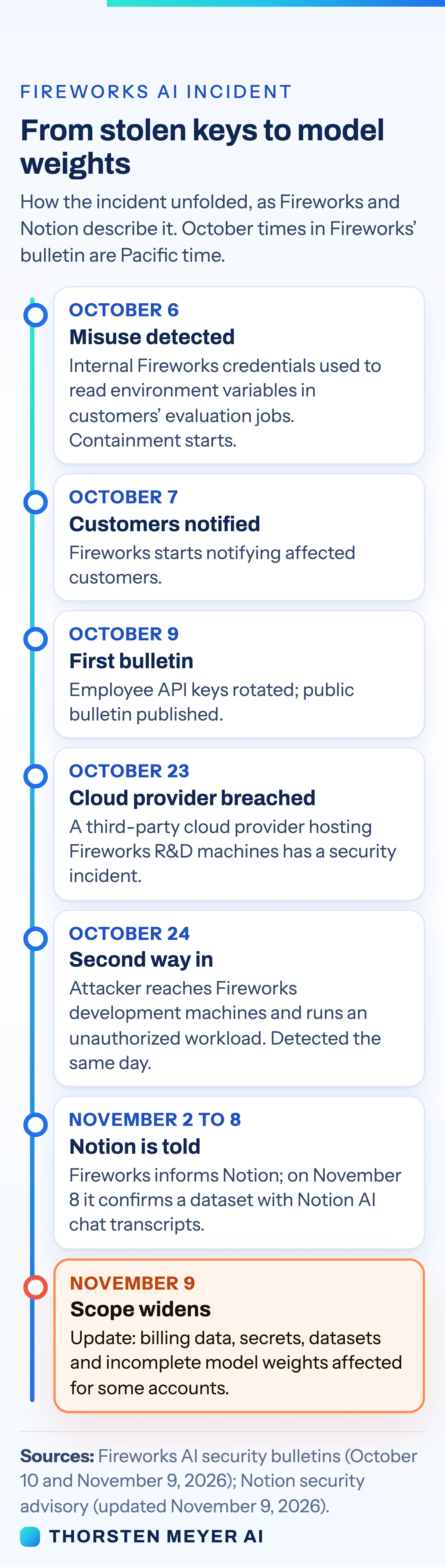
Fireworks says it identified the initial activity on October 6 and began containment. It says it started notifying affected customers on October 7, published its first bulletin on October 9, and rotated employee API keys that day. On October 10, it revoked additional user API keys and rotated service-account tokens.
The separate cloud-provider incident occurred on October 23, followed by the unauthorized workload on Fireworks development machines on October 24. Fireworks says it detected that activity the same day and has not detected further successful access by the actor since October 25. The company says it notified law enforcement and engaged Palo Alto Networks Unit 42 for forensic work.
The November 9 update came 34 days after Fireworks says it first detected the October 6 activity. That interval marks the time between detection and the broader public account; it does not establish when each customer learned of their specific exposure. Fireworks and Notion’s statements provide the main timeline available in the supplied material.
“For a limited set of accounts, we also discovered impact to secrets, datasets, and incomplete models.”
— Fireworks AI, November 9 security update
Scope and Data Use Remain Open
Fireworks has not named the third-party cloud provider, disclosed the total number of affected customers, or explained how the internal credentials used in the first path were obtained. It has not said what happened to information that may have been accessed, including whether data was copied, retained or shared beyond the observed activity.
The company also has not defined what “incomplete” means for the affected model weights, or specified how many customers’ datasets and secrets were involved. Notion’s statement concerns its own workspaces and does not provide a count of affected transcripts or describe their contents. Fireworks says its investigation may reveal further information, so the reported scope could change.
Watch for Customer Notifications
Fireworks says it is continuing its investigation with forensic support from Unit 42 and has notified law enforcement. Customers should look for direct notices from Fireworks identifying affected accounts and data categories, then compare those notices with their own use of evaluation jobs, stored datasets and model checkpoints during the relevant period. Businesses that used Notion AI Insights can also follow Notion’s guidance and any account-specific notice.
The next useful public updates would clarify the number of affected customers, the cloud provider involved, the route by which the initial credentials were obtained and what investigators learned about the accessed data. Fireworks has not announced a date for another update.
Key Questions
What did Fireworks AI say was affected?
Fireworks says the incident reached account and billing information and, for a limited set of accounts, secrets, datasets and incomplete models. It also lists resource metadata among the information the affected internal application could access.
Were payment card numbers exposed?
Fireworks says it does not store payment card numbers and that they were not affected. The company did list billing and payment history, account balances and credit usage among affected information categories.
Were Notion AI conversations involved?
Notion said transcripts from its AI Insights feature were in a dataset attackers may have accessed. It said fewer than 1% of workspaces were potentially affected; it has not provided a transcript count in the supplied material.
How many Fireworks customers were affected?
Fireworks has not disclosed a total customer count. Its update says a limited set of accounts had impact to secrets, datasets and incomplete models, but does not quantify that set.
What should customers check?
Customers can review whether they used Fireworks evaluation jobs or stored datasets, secrets or model checkpoints with the service, and check for direct notices identifying affected accounts. The company’s findings remain under investigation, so customers should rely on account-specific updates for confirmed exposure.
Source: Thorsten Meyer AI