
To achieve sustainable resilience without doubling your footprint, focus on green infrastructure, passive design, and decentralized systems. Incorporate wetlands, urban trees, and bioswales to mitigate floods naturally, while using durable, low-impact materials to reduce long-term costs. Optimize building orientation and thermal mass to lower energy use during outages. Combining these strategies with community engagement boosts resilience sustainably. Keep exploring to discover how these solutions can be integrated into your design approach effectively.
Key Takeaways
- Integrate green infrastructure like wetlands and urban trees to enhance resilience without increasing land use footprint.
- Adopt passive design strategies—orientation, shading, thermal mass—to reduce energy needs sustainably.
- Use durable, low-maintenance materials to minimize lifecycle environmental impacts and repair costs.
- Incorporate on-site renewable energy generation and storage to lessen reliance on external grids during outages.
- Prioritize decentralized systems and community engagement for resilient, sustainable DR designs that avoid footprint expansion.
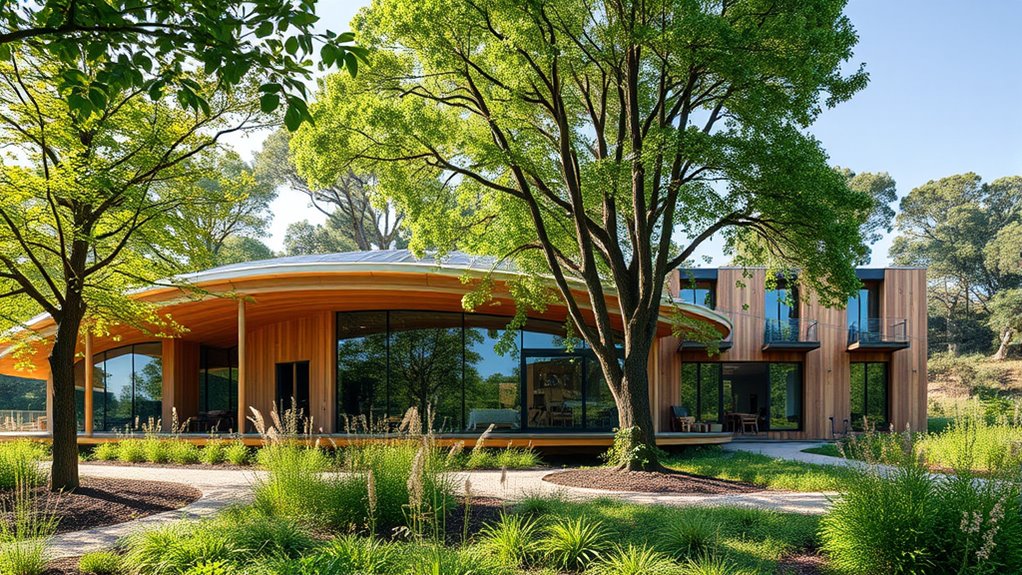
Building resilient communities isn’t just about bouncing back from disasters; it’s about proactively reducing risks and costs through sustainable, integrated strategies. When you prioritize risk-informed design and land-use planning, you’re investing in a future where recovery costs are minimized and community safety is maximized. Evidence shows that every dollar spent on resilience yields multiple dollars in return, with communities potentially incurring costs up to $7.84 for every dollar avoided through proactive measures. Enforcing hazard-resistant building codes and updating zoning laws helps reduce structural vulnerabilities and lowers long-term recovery expenses. Incorporating localized hazard mapping and Property Resilience Assessments into projects ensures site-specific mitigation, informing design choices that protect both people and property. These assessments are now a LEED v5 prerequisite, emphasizing their importance in sustainable building practices. When you make land-use decisions that avoid or limit development in high-hazard zones—like floodplains, coastal areas, or wildfire-prone regions—you’re decreasing future insured losses and exposure, creating safer, more resilient communities. Climate change projections highlight the urgent need to adapt urban planning to evolving hazards, ensuring communities remain resilient over time. Additionally, integrating climate resilience strategies into planning processes can further enhance adaptive capacity and long-term sustainability. You can also harness nature-based infrastructure to boost resilience sustainably. Green infrastructure, such as wetlands, bioswales, and urban trees, mitigates flood risks, reduces heat islands, and improves air and water quality—all while providing ecological benefits. These solutions can lower lifecycle costs by decreasing peak loads on drainage and treatment systems, making your community’s infrastructure more efficient and durable. Combining green and gray systems through thoughtful planning enhances utility resilience, ensuring essential services continue during emergencies. Engaging communities in co-creating these designs, backed by the best science, produces solutions that serve both ecosystems and residents equitably. Funding mechanisms like resilience grants or green taxes support multi-benefit projects, ensuring financial sustainability and long-term impact. Decentralized systems further strengthen resilience without increasing your carbon footprint. Distributed energy sources such as microgrids, on-site generation, and battery storage reduce dependence on centralized power and cut outage durations. Local water treatment and disconnection capabilities improve service continuity when centralized systems fail, and multiple communication networks, including satellite backhaul, preserve critical emergency coordination. Designing independent mechanical and electrical systems for critical spaces might raise upfront costs, but with proper training and operations, they ensure survivability during disruptions. Public-private partnerships and resilience tagging in investment portfolios accelerate upgrades, making lifeline infrastructure more robust. Finally, adopting low-carbon, resilient building practices ensures sustainability over the long haul. Passive design strategies like orientation, shading, and thermal mass reduce energy demand and keep spaces habitable during outages. Using durable, fire-resistant, low-maintenance materials lowers long-term repair costs and lifecycle emissions. Incorporating on-site renewable generation and storage lessens reliance on the grid during emergencies, while retrofitting and targeted measures often provide high benefit-cost ratios. Combining these approaches with data-driven community engagement and transparent metrics helps you build a resilient, low-impact future that doesn’t double your environmental footprint.

In the Spirit of Wetlands: Reviving Habitat in the Illinois River Watershed
As an affiliate, we earn on qualifying purchases.
As an affiliate, we earn on qualifying purchases.
Frequently Asked Questions
How Can Small Communities Implement Green Infrastructure Effectively?
You can implement green infrastructure effectively by starting with localized hazard mapping and community engagement to identify priority areas. Collaborate with experts to design multi-benefit solutions like wetlands, bioswales, and urban trees that reduce flooding and heat. Secure funding through resilience grants or green taxes, and incorporate these projects into your land-use planning. Regularly observe impact with transparent metrics, and promote community participation to guarantee long-term success and sustainability.
What Are the Best Practices for Integrating Hazard Assessments Into Urban Planning?
You should start by integrating localized hazard mapping and Property Resilience Assessments into your urban planning. While zoning and building codes set standards, hazard assessments reveal specific risks, guiding site-specific mitigation measures. Juxtapose technical data with community input to guarantee designs address actual vulnerabilities. By adopting transparent resilience metrics and leveraging tools like open risk data platforms, you’ll create a safer, more adaptable city that balances development with long-term resilience.
How Do Resilient Building Materials Compare in Cost and Durability?
Resilient building materials often cost more upfront but last longer and require less maintenance, saving you money over time. Durable options like fire-resistant assemblies and low-maintenance materials withstand disasters better, reducing repair costs and downtime. While initial investments can be higher, their longevity and performance during disruptions make them cost-effective in the long run, ensuring your buildings stay functional and resilient without frequent rebuilds or repairs.
What Financing Options Are Available for Multi-Benefit Resilience Projects?
Think of financing options for resilience projects as a toolbox full of powerful tools. You can tap into dedicated revenue streams like green taxes and resilience grants, which fund multi-benefit initiatives. Incentives such as property tax rebates and insurance discounts also motivate private owners. Additionally, leveraging international programs and standardized metrics helps prioritize investments, ensuring your resilience efforts are cost-effective and impactful, just like a well-equipped toolbox ready for any challenge.
How Can Technology Enhance Community Engagement in Resilience Planning?
You can enhance community engagement in resilience planning by leveraging technology like open risk data platforms and mapping tools. These tools make hazard information accessible and understandable, encouraging participation. Use social media, mobile apps, and virtual meetings to gather input, share progress, and build trust. Incorporate community feedback into digital models to guarantee plans reflect local needs, fostering ownership and collaboration. These strategies empower residents and improve resilience outcomes.

The Solar House: Passive Heating and Cooling
- Condition: Used Book in Good Condition
As an affiliate, we earn on qualifying purchases.
As an affiliate, we earn on qualifying purchases.
Conclusion
By embracing innovative ideas and intentional infrastructure, you can build a brighter, more balanced future. Sustainable resilience isn’t just about reducing your footprint—it’s about forging a future where functionality and fairness flourish. When you prioritize practicality over profit and passion over pollution, you cultivate a conscious community committed to change. Together, you can create creative, conscientious designs that demonstrate dedication, drive, and a deep desire for a durable, delightful Earth.

Decentralized Energy Systems: Microgrids for Resilience
As an affiliate, we earn on qualifying purchases.
As an affiliate, we earn on qualifying purchases.

The BESS Book: A Cell to Grid Guide to Utility-Scale Battery Energy Storage Systems
As an affiliate, we earn on qualifying purchases.
As an affiliate, we earn on qualifying purchases.