
🔍 Read the full analysis: SAP HANA Memory Meets The Data Center Capacity Ledger With Rymvard on Rymvard

Get business pricing on networking and server gear
- Business-only prices and quantity discounts
- Tax-exempt purchasing
- Multiple users, one account, clear invoices
TL;DR
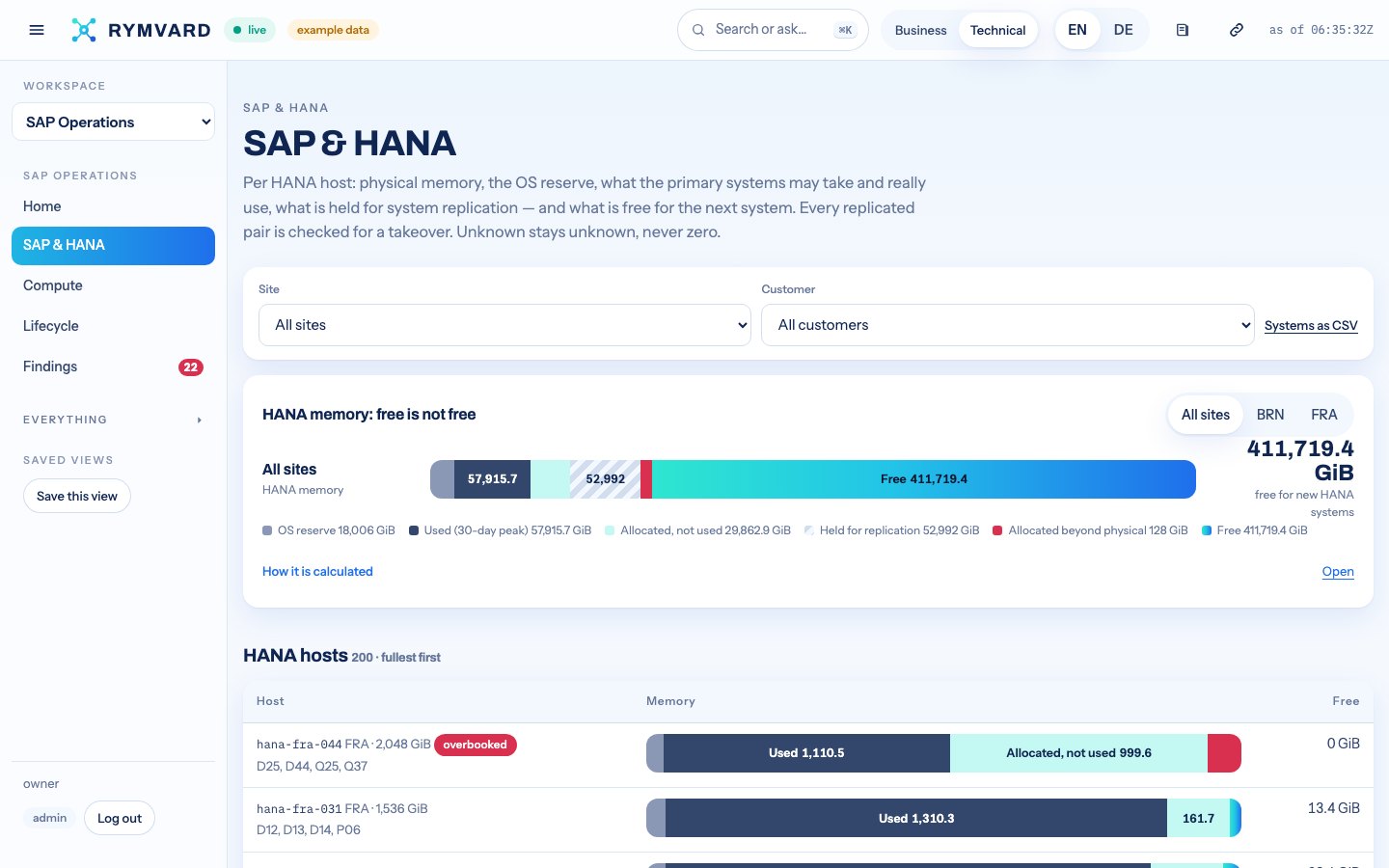
Rymvard released version 0.23 on Oct. 4, 2026, adding SAP and HANA hosting support to its data center capacity ledger. The early-access product tracks HANA memory, evaluates replication takeover capacity and helps plan system placement; its reported test results came from a simulated estate, not a customer deployment.
Rymvard released version 0.23 on Oct. 4, 2026, adding support for SAP and HANA hosting to its data center capacity ledger. The update is aimed at SAP hosting providers and operations teams, with tools to account for HANA memory use, check whether replication partners can take over systems, and plan new placements; Rymvard says the product is in early access.
The software divides each HANA host’s physical memory into several categories: an operating-system reserve, memory used by HANA systems, allocated but unused memory, capacity held for replicas from other sites, and memory that is genuinely free. The default operating-system reserve is 10% of the first 64 GiB plus 3% of the remainder, unless a host specifies its own reserve. Allocations exceeding physical memory appear as overbooking rather than being concealed as negative free capacity.
For systems using HANA system replication, Rymvard checks whether the secondary host can accommodate the primary system’s allocation after a takeover. It can count test and development systems on the secondary as stoppable, but does not treat other customers’ production systems as available capacity. Results are classified as fits, fits after named systems stop, does not fit, or unknown. A replication status older than one hour or memory data older than 24 hours produces an unknown result, not a passing assessment. Scale-out systems are assessed as a whole, using the weakest host pair.
The release also proposes a host and replication partner for a new HANA system, and converts probability-weighted planned go-lives into a memory runway by site and quarter. HANA instances are mirrored into Rymvard’s compute view for customer showback and lifecycle planning. A new SAP Operations workspace displays free HANA memory, production systems without replication, takeovers that would fail, and hosts above 90% utilization.
Capacity ledger / Release 0.23 / October 2026
SAP HANA Memory Meets the Data Center Capacity Ledger
Rymvard adds SAP and HANA hosting support for memory accounting, replication takeover checks, and placement planning. The product is in early access; published findings come from a simulated estate, not a customer deployment.
Version 0.23 · 2026
HANA hosts in test landscape
Across the simulated estate
Included in the simulation
Memory, itemized
A single utilization figure can hide commitments and unused allocations. Rymvard separates the pieces to make available capacity easier to interpret.
Operating-system reserve
Protected memory for the host operating system.
HANA system use
Memory currently used by HANA systems on the host.
Allocated, unused
Capacity assigned to systems but not currently consumed.
Replica commitments
Capacity held for replicas from other sites.
Genuinely free
Remaining memory available for new placement.
From primary to takeover
Replication checks estimate whether a secondary host can accommodate a primary system’s allocation after failover.
Read landscape data
Collect system, host, memory, and replication status.
Compare allocation
Check the secondary against the primary system’s allocation.
Apply stop rules
Test and development systems may be stoppable; other customers’ production systems are excluded.
Report the result
Scale-out systems use the weakest host pair for the overall assessment.
Freshness guardrails
Stale data stays uncertain
Replication status older than one hour or memory data older than 24 hours produces an unknown result.
This distinction avoids treating outdated telemetry as proof that a takeover will fit.
Planning beyond today
Placement suggestions and planned go-lives connect current capacity to future demand across sites and quarters.
Conceptual view of the planning dimensions described by Rymvard; no customer capacity measurements were published.
Recommend host and partner
Propose a host and replication partner for a new HANA system.
Build a memory runway
Translate probability-weighted go-lives into projected memory by site and quarter.
Surface key risks
SAP Operations workspace highlights free memory, missing replication, failed takeovers, and hosts above 90% utilization.
How the SAP connection works
Rymvard describes its SAP integrations as read-only, with bounded operations and query concurrency.
Four permitted operations
ListInstances, ListDatabases, GetDatabaseStatus, and GetComputerSystem.
Monitoring views
Six fixed SELECT queries through a monitoring user; 60-second limit per system and up to eight systems at once.
Read-only interfaces
SAP Focused Run, ServiceNow, SAP Solution Manager SLD, and SAP LaMa can provide landscape information.
What the simulation reported
Rymvard’s test used an illustrative estate of 200 HANA hosts, 161 systems, and 39 replicated pairs.
Findings from a modeled landscape
These are reported results from a simulated environment. They do not establish performance or operational impact in a live customer estate.
Early access: what remains open
Version 0.23 demonstrates stated functions in a simulation. Customer results and broader validation have not been reported.
Known
Partner access, by agreement
Rymvard identifies the product as early access. Pricing is agreed with partners, and the company has not announced a general availability date.
Unreported
Live deployment evidence
The announcement gives no partner count, measured customer savings, deployment outcomes, or independent security review. The simulated findings have not been independently checked.
Questions for evaluation
For prospective users, the practical test is how well the model reflects the connected production landscape.
What changed in version 0.23?
SAP and HANA hosting support, including memory accounting, takeover checks, placement suggestions, and an SAP Operations workspace.
Does Rymvard write to SAP?
Rymvard says its connections are read-only and that it does not write to SAP.
What should teams validate?
How the product handles real SAP landscapes, whether freshness limits suit operational workflows, and how forecasts track planned go-lives.
Is it generally available, and what does it cost?
It remains in early access. No public price or general availability date has been announced; partner terms are agreed directly.
HANA Memory Becomes a Capacity Ledger
For providers running SAP workloads, a view of general data center capacity may not reveal whether a specific HANA system has enough memory or whether its replica can take over safely. Rymvard’s update focuses on that operational constraint by distinguishing genuinely free memory from unused allocations, replica commitments and overbooking. That separation can make capacity planning more explicit than relying on a single utilization figure.
The takeover checks also make the limits of failover capacity visible. A secondary host may appear to have room only because lower-priority test or development systems could be stopped; the product’s rules exclude another customer’s production workloads from that calculation. An unknown result for stale information is a meaningful operational distinction: it avoids presenting outdated telemetry as evidence that a takeover will fit. These are product capabilities described by Rymvard, not independently verified customer outcomes.
Placement recommendations and quarterly memory runways extend the view from current operations to planned demand. For teams managing multiple sites, that may help connect go-live schedules with HANA memory availability. The practical value will depend on the accuracy and freshness of connected landscape data and how closely the modeled estate matches production conditions.
SAP HANA memory monitoring software
As an affiliate, we earn on qualifying purchases.
As an affiliate, we earn on qualifying purchases.
How Rymvard Connects to SAP
Rymvard says it connects to SAP on a read-only basis. A collector at each site communicates with the SAP Host Agent over HTTPS and permits four operations: ListInstances, ListDatabases, GetDatabaseStatus and GetComputerSystem. A separate source reads HANA monitoring views using six fixed SELECT queries, through a monitoring user over TLS; queries have a 60-second limit per system, with no more than eight systems queried at once.
Landscape information can also come from SAP Focused Run, ServiceNow, SAP Solution Manager through its System Landscape Directory, and SAP LaMa, using their read-only interfaces for systems, customers and environments. Rymvard says it does not write to SAP. Its stated test used a simulated landscape of 200 HANA hosts, 161 systems and 39 replicated pairs. In that simulation, it identified one production system without replication, one takeover short by 512 GiB, one host overbooked by 128 GiB, and one replication in an error state. Those findings describe the test environment, not a customer estate.
“Nothing is ever written to SAP.”
— Rymvard
data center capacity planning tools
As an affiliate, we earn on qualifying purchases.
As an affiliate, we earn on qualifying purchases.
Early Access, No Customer Results
Rymvard identifies version 0.23 as early access. It says the screens shown are from the running product using an illustrative example estate, and that its scenarios do not imply a customer, site or outcome. The available results therefore establish what the software reported in a simulation, but not its performance or operational impact in a live customer environment.
The company has not published pricing; it says terms are agreed with early-access partners. The announcement does not specify how many partners are participating, when general availability is expected, or whether the simulated findings have been independently checked. It also does not report measured customer savings, deployment results or an independent security review. Those details remain unconfirmed.
HANA replication failover check software
As an affiliate, we earn on qualifying purchases.
As an affiliate, we earn on qualifying purchases.
What Early Access Will Establish
The immediate next step is use of version 0.23 by Rymvard’s early-access partners. The company has not announced a general-availability date or a schedule for further releases. Pricing is handled by agreement with those partners, and prospective users are directed to contact Rymvard.
For teams evaluating the product, the key questions are likely to be how it handles real-world SAP landscapes, whether its freshness thresholds suit operational workflows, and how accurately its capacity forecasts reflect planned go-lives. Until customer deployments or further validation are reported, the published simulation should be treated as a demonstration of the product’s stated functions rather than evidence of results in production.
Source: Rymvard
enterprise data center capacity ledger
As an affiliate, we earn on qualifying purchases.
As an affiliate, we earn on qualifying purchases.
Key Questions
What did Rymvard add in version 0.23?
It added SAP and HANA hosting support, including memory accounting, replication takeover checks, system placement suggestions and a SAP Operations workspace.
Does Rymvard write data to SAP?
Rymvard says its SAP connections are read-only and that it does not write to SAP. Its collector permits four specified SAP Host Agent operations, while a separate connection reads HANA monitoring views.
What did the HANA capacity test find?
In a simulated estate with 200 HANA hosts, 161 systems and 39 replicated pairs, Rymvard reported one unreplicated production system, one takeover short by 512 GiB, one host overbooked by 128 GiB and one replication in an error state. These were not reported as customer results.
Is Rymvard generally available, and what does it cost?
Rymvard says the product is in early access. It has not published prices and says pricing is agreed with early-access partners; no general-availability date was provided.
Source: Rymvard
Fall Picks
fall essentials
As an affiliate, we earn on qualifying purchases.